What's inside
As an Amazon Associate I earn from qualifying purchases. This post may contain affiliate links at no extra cost to you.
A portable drill press stand holds a handheld drill at a fixed angle and guides it up and down. A benchtop drill press is a complete machine, with its own motor, spindle and table. Both can help make straighter holes than freehand drilling, but they differ in accuracy, capacity and setup. For a small workshop, the right choice depends less on floor space alone than on how often you drill, what materials you work with and how precise the holes need to be.
As an Amazon Associate we earn from qualifying purchases at no extra cost to you.


Our Top Picks
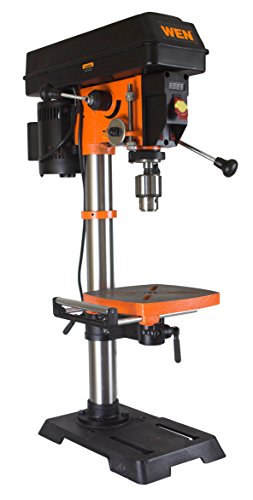
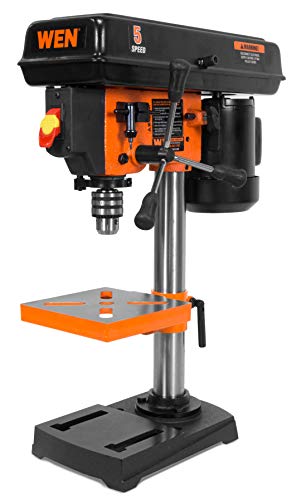 WEN 2.3-Amp 8-Inch 5-Speed Cast Iron Benchtop Drill16.88 x 8.63 x 22.88 inches32 poundsCheck on Amazon


How the two options work
A portable stand clamps or otherwise supports a compatible handheld drill. You lower the drill with a lever, much as you would on a drill press. The drill, chuck and battery or cord remain part of the setup, so results depend partly on how securely the tool fits and how much play the stand’s guide has.
A benchtop drill press is a dedicated machine. Its motor turns a spindle, and a feed handle lowers the quill and bit. The work sits on an adjustable table. Many small models offer a spindle stroke around 2 to 3 inches and a throat depth—the distance from the spindle center to the column—of roughly 5 to 8 inches. Check those measurements against your workpieces; a large table does not necessarily mean you can drill near the center of a wide panel.
At a glance
| Factor | Portable drill press stand | Benchtop drill press |
|---|---|---|
| Initial cost | Usually lower if you already own a drill | Higher; includes a dedicated motor and spindle |
| Storage | Compact; stand and drill can be stored separately | Bulky and heavy, even in benchtop sizes |
| Setup | May require checking the drill clamp, travel and alignment | Needs a secure mounting surface and initial assembly |
| Repeatability | Depends on stand rigidity and drill fit | Generally better for repeated holes and depth control |
| Portability | Easy to move; can use a cordless drill | Can be relocated, but awkward to carry and mount |
| Best fit | Occasional holes in small or medium workpieces | Frequent drilling, repeated operations and tougher stock |
Accuracy, capacity and common failure modes
A stand can produce square holes in wood or light metal, but do not assume it will match a dedicated press for precision. Clamp fit, guide play and drill runout all stack up. If the drill shifts in its holder or the stand flexes under pressure, the bit can wander, chatter or enter at an angle. A handheld drill’s side handle may also get in the way, and some drills have housings that do not fit a stand’s clamp.
A press has its own limits. A cheap or poorly aligned machine can have spindle runout, and a small throat may stop you reaching the center of a broad board. A 2-inch quill stroke is not enough to bore through every thick workpiece in one pass; you may need to retract, clear chips and continue. For holes deeper than the press’s travel, check that the work can be repositioned without losing alignment.
For either setup, secure the work with a vise or clamps. A loose piece can spin when a bit catches, especially in metal. Use a center punch on metal, start with a smaller pilot hole when appropriate and reduce speed for larger bits. Never hold a small workpiece by hand while drilling.
Space, setup and cost
A stand is attractive when every square foot matters. It can go in a drawer when the job is done, and you may already own the drill it needs. But count the space required for the work itself: a stand does not make a long board easier to support. You will still need a stable bench, clearance for the lever and a way to keep the piece from moving.
A benchtop press takes up a permanent footprint and may need to be bolted down. A typical compact unit can weigh several dozen pounds, so moving it between jobs is possible but inconvenient. In return, it is ready for repeat use and avoids tying up your handheld drill. Compare the total cost of a stand plus any needed drill against the price of a press, rather than treating the stand as a complete tool on its own. For occasional use with an existing drill, a portable drill press stand can be the economical option.
Which one should you buy?
Choose a stand if you drill only now and then, work mainly in wood or light materials, have a compatible drill and can tolerate some setup and alignment checks. It is also useful when you need to bring a guided drill to a workpiece that cannot be carried to a fixed machine. Before buying, check the drill’s body dimensions, the stand’s clamping range, maximum travel and how it attaches to the bench. A stand that does not hold your drill securely is a poor bargain, however low its price.
Choose a benchtop press if you make the same holes repeatedly, need a more controlled feed or often drill metal. Its table and spindle make it easier to keep work positioned, adjust depth and repeat an operation. Look for a model with enough throat depth and quill travel for your usual stock, plus speed settings appropriate for both small bits and larger cutters. If that work is routine, browse benchtop drill presses by capacity rather than choosing on price or advertised power alone.
A practical test before deciding
List your three most common drilling jobs: material, hole diameter, workpiece size and how many holes you make at a time. If they are occasional holes in small parts, and your drill fits a stand, the cheaper setup is often enough. If you regularly need a series of square, consistent holes or drill larger bits in metal, the convenience and control of a dedicated press can justify its footprint and cost.