What's inside
As an Amazon Associate I earn from qualifying purchases. This post may contain affiliate links at no extra cost to you.
Match the whole fastener, not just the screw name
A countersink bit makes a tapered recess so a flat-head screw can sit flush or slightly below the surface. The right bit depends on the screw’s head diameter and angle, the material, and how you plan to drill the pilot hole. A bit that is too small leaves the head proud; one that is too large can remove the support around it and leave a sloppy-looking hole.
Check the screw itself rather than relying only on labels such as “#8” or “3 mm.” Screw sizes identify shank dimensions, but head diameters vary by screw type and manufacturer. If possible, measure the head across its widest point and check the angle printed on the package or listed by the maker. Common wood-screw flat-head angles include 82 and 90 degrees; they are not interchangeable if you need a close fit.
Choose the countersink geometry
For a clean, flush seat, match the countersink’s included angle to the screw head. An 82-degree screw head against a 90-degree cutter may bear mainly near the rim, while an angle mismatch in the other direction can leave the screw sitting high. Either can be acceptable for a rough utility job, but it is not a reliable way to get a neat, repeatable seat.
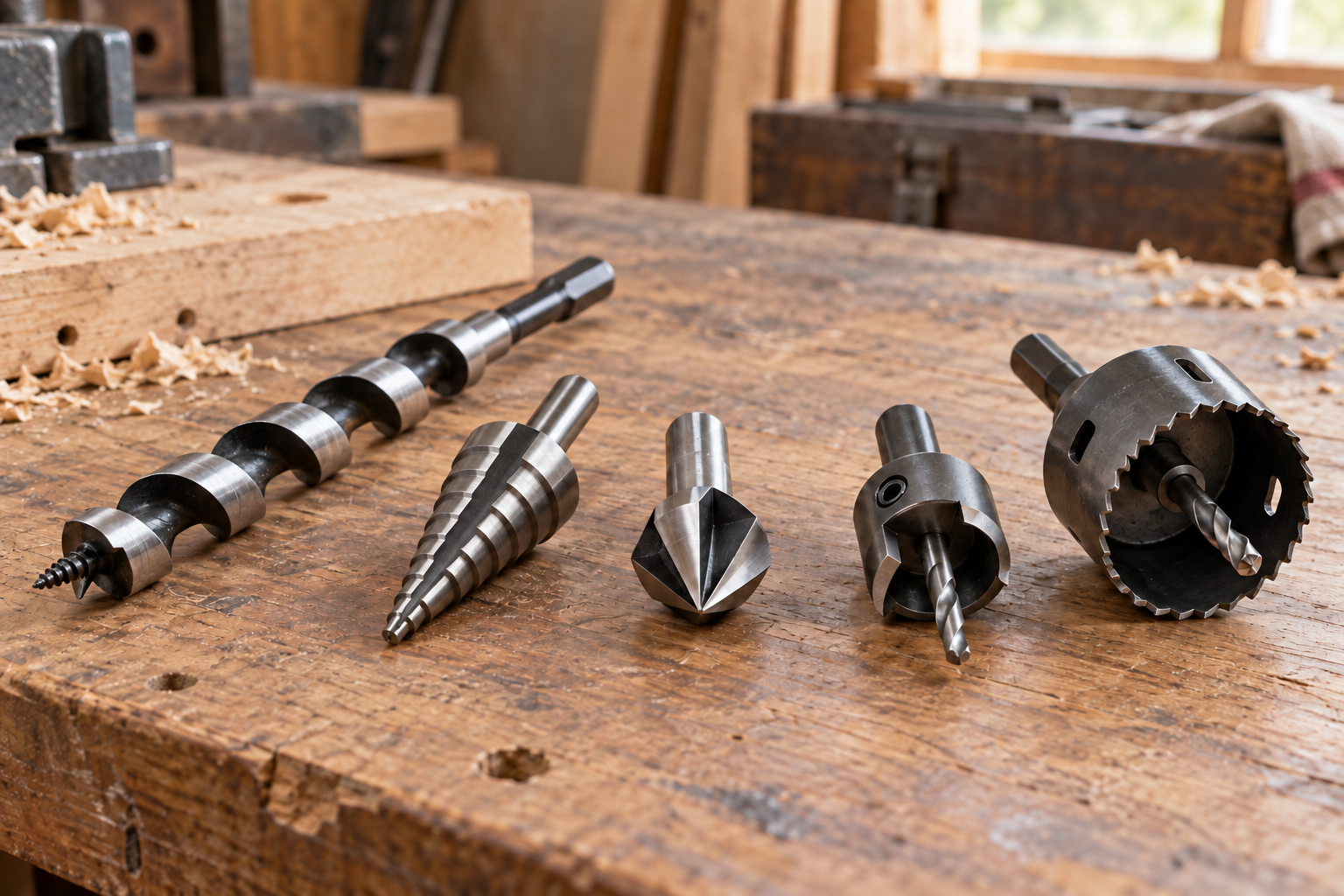
Measure the cutter’s maximum diameter against the screw head. The recess should be wide enough for the head, but not so wide that it removes unnecessary surface material. A single-flute countersink is inexpensive and works well in wood when used slowly. Multi-flute versions often cut more smoothly, while an adjustable-depth or stop-collar style helps when many holes must be consistent. For occasional repairs, a basic cutter is usually enough; for repeated cabinetry or trim work, a depth-stop countersink bit can reduce variation.
Size the pilot hole for the screw
The pilot hole is separate from the countersink. It gives the screw’s shank or core somewhere to go and helps prevent splitting. In softwood, a pilot hole close to the screw’s root diameter is a useful starting point; in hardwood, use a bit closer to the root diameter or slightly larger. The root diameter is the narrow part between the threads, not the outer diameter across the thread crests.
For example, a screw with an outside thread diameter near 4 mm might take a pilot around 2.5 to 3 mm in softwood, with a larger hole often needed in dense hardwood. Those are starting ranges, not universal sizes: screw design, wood species, edge distance, and moisture all matter. Check the screw maker’s chart where available, and test in scrap from the same material. If the screw is difficult to drive, squeals, or starts to split the wood, stop and reassess rather than forcing it.
For a through-hole in the top piece, make that hole wide enough for the screw shank to pass through freely. The threaded section should bite into the lower piece, not bind in both pieces. A combination pilot-and-countersink bit drills and seats in one pass, which is convenient for repetitive work, but separate bits offer more control over pilot size and recess depth. Compare combination pilot-and-countersink sets with a standalone cutter before buying.
Which setup fits the job?
| Setup | Best for | Trade-off |
|---|---|---|
| Basic single-flute countersink | Occasional wood screws and repair work | Low cost, but can chatter or leave a rough rim if pushed too fast |
| Multi-flute countersink | Cleaner seats and more frequent use | Often smoother cutting, but does not correct the wrong angle or depth |
| Pilot-and-countersink combination bit | Repeated holes in one screw size | Fast and consistent, but less flexible if pilot size or screw changes |
| Separate drill and countersink | Mixed materials, screw sizes, or precise work | More steps and tool changes, with better control of each hole |
Cut a test hole before the workpiece
Set the drill to a moderate speed and keep the bit square to the surface. Let the cutter remove material without leaning on it; excess pressure can cause chatter, tear-out, or a recess that is too deep. In hardwood, a sharp bit and a slower feed matter more than brute force. Clear chips if they pack into the flutes, since trapped dust adds heat and can make the cut uneven.
Drill the pilot first if using separate bits, then cut the countersink in small increments. Seat the screw by hand or at low clutch torque. Stop when its head is flush or at the intended depth; driving it hard can strip the hole, crush the wood fibers, or bury the head below the surface. Test the fit in scrap: the head should bear evenly around its tapered face, not rock on the rim or disappear into an oversized crater.
Common mistakes and material limits
Do not use a countersink to fix a pilot hole that is too small. The countersink only clears room for the head; it does not reduce the force needed to drive the threaded shank. Likewise, a countersink bit is not a substitute for a clearance hole in the top board of a two-piece joint.
Metal and plastic need a lighter touch than ordinary wood. In thin sheet metal, a countersink can break through quickly, so use a suitable cutter, low pressure, and frequent checks. In brittle plastic, sharp tooling and a test cut help limit cracking. For a hidden rough joint, a slightly imperfect seat may be harmless; for painted trim or visible furniture, matching the angle and controlling depth are worth the extra setup.
Buy a dedicated set only if you will use its range of pilot sizes or countersink angles. Otherwise, one correctly sized cutter and a separate pilot bit are often the cheaper, more adaptable choice. A countersink matched to the screw’s angle is the better purchase when a flush, even finish matters across multiple holes.