What's inside
- Choose by island size and shape
- Two pendants, three pendants, or one linear fixture?
- Set the hanging height for the people and the room
- Get useful brightness, not just a high wattage number
- Match the finish and shade to everyday use
- Check damp-location suitability before buying
- A quick decision matrix
- Before you order
As an Amazon Associate I earn from qualifying purchases. This post may contain affiliate links at no extra cost to you.
The best kitchen island pendant lights are sized to the island and the room: use two pendants over a compact island, three over a longer one, or a linear fixture when you want a single, even band of light. Before choosing a style, check fixture width, hanging height, brightness, finish, and whether the location calls for a damp-rated fitting.
As an Amazon Associate we earn from qualifying purchases at no extra cost to you.


Our Top Picks
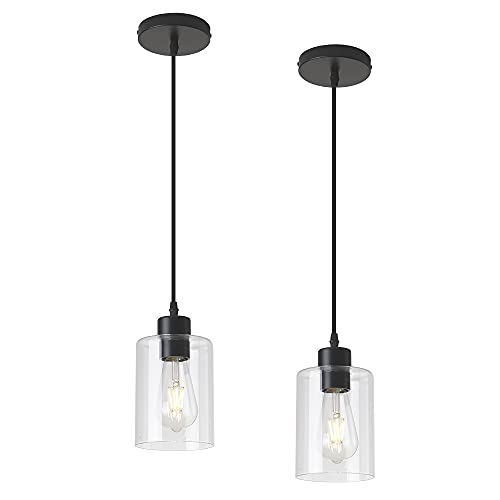 KLSS Modern Black Farmhouse Clear Glass Cylinder Pendantm5 x 4.7 x 4.7 inches3.3 poundsCheck on Amazon


Choose by island size and shape
As a starting point, leave about 6 inches between a pendant’s widest point and the island’s ends, and aim for roughly 24–30 inches of space between neighboring fixtures. These are planning guidelines, not strict rules: shades that flare outward need more clearance, and a large visual centerpiece may work better alone.
| Island length | Good starting choice | Typical fixture width | What to check |
|---|---|---|---|
| 4–5 ft (48–60 in) | Two small pendants or one medium pendant | 8–12 in per small pendant; 16–20 in for one fixture | Keep shades clear of the island ends and each other. |
| 6–7 ft (72–84 in) | Two medium pendants or three small pendants | 10–14 in per pendant | Center the group over the usable work area, not necessarily the whole room. |
| 8–10 ft (96–120 in) | Three pendants or one linear fixture | 10–14 in per pendant; 36–60 in for a linear fixture | Check that the fixture does not overwhelm nearby cabinets or sightlines. |
These dimensions are practical starting points, not a promise of an exact fit. Measure the shade at its widest point, then mark the proposed positions with painter’s tape or paper cutouts. This quickly reveals whether a row will look crowded from the main approach to the kitchen.
Two pendants, three pendants, or one linear fixture?
Choose two when the island is compact
Two pendants suit many 4–6-foot islands and keep the layout simple. They work especially well when each shade provides a broad pool of light. Avoid oversized shades that leave too little space at the ends; narrow, taller pendants can be easier to fit.
Choose three when the island is long or divided into work zones
Three smaller pendants can spread light across a longer surface and create a balanced rhythm. They are a good option when people use several parts of the island for prep, serving, or seating. Make sure the center fixture aligns with the island’s midpoint and the outer fixtures remain comfortably inside its ends.
Choose linear when you want continuous coverage
A linear fixture can simplify spacing over a long island, but its length should relate to the island rather than span nearly from end to end. A fixture around half to two-thirds of the island’s length is a useful visual starting point. Check the manufacturer’s mounting and bulb instructions: one long fixture may have multiple lamps, while an integrated LED model may have a built-in light source that is not user-replaceable.
Set the hanging height for the people and the room
A common starting point is to place the bottom of the pendant about 30–36 inches above the countertop. In a kitchen with high ceilings, a taller shade, or occupants who are frequently standing around the island, test a little higher. The fixture should light the work surface without blocking conversation or views across the room.
Measure from the countertop to the lowest point of the shade—not from the ceiling to the canopy. If the island is also used for seated dining, consider how the fixture looks from a chair. Adjustable cords or rods make it easier to refine the height after installation, but confirm the fixture can accommodate your ceiling height and that excess cord can be managed safely.
Get useful brightness, not just a high wattage number
For kitchen task lighting, compare lumens rather than watts: lumens describe visible light output, while watts describe energy use. As a rough planning range, a pendant might provide around 400–800 lumens, with the total depending on island size, shade opacity, and other lighting in the room. Three fixtures at 500 lumens each provide 1,500 lumens on paper, but dark or closed shades can direct less light onto the counter.
Look for a color temperature around 2700–3000K for a warmer kitchen atmosphere, or around 3000–3500K if you prefer a more neutral task-lighting appearance. Dimming is useful when the island shifts from food preparation to dining. Check that the bulbs and dimmer are compatible; a dimmer does not make a non-dimmable LED bulb suitable for dimming.
Match the finish and shade to everyday use
Metal, glass, and ceramic shades each have different upkeep needs. Metal shades tend to conceal fingerprints but can collect dust around seams. Clear glass shows bulbs and can reveal dust more readily, while opaque glass softens the light and hides the lamp. Ceramic can add visual weight and color, but larger shades may feel bulky over a narrow island.
- For easy cleaning: favor smooth, open shapes with few crevices. Wipe the fixture with a soft cloth once it is cool and switched off.
- For a coordinated room: repeat one finish already present in cabinet hardware, faucets, or appliances, or use a contrasting finish deliberately rather than adding several competing metals.
- For flexible styling: choose a fixture with a replaceable standard bulb and a shade that can be cleaned without disassembly.
Painted and plated finishes can wear at edges or where they are handled during cleaning. Avoid abrasive pads and harsh cleaners unless the manufacturer specifically permits them. For glass shades, check how they attach and whether replacement parts are available; a fragile shade can become the first part that needs replacing.
Check damp-location suitability before buying
A kitchen island is usually indoors, but placement matters. If a pendant will be near a sink, exposed to frequent steam, or installed in a covered area with moisture, check the fixture’s location rating and follow the manufacturer’s instructions. A damp-rated fixture is designed for locations that may be exposed to moisture; a dry-rated one is intended for dry indoor areas. Neither rating means the fixture can be sprayed or submerged. For an ordinary island away from direct moisture, a dry-rated fixture may be appropriate, subject to local code and installation conditions.
A quick decision matrix
| Your situation | Consider | Why |
|---|---|---|
| Short island, limited visual space | Two narrow pendants or one modest fixture | Keeps the layout balanced without crowding the ends. |
| Long island used for prep and seating | Three pendants or a linear fixture with dimming | Spreads light while allowing lower output for meals. |
| Low ceilings or obstructed sightlines | Compact shades and careful height adjustment | Reduces visual bulk and keeps the fixture out of the way. |
| Near a sink or moisture-prone area | Fixture rated for the actual location | Matches the fitting to its exposure rather than relying on appearance. |
| Want easy long-term bulb replacement | Replaceable-lamp fixture with standard sockets | A failed bulb is simpler to replace than an integrated LED module. |
Before you order
- Measure the island and record its length, width, and countertop height.
- Confirm the canopy and fixture fit the ceiling box and do not conflict with cabinets or nearby doors.
- Check total fixture width, shade spacing, hanging range, lumen output, and bulb type.
- Verify the location rating, dimmer compatibility, and whether light sources or shades are replaceable.
- For new wiring, an unfamiliar ceiling box, or any uncertainty about local electrical requirements, use a qualified electrician.
The right choice is the one that fits the island’s dimensions first, then provides enough useful light at a comfortable height. If you are torn between more small pendants and fewer large ones, mock up their widths above the counter before buying; that simple check often settles the decision.