What's inside
As an Amazon Associate I earn from qualifying purchases. This post may contain affiliate links at no extra cost to you.
Trimming a protruding screw, bolt, cotter pin, or threaded rod in a cramped space is where a junior hacksaw earns its keep. Its narrow frame and short blade can reach places a full-size hacksaw cannot, while the controlled cutting action is safer around finished surfaces than an angle grinder or reciprocating saw.
The best choice is not necessarily the most expensive saw. For occasional hardware trimming, a basic junior hacksaw with a correctly tensioned 24- or 32-teeth-per-inch blade is usually enough. Frequent use, stainless steel, or awkward overhead cuts justify paying more for a rigid frame, a comfortable grip, and better blade retention.
As an Amazon Associate we earn from qualifying purchases at no extra cost to you.



Our Top Picks
 KATA 10 Inch Mini Hacksaw for Metal Cutting10 Inch (3 Blades)11.4 x 2.75 x 1.18 Inches0.3 PoundsCheck on Amazon


What Makes a Good Junior Hacksaw?
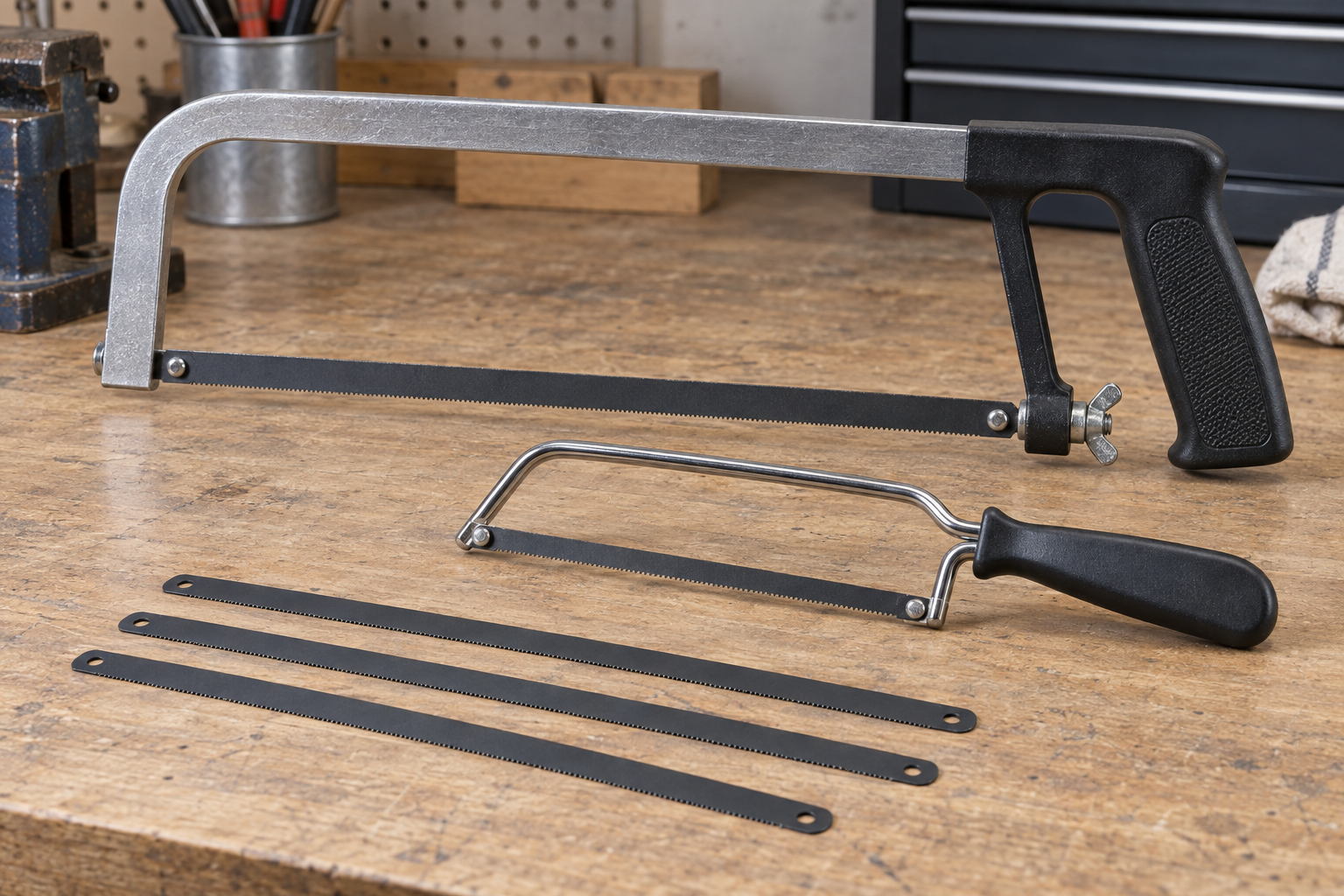
A junior hacksaw typically takes a blade about 6 inches long and has a compact frame that supports the blade at one end or both ends, depending on the design. Compared with a standard 12-inch hacksaw, it gives you less cutting speed but much better access around small fasteners and obstructions.
Look for four things:
- A rigid frame: Flex causes the blade to twist, wander, and snap. This matters when only a few inches of hand clearance are available.
- Reliable blade tension: The blade should stay straight under moderate hand pressure. Loose blades tend to bind; excessive tension can break thin blades or damage a cheap frame.
- Comfortable control: A handle with a usable palm surface is more important than thick rubber. You need to make short, straight strokes without your knuckles hitting the work.
- Easy blade replacement: A wing nut or tool-free tensioner is useful when the blade breaks in a confined spot.
For a ready-to-use option, compare junior hacksaws with replacement blades rather than buying a bare frame. A spare blade is cheap, and the first one may be damaged while you learn how much pressure the saw needs.
Blade Choice for Small Fasteners
Tooth count has a bigger effect on the result than small differences between saw frames. Use at least three teeth in contact with the material at all times. If too few teeth engage, the blade catches and strips teeth. If too many teeth are buried in thick material, chips cannot clear and the cut becomes slow.
| Blade pitch | Best use | Advantages | Common problem |
|---|---|---|---|
| 18 TPI | Thicker mild steel, roughly 3/16 inch and above | Fast chip clearance and aggressive cutting | Can snag on thin sheet or small bolts |
| 24 TPI | General-purpose bolts, screws, and mild steel | Good balance of speed and control | Not ideal for very thin sheet |
| 32 TPI | Small fasteners, thin wall tubing, and stainless steel | Cleaner cut and less tooth snagging | Clogs with chips and cuts more slowly |
Bi-metal blades are worth choosing when the fastener is stainless steel, hardened, or difficult to replace. Their high-speed-steel teeth resist breaking better than inexpensive all-carbon blades. For soft mild-steel screws, a carbon blade is often perfectly adequate, especially if you only have one or two cuts to make.
Use a 6-inch 24 TPI junior hacksaw blade as the sensible starting point. Move to 32 TPI when cutting a small bolt, thin bracket, or a fastener close to a finished surface.
Junior Hacksaw Options Compared
| Type | Best for | Strengths | Limitations |
|---|---|---|---|
| Basic fixed-frame junior hacksaw | Occasional household repairs | Low cost, simple, compact | May flex; blade changes can be awkward |
| Heavy-duty junior hacksaw | Regular cutting and tougher fasteners | Stiffer frame and better tension | Usually heavier and less nimble |
| Mini adjustable hacksaw | Very tight access and varied blade lengths | Can fit around obstructions; versatile | More flex and less cutting depth |
| Flush-cut mini saw | Trimming a fastener nearly level with a surface | Good control and low risk of gouging | Slower; often uses specialized blades |
The basic fixed-frame type is the best value for most people. The cheaper option is fine when trimming a few mild-steel screws during a cabinet, plumbing, or automotive repair. Spend more on a heavy-duty frame if you routinely cut hardened bolts, work one-handed, or cannot afford the blade to twist into nearby material.
An adjustable mini frame helps when access is unusually poor, but its flexibility is a real trade-off. If the blade bows visibly during a stroke, stop and reposition the work rather than forcing it. The saw may fit the space, but a stiff fixed frame usually makes a straighter cut.
How to Trim a Fastener Cleanly
First, protect the surrounding surface with masking tape, a thin piece of sheet metal, or a scrap of plastic. Mark the cut with a marker or scribe. If the fastener is threaded, screw a nut onto it before cutting. After the cut, unscrewing the nut can straighten minor burrs and restore the thread at the end.
Set the blade so its teeth point forward, then tension it until it gives only slight movement when pressed sideways. Start with short, light strokes to create a groove. Once the groove is established, use the full available blade length with steady pressure. A 6-inch blade does not need to travel 6 inches in a tight space; even 1 to 2 inch strokes work if they stay aligned.
Keep the blade square to the fastener. Twisting during the return stroke is a common cause of broken teeth. Let the teeth cut rather than leaning hard on the frame. On a small mild-steel bolt, expect roughly 30 seconds to 2 minutes of sawing, depending on diameter, blade sharpness, and access.
When a Junior Hacksaw Is the Wrong Tool
A junior hacksaw is a poor choice when you need many identical cuts, when the fastener is over about 3/8 inch in diameter, or when access allows a faster tool without risking damage. An angle grinder cuts quickly but throws sparks and can scorch paint, melt plastic, or remove too much material. A rotary tool with a cutoff wheel works in tighter spaces, but its thin wheels can shatter and the cut creates abrasive dust.
For repeated work, a compact reciprocating saw with metal-cutting blades saves time, provided you can secure the work and control the blade tip. For one awkward fastener near wiring, plumbing, painted trim, or upholstery, the slower junior hacksaw is usually the safer answer.
Wear eye protection, clamp or support loose parts, and check what is behind the fastener before starting. Replace a blade when the teeth are rounded, missing, or require heavy pressure. A sharp, properly tensioned blade is what makes a junior hacksaw effective in tight spaces—not brute force.