What's inside
As an Amazon Associate I earn from qualifying purchases. This post may contain affiliate links at no extra cost to you.
Choosing a drill chuck is not just a matter of picking keyed or keyless. The chuck must fit the tool’s spindle or arbor, accept the bit sizes you use, and suit the torque and speed of the job. A mismatch can leave the chuck loose, limit the bits you can install, or make a high-torque tool unsafe to use.
Start with the tool, not the chuck
Before shopping, identify how the chuck attaches. On many corded drills, the chuck screws onto a threaded spindle; on others, it mounts to a taper. Cordless drills commonly use a chuck designed for the drill’s specific spindle connection. Hammer drills may use a standard three-jaw chuck, while rotary hammers often use an SDS-plus or SDS-max holder instead. Those systems are not interchangeable with an ordinary drill chuck.
Check the tool manual or existing chuck for the mounting type and size. Common threaded mounts include 3/8-24 and 1/2-20, where the first number indicates nominal thread diameter and the second is threads per inch. Jacobs tapers are marked by codes such as JT33. Do not assume two chucks fit because both are 1/2-inch capacity: that number describes the largest bit shank they accept, not the mount.
If the chuck is held by a screw inside the jaws, that screw often has a left-hand thread. Open the jaws fully and check before removal; turning it the wrong way can damage the screw. For a chuck that is stuck or an unfamiliar mount, use the manufacturer’s removal instructions rather than forcing it with pliers.
Match capacity to your bits
Chuck capacity is the range of shank diameters the jaws can grip. A 3/8-inch chuck accepts shanks up to 3/8 inch; a 1/2-inch chuck can accept larger bits, but only if the drill and its mount are rated for them. Many small drills have 3/8-inch chucks, while full-size drills commonly use 1/2-inch chucks.
Also check the minimum capacity. A chuck that opens no smaller than 1/16 inch will not reliably grip a finer shank. If you often use small bits for pilot holes, jewelry work, or electronics, verify the lower limit rather than focusing only on the maximum.
A larger chuck does not make a drill more powerful. Putting an oversized bit in a light-duty drill can stall the motor, overheat it, or twist the tool in your hands. Follow the drill maker’s limits for bit diameter and material, especially for hole saws and large augers.
Keyed versus keyless
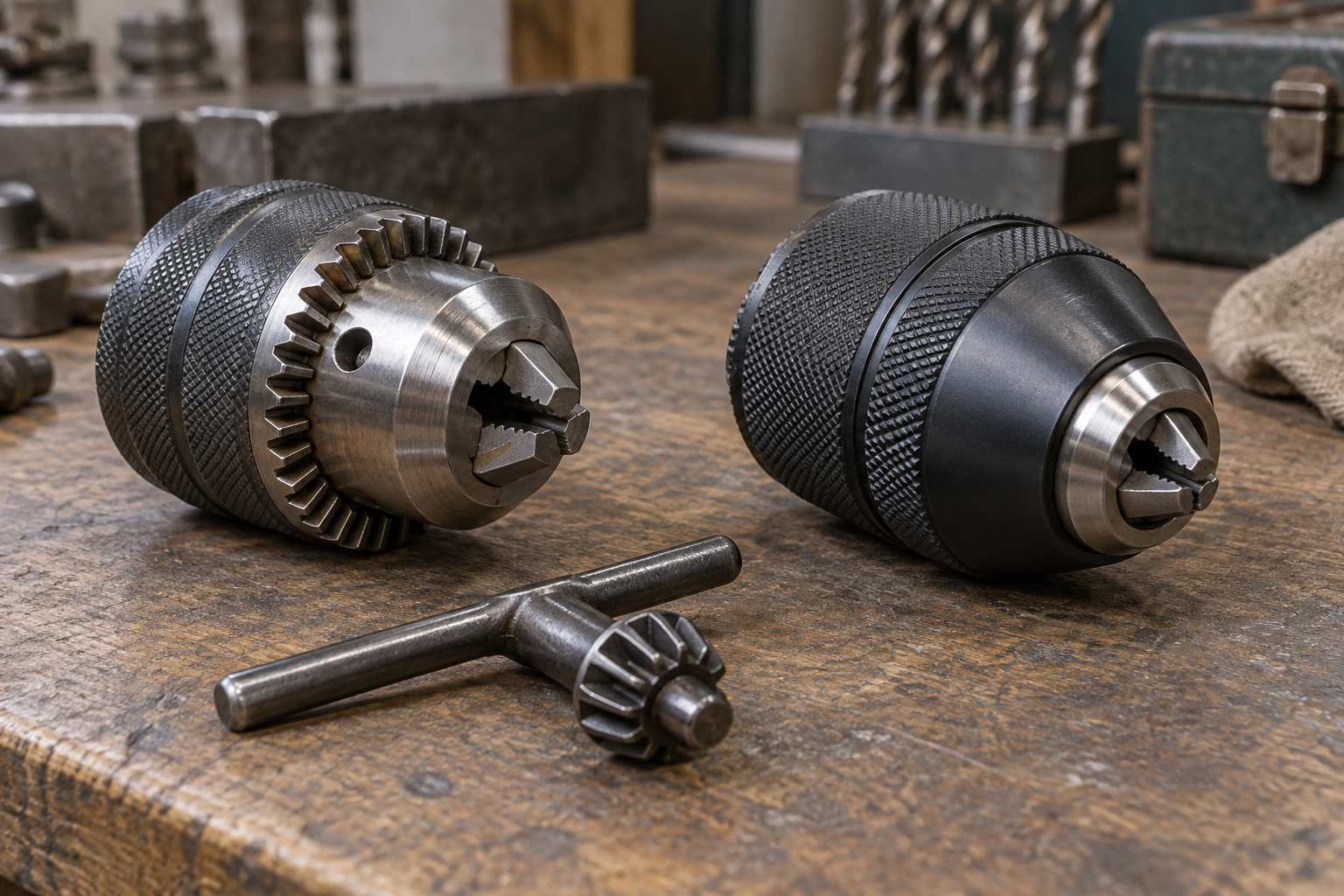
A keyed chuck uses a toothed key to tighten the jaws. It takes an extra step, but lets you apply strong, repeatable clamping force. That makes it a sensible choice for heavy drilling, larger bits, or work where a slipping bit could damage the stock. The main drawback is practical: the key can be misplaced, and a loose key left in the chuck can become a dangerous projectile when the drill starts.
A keyless chuck tightens by hand, often with one or two sleeves. It is quicker for frequent bit changes and avoids keeping track of a separate key. Some drills have a spindle lock; others need the motor to hold the spindle while you tighten. Keyless models can loosen under sustained high torque or vibration, particularly if the user does not tighten them firmly. That does not make them unsuitable for ordinary work, but it is a reason to recheck the bit before demanding drilling.
| Feature | Keyed chuck | Keyless chuck |
|---|---|---|
| Bit changes | Slower; requires the matching key | Faster; tightened by hand |
| Clamping | Strong, controlled tightening | Depends on grip and chuck design |
| Best fit | Heavy drilling and demanding bit use | General drilling and frequent changes |
| Common nuisance | Lost key or key left in chuck | Can loosen under vibration or high torque |
For most household repairs, furniture assembly, and routine wood or metal drilling, a sound keyless chuck is convenient and adequate. If you regularly run large bits, mix drilling with aggressive mixing attachments, or value mechanical tightening over speed, consider a keyed 1/2-inch drill chuck, provided its mount matches your tool.
Check the mount before buying
Compatibility is the most common reason a replacement chuck fails to fit. Confirm both the mounting style and the exact size or code. A threaded chuck will not fit a Jacobs taper without the correct adapter, and a chuck with the wrong thread pitch may start to screw on but bind or damage the spindle. Avoid using a forced fit as a substitute for checking specifications.
For a taper-mounted chuck, the arbor may be a separate part that fits the drill’s spindle at one end and the chuck at the other. That setup adds another interface to verify. For a threaded mount, check whether the drill requires a retaining screw and whether the replacement includes a compatible one. If the original chuck is still installed, its markings can help, but verify them against the tool documentation.
Keyless options are widely available, but do not buy by appearance alone. Search for the chuck’s mount and capacity together, such as a keyless chuck with the specified thread mount. When the mount is uncertain, a manufacturer-approved replacement is safer than a generic chuck that merely has the right jaw capacity.
Consider accuracy and durability
For woodworking, metalworking, or repeat drilling, jaw alignment matters. Runout is the amount the bit wobbles as it spins. Excessive runout can make holes oversized, break small bits, or produce rough work. A chuck with cleanly machined jaws and a solid fit is more useful than a bargain chuck with a generous capacity but noticeable wobble.
Small runout can also come from a bent bit, dirt on the mounting surfaces, or a damaged spindle. Test with a straight, known-good bit before blaming the chuck. If the chuck itself wobbles, tightening harder will not correct the alignment and may damage the jaws or mount.
A low-cost chuck is reasonable for occasional household use, especially if the existing chuck is worn and the replacement matches exactly. Pay more for a reputable chuck when accuracy, frequent bit changes, or sustained heavy use matter. If you need the convenience of quick changes but work under high torque, a higher-quality keyless chuck may be a better compromise than choosing the cheapest available option.
Make the choice for the job
For a household drill used on wood, plastic, and occasional light metal, prioritize a matching mount and a reliable keyless chuck. For large bits, repetitive demanding work, or a shop drill where accuracy matters, compare keyed models and better-made keyless options. If the tool uses SDS tooling, buy compatible SDS accessories rather than trying to adapt an ordinary chuck unless the manufacturer specifically allows it.
Before drilling, seat the bit straight, tighten all jaws evenly, and remove any chuck key. Run the drill briefly at low speed while keeping the bit clear of the work; stop if it wobbles or slips. A few seconds of checking can prevent a broken bit, damaged material, or a chuck that backs off under load.