What's inside
As an Amazon Associate I earn from qualifying purchases. This post may contain affiliate links at no extra cost to you.
Our Top Picks
 Bosch ITBHQC201 2-Inch Impact Tough Quick Change Bit21" in0.59 x 1.75 x 1.17 inches0.07 PoundsCheck on Amazon
 BOSCH ITBH201 1-Piece 2 In. Impact Tough Magnetic2 In.0.47 x 1.75 x 1.01 inches0.06 PoundsCheck on Amazon


The short answer
For reducing bit wobble during ordinary driving, a good impact-rated bit holder usually beats a magnetic bit sleeve. Its locking mechanism supports the bit closer to the hex shank and keeps the bit centered under load. A magnetic sleeve is cheaper, faster to use, and perfectly adequate for many light-duty jobs, but it does less to control a bit that is already loose, bent, poorly made, or mismatched to the screw.
The difference is most obvious with long bits, large structural screws, and higher-speed driving. If you mainly install cabinet hardware or drive short screws into softwood, the cheaper sleeve can be enough. If you build decks, frame walls, or regularly use an impact driver at high torque, choose a locking holder.
As an Amazon Associate we earn from qualifying purchases at no extra cost to you.



How the two accessories control a bit
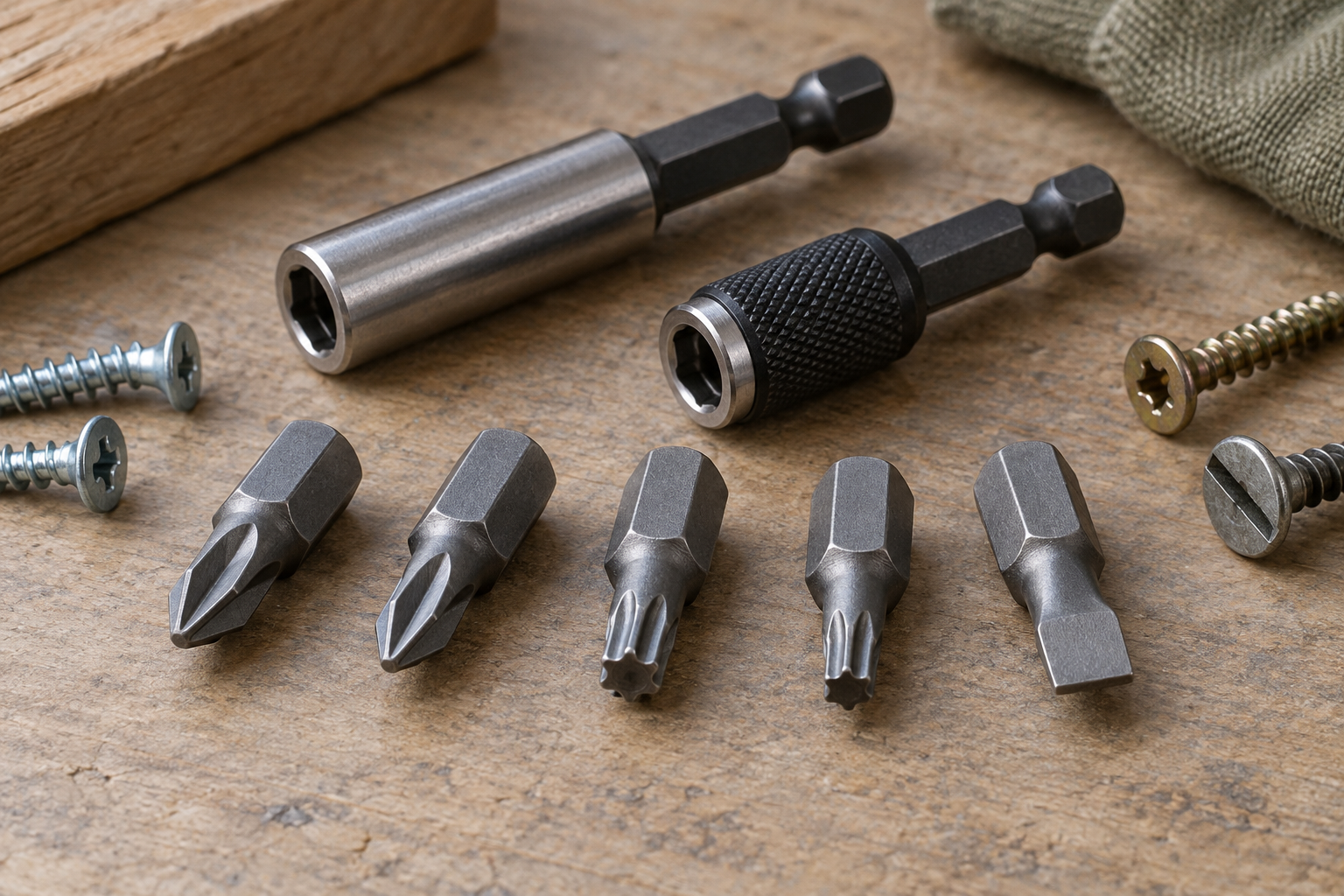
An impact driver bit holder is an extension with a 1/4-inch hex shank on one end and a bit-retention system on the other. Common designs use a spring-loaded collar, locking sleeve, or retaining ring. The bit is held mechanically, so it cannot easily slide out or tilt away from the holder.
A magnetic bit sleeve is usually a hollow sleeve that fits over a standard driver bit. A magnet holds the bit in place, while the sleeve surrounds part of the bit and may support the screw head. Some sleeves are fixed to an extension; others slide forward and backward. They are often sold as “magnetic screw guides” or “magnetic bit holders,” which makes the terminology confusing. The important distinction is whether the bit is mechanically locked or retained mainly by a magnet.
Neither accessory can correct a bent bit or a damaged driver chuck. Wobble starts with several possible sources: a loose bit-to-holder fit, a poor hex shank, an off-center bit tip, a screw head that does not match the bit, or a bit holder whose internal bore is worn. The accessory only addresses some of these problems.
Which one reduces wobble better?
| Factor | Impact driver bit holder | Magnetic bit sleeve |
|---|---|---|
| Bit retention | Mechanical lock or tight spring retention | Magnet, sometimes aided by sleeve friction |
| Wobble control | Usually better, especially under torque | Good to fair on short bits; limited with long bits |
| Speed of bit changes | Fast, but may require pulling a collar | Very fast; pull the bit straight out |
| Holding screws on the bit | Usually requires a separate magnetic tip or sleeve | Usually better for starting screws overhead |
| High-torque work | Best choice when impact-rated | Acceptable only for moderate loads |
| Typical cost | About $10–$30 for a useful single holder or small set | About $5–$15 for a basic sleeve or extension |
In a well-made holder, the bit should show little visible movement when the driver spins at low speed. A small amount of movement at the tip can still occur because the bit and holder have manufacturing clearance. In practical use, a good holder commonly keeps runout below roughly 1/16 inch at the end of a 2-inch bit. A cheap holder, a long bit, or a worn internal spring can produce noticeably more.
A sleeve can look stable with a short 1-inch bit but wobble more as the bit gets longer. The unsupported length acts like a lever: double the exposed length and the same small angular error becomes roughly twice as noticeable at the tip. This is why a sleeve may feel fine for 1-1/4-inch drywall screws but awkward with 3-inch construction screws.
Impact-rated construction matters
Do not confuse a locking bit holder with an impact-rated bit holder. Impact drivers deliver repeated torsional blows, and ordinary chrome extensions can crack, deform, or loosen when used in that environment. Look for a holder specifically marked for impact use, usually with a dark oxide or black finish and a retaining design intended for impact drivers.
A locking collar is helpful, but it is not a guarantee of low wobble. The bit still needs to fit the holder’s internal bore correctly. Some holders have a little radial play so bits can be inserted easily. That play becomes visible with a long bit, especially when the driver is run at full speed.
For the best control, use a short, high-quality impact bit directly in the driver when the job allows it. Every added extension introduces another fit between hex surfaces. A holder improves retention and convenience, but it also creates another possible source of runout.
When a magnetic sleeve is the better buy
Choose a magnetic sleeve when your priority is holding screws on the bit rather than surviving maximum torque. It is useful for assembling furniture, installing hinges, driving small wood screws, and working one-handed or overhead. The sleeve can keep a screw aligned long enough to start it without holding the fastener with your other hand.
It is also the sensible budget choice for occasional DIY work. If you drive fewer than a few dozen screws per project and the screws are short, replacing a worn sleeve is inexpensive. A magnetic sleeve is often easier for a beginner because the bit can be swapped instantly and the screw stays attached.
There are limits. Magnets lose practical holding strength through dirt, paint, and a large gap. Stainless or some coated fasteners may not respond strongly to the magnet. A sleeve can also push against the work surface and prevent the bit from seating fully in a recessed screw head.
When a locking holder is worth paying for
Buy an impact-rated locking holder if you frequently drive structural screws, use long driver bits, work at high speed, or are tired of bits falling out when the driver is pointed downward. The mechanical retention is more dependable, and the holder generally tolerates repeated insertion better than a simple magnetic design.
For a general-purpose upgrade, look for an impact-rated locking bit holder with a short body and a spring-loaded collar. A shorter holder reduces leverage and usually wobbles less than an extra-long extension. If you need to reach into deep recesses, buy the shortest holder that gives you the required access.
If you want both retention and screw holding, consider a magnetic impact bit holder that also uses mechanical bit retention. That combination costs more than a sleeve, but it avoids choosing between a secure bit and a screw that falls off.
How to reduce wobble with either type
First, clean the driver chuck and the bit shank. Dust or a burr can prevent the hex surfaces from seating fully. Insert the bit all the way, then pull it out slightly if the holder’s instructions call for clearance. Check the bit at low speed before driving a fastener.
If the tip traces a circle wider than about 1/16 inch at the end of a short bit, test another bit. If the wobble follows the bit, discard it. If every bit wobbles in one holder, replace the holder. Finally, check the driver’s quick-change chuck. A damaged chuck can make both a premium locking holder and a cheap sleeve appear defective.
For most buyers, the decision is simple: choose a magnetic sleeve for light work and screw-holding convenience; choose a short, impact-rated locking holder for cleaner alignment, heavier torque, and longer service life. The holder reduces bit wobble more consistently, but the sleeve remains a good low-cost tool when the job does not demand precision or high load.