What's inside
As an Amazon Associate I earn from qualifying purchases. This post may contain affiliate links at no extra cost to you.
For large pipe pass-throughs in wall framing, the best hole saw is usually a heavy-duty bi-metal hole saw with a replaceable arbor and a pilot bit. It cuts ordinary dimensional lumber quickly, survives occasional nails better than cheap carbon-steel sets, and is more controllable than trying to enlarge a hole with a spade bit or reciprocating saw.
The right choice depends mainly on the hole diameter, the framing material, and how often you expect to make the cut. A 2-inch drain line needs a different setup from a 4-inch HVAC sleeve. For one or two holes in soft, dry lumber, an inexpensive hole saw can be perfectly adequate. For repeated work, engineered lumber, or framing that may contain fasteners, spend more on the teeth and arbor.
As an Amazon Associate we earn from qualifying purchases at no extra cost to you.


Our Top Picks
 Milwaukee 49-22-4185 All Purpose Professional Ice Hardened Hole9.5 x 16.5 x 4.75 inches1 PoundsCheck on Amazon


What to look for in a large hole saw
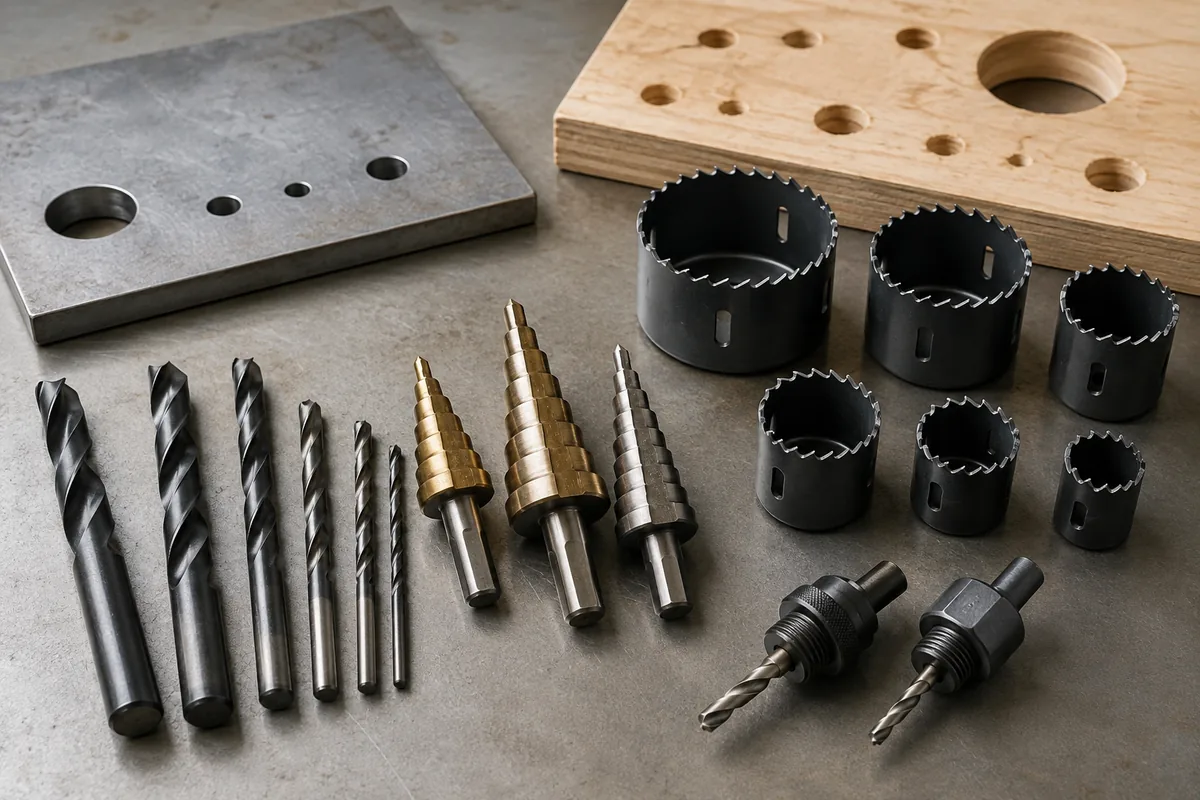
For wood framing, look first for a hole saw with hardened bi-metal teeth. Bi-metal construction gives the teeth better wear resistance and some flexibility, so they are less likely to shatter if they encounter a screw. It is the best general-purpose choice for dimensional lumber, plywood, and many sheathing materials.
Carbide-grit hole saws cut aggressively through abrasive materials such as cement board, fiberglass, and some composites. They can also cut wood, but they are not automatically better for framing. Carbide-grit edges tend to cut more slowly in clean wood and can lose teeth or become uneven after hitting metal. Use one when the material demands it, not simply because the package claims a longer life.
A replaceable pilot bit matters on large saws. The pilot keeps the cutter centered while the teeth start, and it prevents the saw from wandering across the stud. Choose an arbor with a substantial shaft and a positive locking system. Small, loose arbors can slip under the torque produced by a 3-inch or 4-inch cutter.
For holes larger than about 2-1/2 inches, use a drill with a side handle or a low-speed, high-torque setting. A compact drill can make the hole, but it may twist hard enough to injure your wrist when the teeth catch. Do not use hammer mode. Keep the drill square to the stud, and withdraw the saw periodically to clear chips.
Best choice by job
| Job | Recommended cutter | Why it works | Main drawback |
|---|---|---|---|
| One or two holes in pine or spruce | Basic bi-metal hole saw | Low cost and adequate tooth life | Arbor and pilot may be flimsy |
| Repeated holes in dimensional lumber | Professional bi-metal saw with replaceable pilot | Cleaner starts and longer life | Higher purchase price |
| Engineered lumber or occasional nails | Thick-wall bi-metal saw | More tolerant of heat and interrupted cuts | Still not a substitute for checking for wiring and plumbing |
| Very abrasive sheet goods or cement board | Carbide-grit hole saw | Resists abrasive wear | Less forgiving if it hits metal |
| Several pipe sizes on one project | Hole saw set with a quality arbor | Better value than buying individual cutters | Sets often include weak large-diameter saws |
Choose the diameter, not just the pipe size
Do not match the hole saw to the pipe’s nominal size. A 2-inch drain pipe is larger than 2 inches outside diameter, and it needs room to pass through the framing without binding. Measure the actual pipe and add clearance for installation and movement. A common pass-through may need a 2-1/2-inch or 3-inch hole, depending on the pipe, insulation, fittings, and local practice.
For a tight sleeve or conduit, roughly 1/8 to 1/4 inch of clearance may be enough. Drain and waste piping often benefits from more room, particularly when the pipe must be aligned between multiple studs. Avoid making a huge hole simply because the cutter is available: oversized openings weaken the member and may require reinforcement.
Check the framing rules before cutting. Typical residential code limits boring in load-bearing studs to 40 percent of the stud width, with larger holes allowed only under specific conditions and often requiring doubled studs. Holes close to the face of a stud may also need nail plates. The exact requirements vary, so follow the applicable code and the framing plan rather than relying on a generic rule of thumb.
How to drill the pass-through cleanly
Mark the center carefully and check both sides of the framing for electrical cable, plumbing, and fasteners. A stud finder is useful, but it cannot reliably identify every wire or pipe. Turn off power where appropriate and use a small inspection hole or access from the opposite side when the area is uncertain.
Fit the arbor tightly and make sure the pilot bit extends slightly beyond the teeth. Start at low speed with light pressure until the pilot is established. Once the rim is cutting evenly, increase pressure only enough to keep the teeth engaged. For a 3-inch saw in a standard 2-by-4, the cut can generate substantial heat; stop every few seconds to clear chips and let the saw cool.
When the pilot breaks through, reduce pressure. The teeth can grab as they exit, tearing the back of the stud or wrenching the drill. If both sides will be visible, drill until the pilot exits, then finish from the opposite side using the pilot hole as a guide. This produces a much cleaner opening.
What to buy
For general framing work, buy a large-diameter bi-metal hole saw kit that includes the sizes you actually need and an arbor rated for them. Inspect the kit’s largest cutter before buying; some inexpensive sets have useful small saws but thin, poorly supported large ones.
If you already own several saws but the pilot keeps slipping, upgrade the heavy-duty hole saw arbor rather than replacing every cutter. A good arbor often makes a bigger practical difference than a premium tooth coating.
For a single project involving clean softwood, a single 3-inch bi-metal hole saw is usually the economical answer. You do not need a full professional set if you will make two holes and never use the tool again. Choose carbide grit only when you are cutting abrasive material, or consider a carbide-grit hole saw for that specific material.
Common failures to avoid
The most frequent problem is using too much speed. Heat dulls the teeth, burns the wood, and can loosen the arbor. Another is forcing a clogged saw, which stalls the drill and can distort the cutter. Clear chips instead of leaning harder on the trigger.
Do not use a cheap hole saw after it has visibly lost teeth or developed a warped rim. It will cut an oval hole, vibrate badly, and may jam without warning. Finally, never assume a clean-looking stud is safe to bore. Protect the structure and inspect for utilities first; the best hole saw cannot repair a severed cable, pipe, or load-bearing member.