What's inside
As an Amazon Associate I earn from qualifying purchases. This post may contain affiliate links at no extra cost to you.
The right torque wrench for a bicycle or small engine is usually a small-range wrench, not a full-size automotive model. Many delicate fasteners need less than 20 N·m, and a large wrench may not measure that range accurately. First check the torque value in the component or engine manual; then choose a wrench whose working range puts that value away from its ends.
As an Amazon Associate we earn from qualifying purchases at no extra cost to you.



Our Top Picks
 LEXIVON Bike Torque Wrench 1/4-Inch Dr. 15-Piece Kit1/4"DR. 1.48-19.18 FT-LB Kit4.69 x 10.35 x 2.28 inches1.3 poundsCheck on Amazon
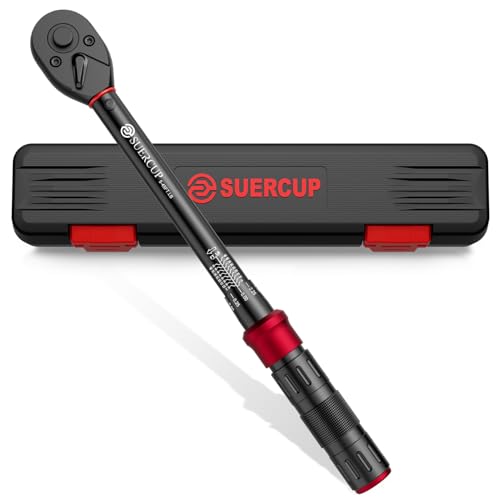 SUERCUP 3/8" Click Torque Wrench3/8" 5-45 Ft.Lb/6.8-61 N.m11.8 x 1.02 x 1.2 Inches1.5 poundsCheck on Amazon


Start with the torque range
Bicycle parts span a wide range. A carbon handlebar clamp might call for 4–6 N·m, while a crank bolt can require several times that amount. Small-engine jobs vary too: carburetor, cover, and control fasteners are often low-torque, while some larger mounting or flywheel fasteners need substantially more. These are examples, not substitutes for the specified value; designs differ.
A wrench marked 10–100 N·m is a poor choice for a 5 N·m stem bolt. Below its calibrated range, its reading is not dependable. For low-torque work, look for a wrench that starts at or below the lowest value you expect to use. For a mixed kit, a small wrench covering roughly 2–20 N·m and a second wrench for higher values are often more useful than one broad-range tool.
Which type fits the job?
| Type | Best use | Advantages | Trade-offs |
|---|---|---|---|
| Beam or deflecting-beam | Occasional low- or mid-torque work | Simple, no click mechanism to adjust or reset; often inexpensive | You must watch the scale while applying force; awkward where visibility is poor |
| Click, preset range | Repeated jobs at known settings | Clear tactile or audible signal; quick to set | Needs careful storage and use; stop at the first click |
| Digital | Users who want a display or multiple units | Easy-to-read number and often an alert before target | More expensive, needs batteries, and still needs correct setup and calibration |
| Torque screwdriver | Very small fasteners and low-torque bicycle fittings | Better suited to small values and controlled hand pressure | Limited range; not a replacement for a higher-capacity wrench |
For most home mechanics, a click wrench is the practical choice if its range matches the work. A beam wrench is a reasonable budget option for occasional jobs, especially when you can see the scale clearly. It is not automatically inaccurate; the main drawback is reading it while keeping the tool straight and applying force smoothly.
What to buy
For bicycle work, compare a low-range 2–20 N·m bicycle torque wrench with a low-range torque screwdriver. The wrench is more versatile if you also have fasteners around 10–20 N·m. The screwdriver makes better sense when your main concern is small clamp bolts, where a bulky ratchet can make it easy to apply too much force.
For small-engine maintenance, a mid-range 3/8-inch click torque wrench can cover many general fasteners, but check the manual before buying: some jobs fall below its minimum, and others exceed its maximum. A cheaper wrench is fine for occasional use if its stated range, drive size, and accuracy suit the specification. Pay more for a better-readable scale or broader documentation when you will rely on it often—not just for a claimed extra feature.
Check accuracy claims and calibration documentation, especially if the wrench will see frequent use. A common stated accuracy is around ±4%, but that figure only applies under the maker’s conditions and within the calibrated range. Also confirm the drive size and whether the supplied adapters change the effective length or fit your sockets.
Use it without damaging the fastener
Find the specified torque and unit first. N·m and inch-pounds are not interchangeable numbers: 1 N·m is about 8.85 in-lb. Confirm which unit the wrench displays, and do not confuse inch-pounds with foot-pounds. If the fastener needs 5 N·m, setting 5 on a foot-pound scale would be a serious error.
Use the correct socket or bit, keep it square to the fastener, and apply force at the handle’s marked grip area. Pull steadily rather than jerking. On a click wrench, stop at the first click; continuing can add torque. If the wrench has a locking collar, lock the setting before working. Afterward, return an adjustable click wrench to its lowest marked setting, not below the scale unless its manual says otherwise.
Clean, undamaged threads matter. Dirt, corrosion, lubrication, threadlocker, or a different fastener can change clamping force at the same torque. Follow the component maker’s instructions on thread condition and any tightening sequence. On a bicycle stem, tighten bolts in the specified pattern and check that the gap is even where the manufacturer calls for it. If a bolt bottoms out, spins without tightening, or feels rough, stop: a torque wrench will not diagnose damaged threads.
Limits and maintenance
A torque wrench is a measuring tool, not a breaker bar. Loosen stubborn fasteners with a regular ratchet or breaker bar, and avoid using the torque wrench for general tightening. Do not drop it or use it as a hammer. Store it in its case and follow the manufacturer’s calibration interval; a drop, overload, or heavy professional use may justify checking it sooner. For a home user who only tightens a few bicycle bolts each season, an inexpensive, in-range wrench used carefully can be enough. For safety-critical fasteners or regular shop work, range fit, calibration support, and repeatable technique matter more than the lowest purchase price.