What's inside
As an Amazon Associate I earn from qualifying purchases. This post may contain affiliate links at no extra cost to you.
Our Top Picks

Short answer: reversing is easier, when you have room to use it
A reversible ratcheting wrench is usually easier to operate one-handed because you can change the direction of the ratchet without taking the wrench off the fastener. That matters when your other hand is holding a hose, steadying a part, or keeping a nut from falling into a tight space.
But “reversible” does not mean every adjustment is one-handed. Some wrenches use a small thumb lever that is awkward to reach in a cramped spot, and both styles need enough clearance to swing back and forth. If you rarely change direction, or want the simplest inexpensive wrench for a job with clear access, a fixed-direction ratcheting wrench can be perfectly practical.
As an Amazon Associate we earn from qualifying purchases at no extra cost to you.


What the two designs do
A fixed-direction ratcheting wrench tightens in one direction and freewheels on the return stroke. To loosen, you normally flip the wrench over and work from the other side of the fastener. That can be easy on an exposed bolt, but impossible if a pipe, bracket, or wall blocks access to the side you need.
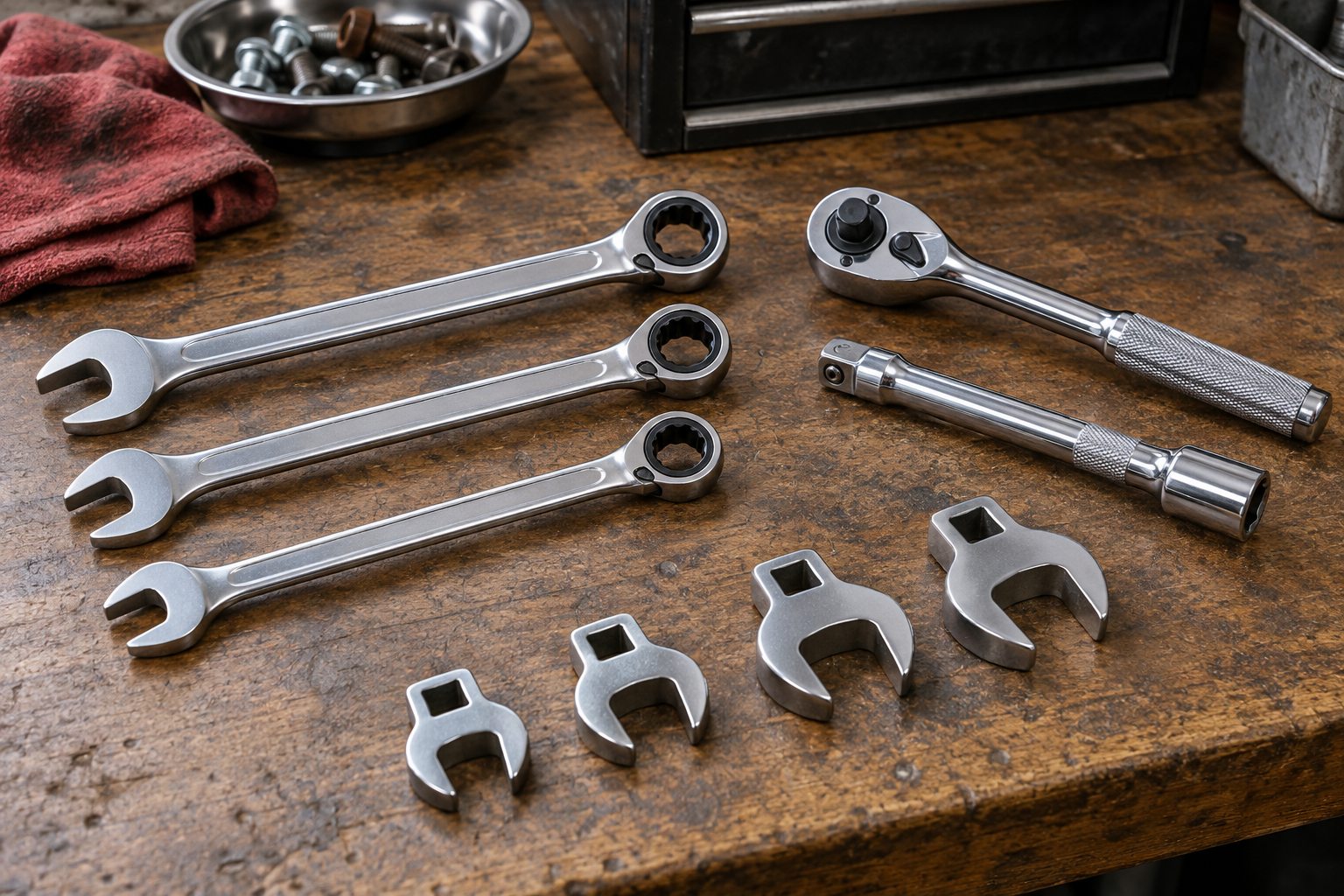
A reversible ratcheting wrench changes its drive direction with a lever, slider, or rotating switch. You leave the wrench seated on the fastener and select clockwise or counterclockwise drive. This is useful when access is limited, though the selector itself may be difficult to operate with gloves or oily fingers.
One-handed use at a glance
| Situation | Reversible ratcheting wrench | Fixed-direction ratcheting wrench |
|---|---|---|
| Changing from tightening to loosening | Usually faster; switch direction without removing the wrench | Often requires flipping or repositioning the wrench |
| Other hand is occupied | Better if the selector is reachable | Can be awkward if flipping the tool needs two hands |
| Tight clearance | Selector can be blocked; wrench still needs swing room | Simple head, but flipping may be impossible |
| Cost and simplicity | Typically costs more and has an extra mechanism | Usually the cheaper, simpler choice |
| Risk of wrong setting | Possible if the selector is bumped or hard to see | Direction is fixed; orientation determines the drive |
Where reversible is easier with one hand
The clearest advantage appears when a fastener needs repeated direction changes. Think of adjusting a linkage, working a nut on a stud in a confined bay, or loosening a bolt after an earlier attempt to tighten it. With a reversible wrench, you can keep the head on the nut while your thumb changes the setting. With a fixed-direction wrench, you may have to lift it, turn it over, and reseat it.
That small difference becomes important when the other hand is keeping a washer in place or supporting a component. A dropped nut can cost more time than the wrench saved. Reversal is also helpful when the wrench cannot be flipped because it sits close to a panel or another fitting.
For regular mixed work, consider a reversible ratcheting wrench set. Check that the direction control is easy to reach with the wrench seated, not just easy to move while the tool is in your hand.
When fixed direction is the better choice
A fixed-direction wrench has fewer controls to bump or jam, and its operation is straightforward: orient the wrench for the direction you want, then ratchet. If you are working on a bench, tightening accessible fasteners, or carrying a single wrench for occasional household repairs, paying extra for reversal may not buy much.
It can also be easier to control when your grip is compromised. A reversible tool’s selector may be small, stiff, or partially hidden by your hand. If you cannot confirm which way it is set, pause and check before applying force. A ratcheting wrench is not a substitute for a breaker bar: if a fastener is stuck, forcing the ratchet can damage its mechanism or round the fastener. Use a suitable non-ratcheting wrench to break it free, then ratchet once it turns normally.
If your work is occasional and access is open, a fixed-direction ratcheting wrench can be a sensible lower-cost buy. Some fixed-direction designs are also double-ended, with each end arranged to drive in a different direction, but you still have to turn the wrench over or change ends to switch.
Clearance, selectors, and common mistakes
Neither design eliminates the need for working clearance. A wrench needs room to move through a short arc and return. In a very tight space, a fine-tooth ratchet may engage with less movement, but the head still needs to fit around the fastener. Check both the head clearance and the return-stroke clearance before buying; a slim profile can matter more than reversal.
Selector placement is a real trade-off. A lever on the back of the head may be easy to thumb in open space but blocked against a nearby surface. A small side switch may clear an obstruction but be harder to move with gloves. Dirt can also make a selector stiff. If it will not shift cleanly, do not force it with pliers; clean the mechanism according to the manufacturer’s instructions or use another tool.
Most importantly, confirm the selected drive direction before applying significant torque. If the ratchet slips when you expect it to drive, stop rather than pushing harder. The wrench may be set the wrong way, not fully engaged, or worn. Continuing can strip the ratchet teeth or round the fastener. Keep the wrench square on the nut, and avoid using an extension that overloads a small ratchet head.
What to buy for your work
Choose reversible if you often alternate between tightening and loosening, work one-handed, or encounter places where flipping the wrench is blocked. Choose fixed direction if you mainly handle accessible fasteners, want a simple occasional-use tool, and can reposition the wrench freely.
If you are uncertain, buy for the work you actually do most. A reversible wrench is not automatically better in every hand: its advantage is fewer removals during direction changes, not more power or zero-clearance access. Compare the selector operation, head thickness, and tooth engagement, then test the switch before relying on it in a cramped job.