What's inside
As an Amazon Associate I earn from qualifying purchases. This post may contain affiliate links at no extra cost to you.
Why breaker bar length matters
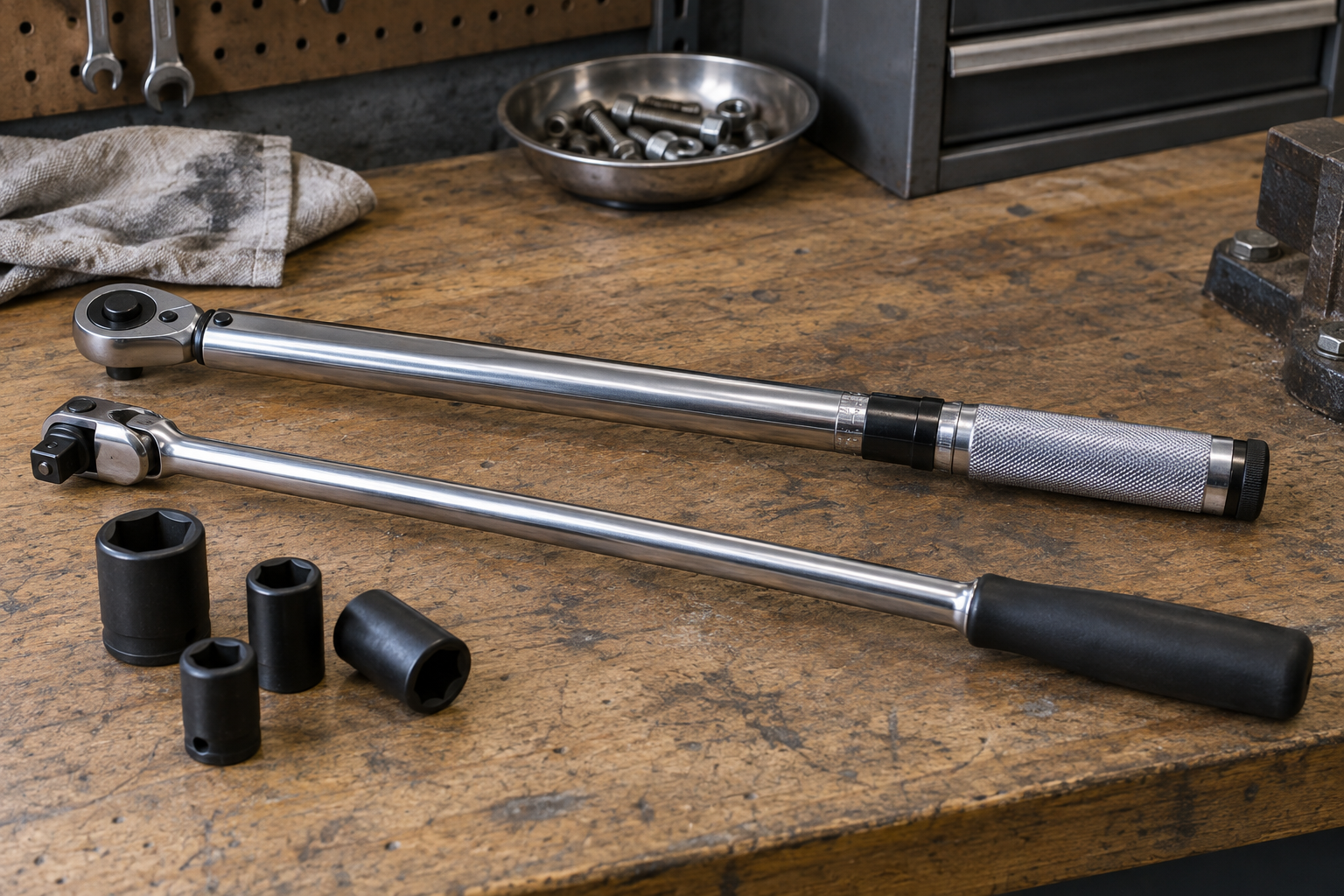
A breaker bar gives you leverage for loosening a fastener without the impact pulses of an impact wrench. For a given force at your hand, a longer bar applies more torque: a 24-inch bar gives roughly twice the leverage of a 12-inch bar. But that does not mean the longest bar is always the right one. More leverage also makes it easier to overload a socket, twist a fastener, or lose control when it breaks free.
For typical passenger-car work, a 1/2-inch-drive bar around 18 to 24 inches is a useful starting point. A 3/8-inch-drive bar, often 10 to 18 inches long, fits tighter spaces and is better suited to smaller fasteners. Choose by fastener size, access, and the force you can apply steadily—not by length alone.
Match the bar to the job
For lug nuts, suspension hardware, and other large fasteners, a 1/2-inch drive is usually the practical choice. An 18-inch bar is easier to position in a cramped wheel well; a 24-inch bar gives more leverage when access is clear. A 3/8-inch bar is handy for smaller fasteners but is generally not the tool to reach for on a badly seized lug nut.
If you work on trucks, larger vehicles, or stubborn suspension fasteners, consider a 3/4-inch-drive bar. It is bulkier and needs compatible sockets, but it is a better match for high loads than trying to extract extreme force from a smaller drive. For ordinary passenger-car maintenance, the extra size and cost are rarely necessary.
When shopping, compare 18-inch 1/2-inch-drive breaker bars with 24-inch versions. A basic fixed-head bar is often enough for occasional home use; paying more for a flexible head or a premium finish is most useful when access or frequent use justifies it.
Length comparison
| Bar length | Typical use | Main trade-off |
|---|---|---|
| 10–15 inches | Smaller fasteners and confined spaces | Less leverage; may demand more hand force |
| 18 inches | General passenger-car work | Good balance, but sometimes short for seized hardware |
| 24 inches | Lug nuts and accessible stubborn fasteners | More leverage, but harder to control in tight areas |
| 30 inches or longer | High-force work with ample clearance | Bulky; raises the risk of overloading parts or losing control |
These are practical ranges, not torque ratings. The force required depends on corrosion, thread condition, fastener size, and whether it was previously tightened correctly. A longer bar cannot guarantee a fastener will move safely.
Choose by clearance and control
Measure the space the handle needs to sweep through. A 24-inch bar may have plenty of leverage on a wheel lug but be unusable against a strut or body panel. A shorter bar can let you position the socket squarely and apply force without the handle striking something. A flex-head bar helps angle the handle around obstacles, but its joint adds a potential weak point under heavy load. For maximum stiffness, a fixed head is a sensible choice when it fits.
Socket fit matters just as much as bar length. Use a quality six-point socket that fully seats on the fastener. A loose or shallow-fitting socket can round the corners, especially when the fastener is rusty. Avoid using a chrome hand socket with an impact wrench; for breaker-bar use, follow the socket maker’s ratings and inspect for cracks or spreading.
Use leverage without damaging the fastener
Keep the socket aligned with the fastener and the breaker bar in the same plane as the drive. Apply smooth, steady pressure rather than bouncing or jerking. If the handle flexes noticeably, the socket shifts, or the fastener begins to round, stop. More force is not a repair for poor engagement.
Do not put a pipe over the handle unless the tool maker explicitly allows it. An improvised extension can multiply the load beyond what the bar, drive square, or socket is designed to handle. It can also slip suddenly. If a fastener will not move with a suitable bar and controlled force, try penetrating oil where appropriate, allow time for it to work, and use a properly rated impact tool or seek professional help. Heat may damage nearby rubber, wiring, paint, or fuel-system parts, so it is not a casual next step.
On wheel fasteners, use the breaker bar to loosen, not to set final tightness. Tighten with a torque wrench to the vehicle maker’s specification. Over-tightening can stretch studs and make the next removal harder. For work where repeated high force is expected, a 3/4-inch-drive breaker bar is worth considering only if your sockets and jobs call for it; otherwise, a sound 1/2-inch bar is the more economical buy.
A practical buying checklist
For a first automotive breaker bar, choose a 1/2-inch drive and about 18 inches if your work includes tight spaces, or 24 inches if you mainly handle wheel and accessible suspension fasteners. Check that the head rotates smoothly if it is a flex-head design, that the handle gives a secure grip, and that replacement parts are available for a frequently used tool. A cheaper bar is fine for occasional, moderate-duty work when its drive size and construction suit the job. Spending more makes sense for regular use, a longer warranty, or a design that solves a real access problem.
If your usual fasteners require standing on the handle or adding a pipe, the bar is not the only issue. Reassess the socket, access, corrosion, and tool rating before increasing leverage. The right length is the shortest bar that lets you apply controlled force with the socket fully seated and enough room to work.