What's inside
As an Amazon Associate I earn from qualifying purchases. This post may contain affiliate links at no extra cost to you.
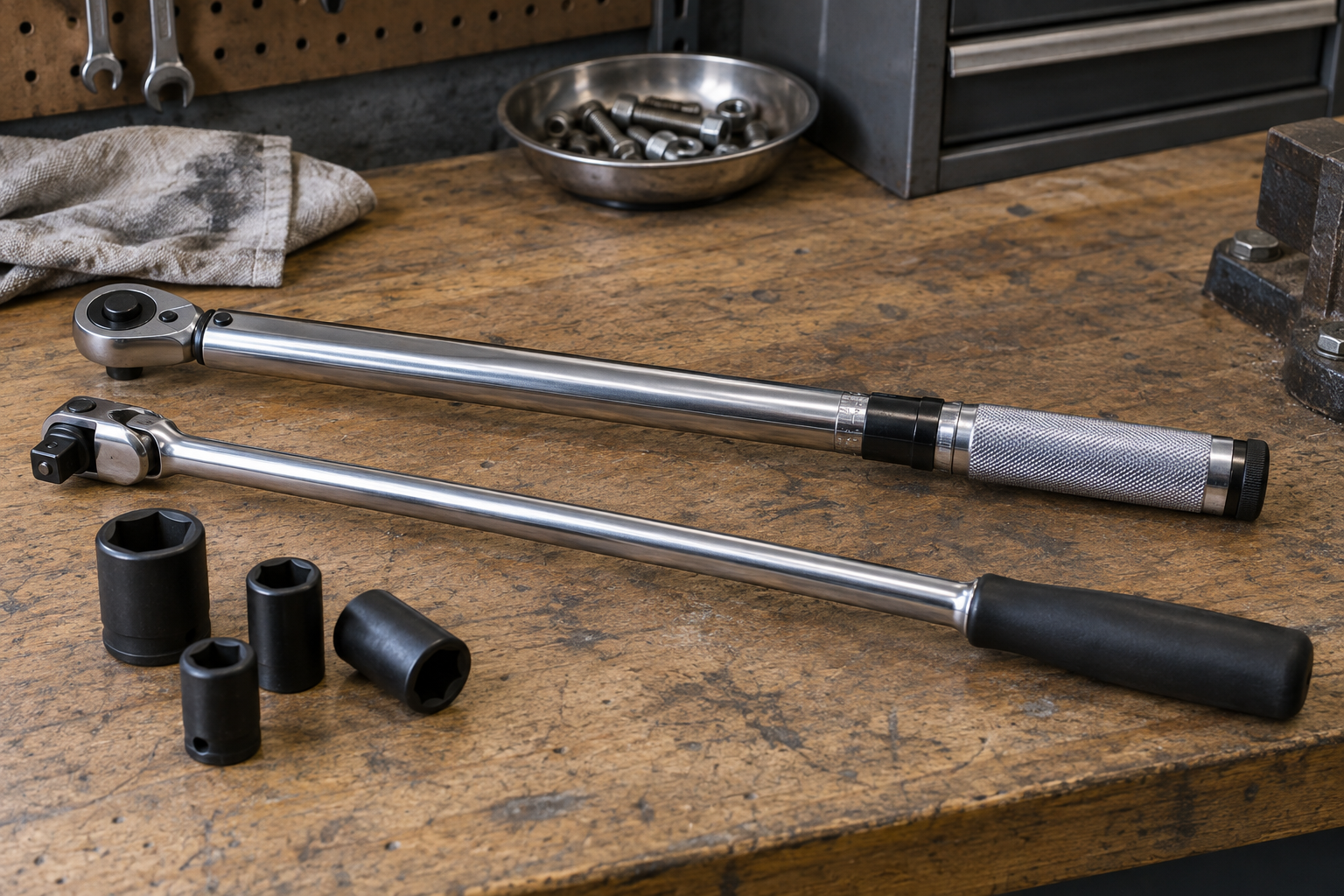
A torque wrench and a breaker bar can look similar: both use a long handle and a socket to turn a fastener. Their jobs are different. Use the breaker bar to loosen stubborn fasteners; use the torque wrench to tighten fasteners to a specified torque. Swapping those roles can damage the tool, the fastener, or the part you’re working on.
As an Amazon Associate we earn from qualifying purchases at no extra cost to you.



Our Top Picks
 LEXIVON Torque Wrench 1/2-Inch Drive Click 10~150 Ft-Lb/13.6~203.51/2"DR. 10-150 FT-LB2.5 x 3 x 18 inches3 PoundsCheck on Amazon
 EPAuto 1/2-inch Drive Click Torque Wrench1/2 Inch Drive (10-150 ft.-lb.)17.4 x 3.3 x 2.6 inches3.5 poundsCheck on Amazon


What each tool does
A breaker bar is a strong, non-ratcheting drive handle made to apply leverage. It has no torque setting and does not tell you how much force you’ve applied. A longer handle makes it easier to turn a tight fastener, but it also makes it easier to apply enough force to break a bolt or round off its head.
A torque wrench measures or limits tightening force so you can reach a specified torque. Common types include click, beam, and digital models. A click wrench signals when you reach its setting; a beam wrench shows torque on a scale; a digital wrench displays a reading and may beep or vibrate. None is meant to be a general-purpose tool for breaking loose stuck fasteners.
Quick comparison
| Task or feature | Breaker bar | Torque wrench |
|---|---|---|
| Best use | Loosening tight fasteners | Tightening to a specified torque |
| Torque control | None; force depends on the user | Set or read torque, depending on type |
| Typical construction | Long handle, sturdy drive head | Measuring or indicating mechanism |
| Suitable for routine loosening? | Yes | No; risk of damaging calibration or mechanism |
| Cost trade-off | Often less expensive and simple | Costs more, and accuracy needs care |
Which tool should loosen a fastener?
Start with a breaker bar when a lug nut, suspension fastener, or other bolt won’t move with a ratchet. Use the correct socket, seat it fully, and keep the bar aligned with the fastener. Pull smoothly rather than jerking; sudden force can make the socket slip or the fastener fail. If the bolt still will not move, penetrating oil, heat where safe, or an impact wrench may be more appropriate than adding a pipe to the handle.
Choose drive size and handle length to suit the work. A 1/2-inch-drive bar is a common choice for automotive fasteners; a 3/8-inch bar can be more manageable in tighter spaces, while larger or exceptionally stubborn hardware may call for 3/4-inch drive. A longer bar provides more leverage but needs more clearance and raises the risk of overloading the fastener. For occasional tire changes, an inexpensive 1/2-inch-drive breaker bar is often enough.
Which tool should tighten a fastener?
Use a torque wrench when the manufacturer specifies torque, especially for wheel lug nuts, engine components, and other safety- or precision-sensitive joints. Check the required value in the vehicle or equipment service information; there is no universal lug-nut torque. Tighten in the specified sequence when one is given. For a wheel, for example, a star pattern helps seat the wheel evenly, but the vehicle’s instructions take priority.
For lug nuts, first snug them with a hand tool, then finish with a torque wrench at the stated setting. Avoid using an impact wrench for the final tightening unless the manufacturer’s procedure explicitly permits it and the tool can control torque reliably. Over-tightening can stretch studs, damage threads, distort parts, or make the next removal difficult. Under-tightening can let a joint loosen. If you do routine vehicle work, a suitable 1/2-inch-drive click torque wrench covers many automotive jobs, provided the required setting falls within its range.
Why not loosen with a torque wrench?
Breaking a tight fastener loose can expose a torque wrench’s internal mechanism to a sharp load beyond its normal measuring range. That can affect accuracy or damage the wrench, even if it still clicks afterward. Some manufacturers allow loosening with particular models, but check the manual rather than assuming. A breaker bar is usually the safer, less costly tool for the job.
Do not use a torque wrench as a substitute for a breaker bar simply because it is already in your hand. If you must loosen a fastener and have no breaker bar, use a properly fitting ratchet or another suitable tool, then verify the torque wrench according to its instructions before relying on it for critical work.
Setting and care matter
Torque is usually specified in newton-metres (N·m) or pound-feet (lb-ft). One lb-ft is about 1.36 N·m, so check the units before setting the wrench. Keep the setting within the wrench’s marked range; a tool used at the very bottom or top of its range may be less suitable than one whose working range centers on the required value. For example, don’t buy a high-range wrench for a small fastener that needs only a few N·m.
With a click wrench, pull steadily on the marked grip area and stop when it clicks. Repeated clicks or continued pressure after the first signal can over-tighten the fastener. Store the wrench as its manual directs; many click types should be returned to their lowest marked setting, not wound below it. Calibration intervals depend on use and manufacturer guidance, but frequent use, drops, or suspected overload are reasons to have accuracy checked.
What to buy for your work
If you only need to change a tire once in a while, a breaker bar is the practical budget choice for loosening, and a torque wrench is worth borrowing or buying if the vehicle specifies a tightening value. A basic, correctly ranged wrench is preferable to guessing by feel on wheel hardware. For regular repairs, keep both tools: they solve different problems and neither is a dependable replacement for the other.
For general home and vehicle maintenance, a 1/2-inch-drive torque wrench and breaker bar make a useful pair, though buying separately lets you choose the right range and handle length. Spend more for durability or measurement features only if the work justifies them. The important point is not brand or price: loosen with a bar built for leverage, and tighten with a wrench suited to the specified torque.