What's inside
As an Amazon Associate I earn from qualifying purchases. This post may contain affiliate links at no extra cost to you.
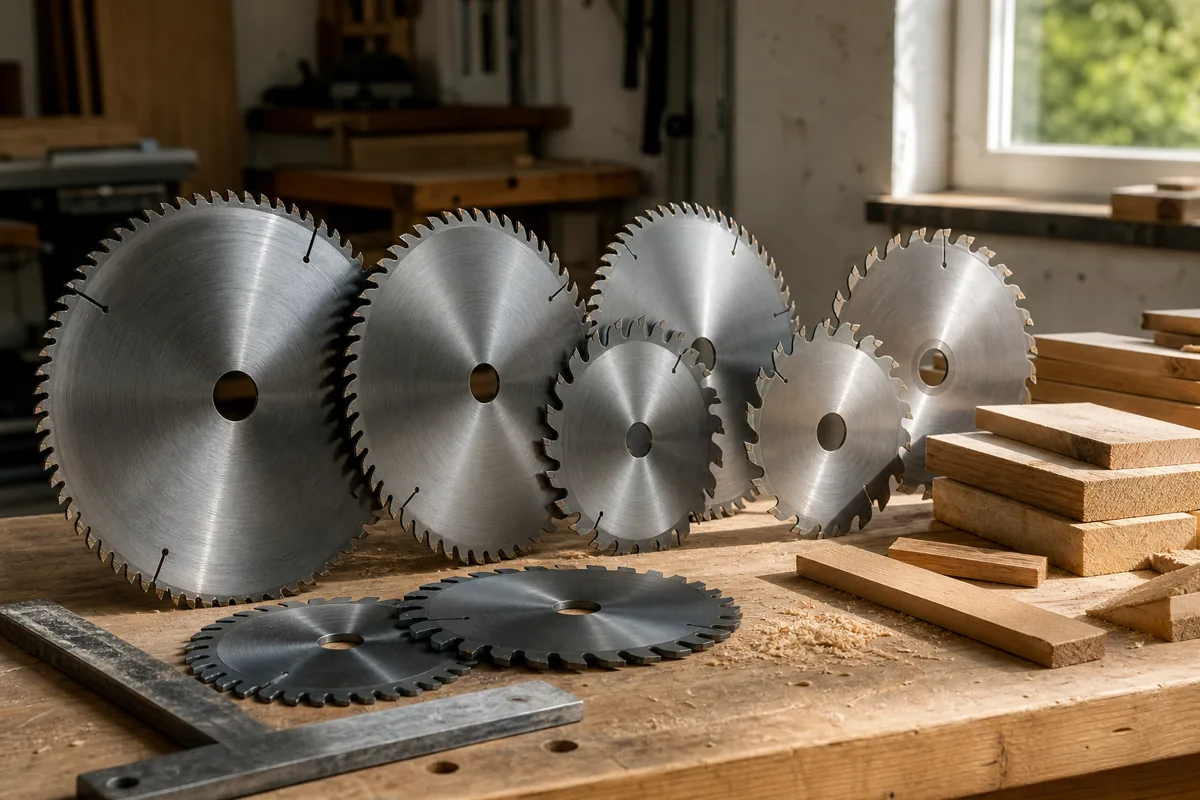
Circular-saw blade tooth count is a useful clue, not a complete measure of quality. Fewer teeth usually mean faster cutting and rougher edges; more teeth usually mean slower cutting and a cleaner finish. But blade geometry, material, saw speed and feed rate all matter. Choose for the material and the cut you need—not by tooth count alone.
What tooth count changes
As a blade turns, each tooth removes a small chip. With fewer teeth sharing the work, each tooth takes a larger bite. That tends to clear sawdust quickly and cut fast, but it can leave torn fibers or a ragged edge. More teeth take smaller bites and make more cuts per rotation, often leaving a smoother edge. They also create more friction and heat, and can bog down if you force the saw.
Tooth count is relative to blade diameter. A 40-tooth blade on a 7¼-inch saw is not equivalent to a 40-tooth blade on a larger saw: the larger blade’s teeth travel farther around its rim. Tooth shape and spacing also matter. Ripping blades have gullets—the spaces between teeth—designed to carry chips out of a cut along the grain. Fine-finish blades commonly use tooth shapes intended to reduce splintering across the grain.
Choose by the cut, not just the material
For rough framing, demolition or quick cuts in dimensional lumber, a low-tooth-count framing blade is often the practical choice. A common 7¼-inch blade has around 24 teeth. It cuts quickly and clears chips well, but it is likely to leave visible tear-out, especially in plywood or veneer. That is acceptable when the edge will be hidden or covered.
For general-purpose work—cutting boards to length, breaking down sheet goods, or doing occasional finish cuts—a 40-tooth blade is a useful middle ground. It is slower than a framing blade but usually leaves a better edge. For exposed crosscuts, cabinets or veneered panels, a 60-to- or 80-tooth blade may reduce splintering. It still cannot guarantee a perfect edge: a dull blade, unsupported panel or poor cutting technique can spoil the finish.
| Typical 7¼-inch blade | Best fit | What to expect | Main trade-off |
|---|---|---|---|
| 24 teeth | Fast cuts, framing, rough ripping | Quick feed and aggressive chip removal | More tear-out and a rougher edge |
| 40 teeth | General construction and mixed cuts | Reasonable speed with a cleaner edge | Not as fast as a framing blade or as fine as a finish blade |
| 60–80 teeth | Fine crosscuts and surfaced sheet goods | More teeth working through the cut | Slower; can burn or bind if pushed too hard |
Material and blade type matter
For plywood, melamine and veneered panels, a higher tooth count can help limit chip-out on the top face. A sacrificial backing board, a sharp blade and a steady feed make a difference too. If both faces need to look clean, check the saw’s cut direction and support the panel; many circular saws cut on the upstroke, which can leave the top face more prone to splintering.
Hardwood is not automatically a reason to choose more teeth. A coarse blade can rip thick stock efficiently, while a finer blade can produce a neater crosscut. The cut direction matters: ripping follows the grain; crosscutting goes across it. If you regularly do both, two purpose-built blades can work better than asking one blade to handle every job. For occasional mixed work, a 7¼-inch 40-tooth general-purpose blade is often a sensible starting point.
Metal and plastic need blades made for those materials, not just a higher tooth count. A wood blade can grab, overheat or damage the workpiece. Check the blade maker’s material rating and the saw’s speed requirements before cutting.
When more teeth can work against you
A high-tooth-count blade can cut poorly if the saw is fed too quickly. The motor slows, the blade heats up, and the cut may scorch the wood. In thick stock, a fine blade may also struggle to clear chips, particularly when ripping. Ease the feed rate and let the blade do the work. If the motor labors, stop rather than forcing it; binding can damage the work or cause kickback.
Too few teeth can be a problem in thin, delicate sheet goods, where the large bites may tear material out. Too many teeth can be inefficient for rough work and make a cut take longer without improving an edge that will be hidden. A cheaper framing blade is perfectly adequate for studs, rough cuts and a one-off project where appearance does not matter.
Buying and using the blade
Match the blade diameter, arbor size and maximum speed to the saw. A standard 7¼-inch saw commonly takes a blade with a ⅝-inch arbor, but check the tool manual rather than assuming. Confirm that the blade is rated for the material and type of cut. Carbide-tipped blades cost more than basic steel blades but generally stay sharp longer; for occasional rough work, the least expensive compatible blade may be enough.
Keep the blade sharp. A dull blade often needs more force, runs hotter and leaves a worse finish than a sharp blade with a less aggressive tooth count. For exposed trim or cabinetry, consider a 60-tooth fine-finish blade. For framing or fast rough cuts, a 24-tooth framing blade is usually the better fit.
Before cutting, secure the work, support offcuts so they cannot pinch the blade, and set the blade depth just beyond the material—about ¼ inch is a common starting point. Wear eye and hearing protection, keep hands clear of the cut line, and wait for the blade to stop before setting the saw down. Tooth count helps choose a blade; safe setup and a controlled feed determine how well it performs.