What's inside
- The best rolling tool cabinet depends on what you store: choose the Husky Heavy-Duty 52-inch for a balanced home-shop setup, the Milwaukee 46-inch Steel Storage Chest and Cabinet for a compact pro-grade footprint, or a 72-inch professional cabinet when drawer capacity and daily use matter most.
- Rolling tool cabinets compared
- Which cabinet suits your workshop?
- Check fit, load, and mobility before buying
- Build quality and ownership: what wears first
- Bottom line
- Related Guides
As an Amazon Associate I earn from qualifying purchases. This post may contain affiliate links at no extra cost to you.
Our Top Picks
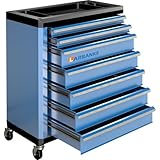
 LARBANKE 7-Drawer Rolling Tool Chest with Wheels7 Drawer Tool Chest24.6 x 13 x 28.6 inches57.47 poundsCheck on Amazon

The best rolling tool cabinet depends on what you store: choose the Husky Heavy-Duty 52-inch for a balanced home-shop setup, the Milwaukee 46-inch Steel Storage Chest and Cabinet for a compact pro-grade footprint, or a 72-inch professional cabinet when drawer capacity and daily use matter most.
Before buying, compare usable drawer space—not just the cabinet’s outside width—along with rated drawer loads, total weight, and the route the loaded cabinet must travel. Brand names and model specifications vary by year and configuration, so confirm the exact dimensions and ratings on the current product label or manufacturer listing.
Rolling tool cabinets compared
The figures below are representative dimensions for common configurations, not a guarantee that every cabinet in a product family has the same layout. Drawer widths are approximate internal widths; published ratings and included accessories can vary by model. Verify them before purchase, particularly for heavy tools.
As an Amazon Associate we earn from qualifying purchases at no extra cost to you.



| Option | Approx. overall width | Typical storage layout | Drawer-load rating | Best fit |
|---|---|---|---|---|
| Husky Heavy-Duty 52-inch rolling cabinet | About 52 in. | Roughly 10 drawers; wide drawers near 47 in. | Often listed around 120 lb per drawer; confirm model | Home shops needing broad, versatile storage |
| Milwaukee 46-inch steel tool chest and cabinet | About 46 in. | Multiple drawers, commonly around 22 in. deep | Check the exact cabinet’s drawer and overall ratings | Smaller shops and users prioritizing a sturdy footprint |
| 72-inch professional rolling cabinet, such as a Snap-on or Mac Tools configuration | About 72 in. | Wide, deep drawers; layouts vary substantially | Model-specific; compare individual drawer ratings | High-volume professional storage and frequent use |
| Budget 26-inch steel rolling cabinet | About 26 in. | Usually 4–7 drawers; narrow drawer interiors | Often lower than heavy-duty models; check label | Starter sets, small tool collections, tight budgets |
Overall cabinet capacity is difficult to compare reliably: some makers publish a volume, while others provide drawer dimensions or load ratings instead. Treat drawer width, depth, height, and load limit as the practical measures. A cabinet’s own weight is also model-specific; loaded weight can quickly exceed what one person can safely move.
Which cabinet suits your workshop?
Best all-rounder for a home workshop: Husky Heavy-Duty 52-inch
A 52-inch cabinet can hold a mixed collection of hand tools, sockets, and power-tool accessories without demanding the floor space of a full professional bank. Its wide drawers make it easier to organize long wrenches and socket rails. Check the usable drawer depth and height against your largest tools: a drawer that is wide enough may still be too shallow for a drill or bulky case.
This is a sensible choice when the cabinet will move occasionally across a smooth garage floor. If it must cross thresholds or rough concrete regularly, prioritize larger casters and a verified loaded-weight rating over extra drawers.
Best for a tighter footprint: Milwaukee 46-inch steel cabinet
A 46-inch cabinet is easier to fit along a garage wall or between a workbench and a vehicle. Milwaukee’s steel storage line is worth comparing when you want a more compact cabinet but still need substantial drawer storage. Confirm whether the quoted dimensions include handles or a side tray; accessories can add several inches to the width and interfere with a narrow aisle.
Choose this size if your tools are mostly hand tools and compact cordless equipment. For larger power tools, measure the interior drawer openings, not the exterior cabinet, and check that the cabinet’s top surface remains usable once any chest or accessories are installed.
Best for daily professional use: a 72-inch cabinet from a professional tool line
Snap-on and Mac Tools offer professional rolling storage in wide, configurable formats. A 72-inch cabinet can separate tools by job or trade and reduce stacking, but it is a major investment in floor space, loaded weight, and cost. Compare the exact drawer ratings and slide construction: two cabinets with similar exterior dimensions may differ substantially in how they handle heavy contents.
For a technician who opens drawers throughout the workday, smooth slides, secure latches, and replaceable casters matter more than a large headline capacity. For occasional home use, that premium may be hard to justify.
Best low-cost starting point: a 26-inch steel cabinet
A compact budget cabinet works for a first tool collection, a dedicated finishing station, or a second cabinet for frequently used tools. Its trade-off is narrow drawers and less room for bulky equipment. Avoid loading a small drawer with dense metal tools simply because they fit; modest drawer ratings and small casters can make a compact cabinet surprisingly difficult to move.
Check fit, load, and mobility before buying
- Measure the route: Record the narrowest doorway, aisle, and turn between delivery point and parking spot. Compare those measurements with the cabinet’s full width, including handles and side-mounted accessories.
- Measure your largest tools: Allow clearance for drawer slides and the opening lip. A tool that fits the cabinet’s exterior dimensions may not pass through a drawer opening.
- Estimate loaded weight: Add the cabinet’s empty weight to the tools you plan to store. If the manufacturer gives only drawer ratings, do not assume every drawer can be loaded to its maximum at once; the cabinet’s total rating may be lower.
- Inspect the floor: Small casters roll well on smooth concrete but struggle over cracks, debris, and thresholds. Larger casters generally handle obstacles better, but check the stated capacity and whether the wheels lock.
- Plan access: Leave room to open drawers fully and stand beside them. A wide cabinet is less useful if it blocks a door or forces drawers to open into a vehicle.
For example, a cabinet with ten drawers rated at 100 lb each does not automatically support 1,000 lb of tools. The cabinet frame, slides, casters, and overall load limit may impose a lower ceiling. Treat each published rating as a limit for its stated component, not permission to load every drawer to capacity simultaneously.
Build quality and ownership: what wears first
Drawer slides and casters take the most routine strain. Heavy tools concentrated at the front of a drawer can cause binding or sagging, while overloading a small wheel increases wear and makes the cabinet harder to steer. Put dense items in lower drawers, distribute weight across the cabinet, and keep top drawers lighter to reduce the risk of tipping.
Dust and metal shavings can collect in slides and around caster swivels. Wipe them away periodically, and use lubricant only if the manufacturer recommends it; some slide types are designed to run with little or no added oil. Check wheel locks, drawer latches, and fasteners occasionally, especially if the cabinet is moved often. A drawer liner helps prevent tools from sliding, but it does not increase the drawer’s weight rating.
Steel thickness alone does not settle build quality. Look at how the drawer fronts and frame are reinforced, how the slides are attached, whether loaded drawers latch securely, and whether replacement keys, casters, or drawer parts are available. A thinner cabinet used on a level floor for light tools can serve well; a heavily loaded unit pushed across a rough shop floor needs more robust hardware.
Bottom line
For most home workshops, start with a 46- to 52-inch cabinet and verify the actual drawer dimensions and ratings. Choose a compact budget cabinet for light, limited storage, or a wide professional cabinet if you need deep capacity and will use it daily. The best rolling tool cabinet is the one that fits your tools and workshop route with a safe load margin—not simply the one with the most drawers or the widest top.