What's inside
As an Amazon Associate I earn from qualifying purchases. This post may contain affiliate links at no extra cost to you.
Our Top Picks


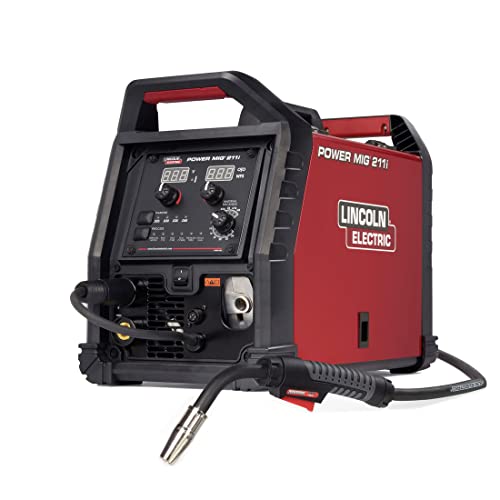

Best Lincoln Arc Welders for Home and Shop Use
For most home users who want a portable stick welder for repairs, the Lincoln Electric POWER MIG 215 MPi is the most versatile choice; for a dedicated, simpler stick setup, choose the AC-only Lincoln AC-225, while frequent shop work calls for a dual-voltage inverter such as the Invertec V155-S. The right Lincoln arc welder depends chiefly on your available power, the thickness of the steel you weld, and how long you need to weld before cooling down.
These machines are not interchangeable. The AC-225 is a straightforward 230-volt transformer welder, the V155-S is a compact DC stick inverter, and the 215 MPi is a multiprocess machine that includes stick welding alongside MIG and TIG capability. Lincoln product specifications and included accessories can vary by configuration and market, so check the specific machine’s manual and package details before buying.
As an Amazon Associate we earn from qualifying purchases at no extra cost to you.



Lincoln arc welder comparison
| Model | Input power | Stick output range | Duty cycle | Portability | Electrodes and practical use |
|---|---|---|---|---|---|
| Lincoln Electric AC-225 | 230 V AC, single phase | 40–225 A AC | 20% at 225 A | Heavy, stationary transformer design; roughly 100 lb | Commonly used with 1/8-in. E6011 and E6013; suitable electrodes depend on amperage and the specific rod |
| Lincoln Electric Invertec V155-S | 120 or 230 V, single phase | About 10–155 A DC | At 155 A, approximately 25% on 120 V or 35% on 230 V | Compact inverter; roughly 15 lb | Designed for common stick electrodes up to about 5/32 in.; 1/8-in. rods are a practical everyday size |
| Lincoln Electric POWER MIG 215 MPi | 120 or 230 V, single phase | Stick: about 20–200 A DC | Stick duty cycle varies with input and output; verify the manual for the exact configuration | Portable for a multiprocess machine, but heavier and bulkier than a stick-only inverter | Supports common stick rods, including 1/8-in. sizes; the manual’s electrode and output limits govern larger rods |
Amperage ranges and duty-cycle figures are useful only when read together. A duty cycle of 20% means the welder can operate for two minutes out of a ten-minute period at the stated output, followed by eight minutes of cooling. Lowering the amperage usually permits longer operating time. Input voltage also matters: a dual-voltage welder may run at reduced output or duty cycle on a 120-volt circuit compared with a suitable 230-volt supply.
Choose by your work, power, and space
- Occasional repairs near a 230-volt outlet: The AC-225 is a durable, uncomplicated option for gates, brackets, and general mild-steel repairs. Its high weight makes it a poor choice if you need to carry the welder between locations.
- Limited space or work in multiple locations: The V155-S is the more convenient stick-only pick. Its inverter design is far easier to transport, and DC output can make starting and maintaining an arc more manageable than with a basic AC transformer. Confirm that the available circuit can support the intended setting.
- One machine for several processes: The 215 MPi makes sense if you expect to use stick welding as well as MIG or TIG. It costs more than a single-purpose machine and needs room for its accessories, but its flexibility can avoid buying separate welders later.
- Longer welds or repeated shop jobs: Prioritize the duty cycle at the amperage you actually use, not just the machine’s maximum output. A machine with higher output can still require frequent pauses when run near its limit.
For a beginner, a stable 120-volt outlet can be convenient, but it does not make every job a 120-volt job. Thicker stock, larger electrodes, and higher amperage can require a properly installed 230-volt circuit. Follow the welder’s manual and local electrical requirements; do not substitute an undersized extension cord or breaker for a suitable circuit.
Electrode size: match the rod to the machine and the job
Electrode diameter is a practical limit on what a small machine can weld comfortably. A 3/32-inch rod generally needs less current than a 1/8-inch rod, while a 5/32-inch rod requires more still. Exact current depends on electrode classification, position, joint, and manufacturer guidance. Use the rod package’s amperage range as a starting point, then consult the welder manual.
For example, if a repair calls for a 1/8-inch electrode whose package recommends roughly 90–140 A, a 155-amp inverter has useful headroom on a suitable supply. On a 120-volt circuit, however, its available output and duty cycle may be lower, so the upper end may not be practical. The AC-225 can supply ample current for many 1/8-inch rods, but it uses AC; confirm that the chosen electrode is rated for AC. Some rods are intended for DC only.
Do not choose an electrode by diameter alone. E6011 is often selected when a forgiving arc and work on less-than-perfect steel are useful; E6013 is commonly used for general-purpose work and a smoother-looking bead. Neither replaces cleaning, correct joint preparation, or proper settings. Remove paint, oil, rust, and coatings near the weld, and never weld material with an unknown or hazardous coating.
What ownership is like
Stick welding has relatively few machine-side consumables, but electrodes absorb moisture and can produce erratic arcs if stored poorly. Keep rods dry according to their manufacturer’s instructions. The ground clamp and electrode holder are wear items: inspect their connections, cable insulation, and jaws, and replace damaged parts rather than continuing with a loose or overheated connection.
Dust and metal debris can also shorten an inverter’s life by obstructing cooling airflow. Keep vents clear, store the machine dry, and follow the manual’s cleaning instructions. On a transformer machine such as the AC-225, the trade-off is different: it is mechanically simple, but its weight makes storage and movement a real part of ownership. A cart can help, provided the machine remains secure and its leads are not strained.
One common mistake is trying to compensate for poor fit-up or a dirty joint by increasing amperage. That can cause excessive spatter, burn-through, or a weak joint hidden under a large bead. Fit the parts closely, use the electrode manufacturer’s settings, and make a short practice weld on matching scrap before working on the actual piece. Welding also requires suitable eye and skin protection, ventilation, and fire precautions; keep flammable materials away and follow the machine’s safety instructions.
Bottom line
Choose the AC-225 if you want a simple, high-output AC stick welder for a fixed 230-volt workspace and can accommodate its weight. Choose the V155-S for portable, stick-focused DC welding, especially when you need a compact machine for occasional repairs or job-site work. Choose the 215 MPi if stick welding is only one part of a broader home or shop setup. Before purchasing any Lincoln arc welder, compare its output and duty cycle at your intended input voltage, check that it supports the electrodes you plan to use, and verify that your circuit is appropriate.