
What's inside
- Milwaukee Electric Ratchet Lineup at a Glance
- Head Dimensions and Access: The Real Deciding Factor
- Torque vs. Speed: What You Actually Get
- Battery System and Runtime: A Worked Calculation
- Decision Matrix: Which Milwaukee Electric Ratchet Fits Your Work?
- Durability and Ownership Realities
- Bottom Line for Hardwaretoolshop Readers
- FAQ
As an Amazon Associate I earn from qualifying purchases. This post may contain affiliate links at no extra cost to you.
For most automotive and general mechanical work, the Milwaukee M12 FUEL 3/8″ Ratchet (2558-20) is the best-balanced milwaukee electric ratchet, but you should choose the 1/4″ model for tight small-fastener work, an extended-reach high-speed model for deep engine bays, and an M18 FUEL model only if you regularly need 1/2″ drive or extra leverage on larger vehicles.
As an Amazon Associate we earn from qualifying purchases at no extra cost to you.


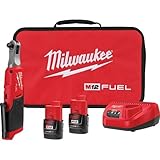
Our Top Picks
 Milwaukee 2457-20 M12 Cordless 3/8" Sub-Compact 35 ft-Lbs3/8"9.47 x 2.94 x 1.76 inches1 PoundsCheck on Amazon
Milwaukee Electric Ratchet Lineup at a Glance
Milwaukee’s cordless ratchets split across two battery platforms, M12 and M18, and three drive sizes. Standard M12 ratchets are compact and affordable, M12 FUEL models add brushless motors and more torque, and extended-reach and INSIDER models change the head design for access. M18 FUEL ratchets are longer and more powerful but heavier.
| Model | Drive Size | Max Torque | No-Load Speed | Overall Length | Head Profile Height | Tool Weight (bare) | Platform |
|---|---|---|---|---|---|---|---|
| M12 Ratchet 2557-20 (non-FUEL) | 3/8″ | 35 ft-lbs | 250 RPM | 10.75″ | 1.08″ | 1.9 lbs | M12 |
| M12 FUEL Ratchet 2558-20 | 3/8″ | 55 ft-lbs | 200 RPM | 11.0″ | 1.05″ | 2.1 lbs | M12 FUEL |
| M12 FUEL Ratchet 2559-20 | 1/4″ | 40 ft-lbs | 300 RPM | 11.0″ | 0.98″ | 2.0 lbs | M12 FUEL |
| M12 FUEL High Speed Extended Reach 2560-20 | 3/8″ | 35 ft-lbs | 450 RPM | 15.0″ | 1.05″ | 2.6 lbs | M12 FUEL |
| M12 FUEL INSIDER Box Ratchet 3050-20 | 1/4″ & 3/8″ pass-through | 60 ft-lbs | 350 RPM | 13.5″ | 0.85″ (box end) | 2.2 lbs | M12 FUEL |
| M18 FUEL Ratchet 2683-20 | 3/8″ | 75 ft-lbs | 200 RPM | 12.8″ | 1.20″ | 3.4 lbs | M18 FUEL |
| M18 FUEL Ratchet 2684-20 | 1/2″ | 85 ft-lbs | 200 RPM | 12.8″ | 1.30″ | 3.5 lbs | M18 FUEL |
Note: Torque figures are Milwaukee’s rated maximum breakaway/fastening torque for the ratchet mechanism, not impact wrench nut-busting torque. All models have a paddle/trigger with variable speed and require hand-breakaway for initial fastener loosening if torque exceeds the rating.
Head Dimensions and Access: The Real Deciding Factor
An electric ratchet rarely fails because it lacks torque. It fails to be useful because the head does not fit.
Standard head vs. extended reach vs. INSIDER
- Standard M12 FUEL (2558/2559): 11-inch overall length with a conventional ratchet head. The yoke housing is about 1.0 to 1.05 inches thick. Best for under-dash, brake, and general repair where you need to maneuver in a tight arc but do not need extra reach.
- Extended Reach High Speed (2560 and 2567): Adds 4 inches of neck length (15 inches total) with the same head thickness. That length lets you reach intake manifold bolts, firewall-mounted accessories, and deep wheel wells without stacking extensions that add wobble. The high-speed gearing (450 RPM vs 200 RPM) cuts rundown time by more than half.
- INSIDER Box Ratchet (3050): Replaces the square drive anvil with a low-profile pass-through box head (0.85-inch thick). It fits over long threaded rod, brake lines, and strut studs where a socket plus anvil would be too tall. It accepts 1/4″ and 3/8″ hex and sockets via interchangeable inserts, which changes the decision if you work on struts, faucets, or threaded fasteners daily.
If you already own a compact 3/8″ cordless ratchet, the most meaningful upgrade for access is not more torque but a different head form factor. An extended reach or INSIDER model solves clearance problems a standard ratchet cannot, even with a wobble extension.
Torque vs. Speed: What You Actually Get
All Milwaukee electric ratchets are ratchets first, not impact wrenches. They deliver continuous rotational torque like a hand ratchet with a motor assist.
- 35 to 40 ft-lbs (M12 non-FUEL, High Speed Extended Reach, 1/4″ FUEL): Enough to run down 8mm-13mm fasteners, interior trim, valve covers, and small engine bolts after you break them loose by hand. You will still need a hand ratchet or breaker bar for the initial break.
- 55 to 60 ft-lbs (M12 FUEL 3/8″ 2558, INSIDER 3050): The sweet spot for automotive. Can finish fastening many 10mm-15mm bolts to snug and handle light suspension and alternator work, but still stalls before achieving final torque spec on critical fasteners. Always finish with a torque wrench.
- 75 to 85 ft-lbs (M18 FUEL 2683/2684): Useful for larger chassis, truck, and equipment fasteners up to about 18mm. The tradeoff is weight and length. At 3.4 to 3.5 lbs bare plus a 1.5 to 3.0 Ah M18 battery, the tool is noticeably heavier overhead than an M12.
Speed matters for productivity. At 200 RPM, a M12 FUEL 3/8″ takes about 15 seconds to run a 50mm long M8 bolt fully in. The 450 RPM extended reach model does it in about 6-7 seconds. If you run dozens of fasteners per job, high speed saves real time. If you need more control to avoid cross-threading in aluminum, the slower 200 RPM models give better feel.
Battery System and Runtime: A Worked Calculation
Choosing between M12 and M18 is mostly a battery ecosystem decision.
M12 batteries are lighter and cheaper, and M12 FUEL ratchets are more compact. M18 batteries provide higher capacity but add bulk where you hold the tool. Most shops already standardize on one system for drills, impacts, and lights.
How long will it run?
Milwaukee does not publish minute-by-minute runtime because fastener length and load vary, but you can estimate from battery energy:
- M12 REDLITHIUM CP 2.0 Ah = 12V x 2.0 Ah = 24 Wh
- M12 REDLITHIUM XC 4.0 Ah = 48 Wh
- M18 REDLITHIUM CP 2.0 Ah = 36 Wh, XC 5.0 Ah = 90 Wh
A M12 FUEL ratchet draws roughly 120-150W under moderate load. In practice:
Example: With a 2.0 Ah M12 CP battery (24 Wh) at ~130W average during rundown, theoretical continuous motor-on time is 24 / 130 = 0.18 hours, or about 11 minutes. Real use is intermittent. If each fastener takes 3 seconds of motor time, that is about 220 fasteners per charge. An XC 4.0 Ah doubles that to roughly 400-450 fasteners.
For a DIY user doing one brake job (30-40 fasteners), a single 2.0 Ah is plenty. For a flat-rate technician, a 4.0 Ah or two 2.0 Ah batteries in rotation avoids mid-job charging. M18 models with 3.0-5.0 Ah batteries will run longer overall but the energy-to-weight ratio is worse for overhead work.
FUEL brushless models are more efficient than brushed M12 2556/2557 models, typically delivering 15-20% more fasteners per amp-hour and less heat during extended use.
Decision Matrix: Which Milwaukee Electric Ratchet Fits Your Work?
| Your Situation | Best Fit | Why |
|---|---|---|
| General auto DIY, limited space, already on M12 | M12 FUEL 3/8″ 2558-20 | 55 ft-lbs covers most car tasks, 11″ length fits engine bays, uses light M12 batteries you likely own |
| Small engines, motorcycles, electronics, 6mm-10mm fasteners | M12 FUEL 1/4″ 2559-20 | Lower profile head (0.98″), finer control, lighter sockets reduce risk of over-torque on small bolts |
| Dealership/engine bay work, deep bolts, need speed | M12 FUEL High Speed Extended Reach 2560-20 (3/8″) or 2567-20 (1/4″) | 15″ reach eliminates extensions, 450 RPM runs long bolts quickly, still light enough for one-handed use |
| Struts, threaded rod, plumbing, tight vertical studs | M12 FUEL INSIDER 3050-20 | Pass-through box head is 20% thinner than square drive, works on long studs where sockets bottom out |
| Heavy truck, farm equipment, 16mm+ fasteners, you are on M18 | M18 FUEL 3/8″ 2683-20 or 1/2″ 2684-20 | 75-85 ft-lbs provides more working torque, 1/2″ drive avoids adapter stack, leverages larger M18 batteries |
| Budget-first, occasional use, light duty | M12 non-FUEL 2557-20 (3/8″) or 2556-20 (1/4″) | Lower market price, 35 ft-lbs sufficient for trim and light mechanical, brushed motor is serviceable but louder and less efficient |
General market price ranges in 2026: M12 non-FUEL bare tools typically sit in the lower tier, M12 FUEL standard ratchets in the mid tier, and extended-reach/INSIDER and M18 FUEL models in the upper mid to higher tier. Kits with two M12 2.0 Ah batteries and a charger cost notably more than bare tools, so buying bare if you already own M12 batteries often gives better value.
Durability and Ownership Realities
Electric ratchets live hard lives with side loading and dirt exposure. Understanding what wears helps you buy and maintain smarter.
- What wears first: The directional switch and the yoke/anvil assembly. Grit entering the head accelerates wear. The rubber overmold on the head will scuff and the retaining ring/detent for sockets loosens over time, especially with heavy 1/2″ sockets on adapters.
- Common mistake: Using the ratchet as a breaker bar. All Milwaukee electric ratchets have a manual breakaway design but the mechanism is not built to repeatedly break loose 100+ ft-lb fasteners. Break loose with a hand tool, then use the motor to spin. Side-loading the head to gain leverage bends the yoke and voids the benefit of the tool.
- Cleaning: Blow out the head with low-pressure air after dusty jobs, wipe the neck, and keep the battery contacts clean. Do not submerge or pressure wash. A drop of air-tool oil is not needed; the head is greased internally. If the head clicks or slips under light load, the internal pawl is worn and needs service.
- Consumables: Batteries are the main consumable. Expect 300-500 full charge cycles before noticeable capacity loss on REDLITHIUM packs. Keep batteries at 40-60% for storage and avoid leaving them on chargers for days in high heat, which degrades cells faster than frequent use.
- Socket choice: Chrome sockets are fine for ratchet use. Avoid using impact-rated thick-wall sockets on M12 heads for long periods because the extra mass increases inertia and can accelerate anvil wear if the tool stalls often.
Bottom Line for Hardwaretoolshop Readers
If you can only buy one milwaukee electric ratchet, the M12 FUEL 3/8″ 2558 is the most versatile for automotive and general repair in 2026. Add an extended-reach high-speed version if reach and rundown speed limit your productivity, choose the INSIDER if pass-through access is your recurring bottleneck, and move to M18 FUEL only when you consistently need 1/2″ drive and higher working torque on larger equipment.
FAQ
Can a Milwaukee electric ratchet replace an impact wrench?
No. Even the M18 FUEL ratchet at 75-85 ft-lbs is far below a mid-torque impact wrench. Ratchets are for speed and access in tight spaces after breaking fasteners loose, not for breaking loose rusted or highly torqued nuts.
Do I need FUEL or is the standard M12 ratchet enough?
The standard M12 ratchet (2556/2557) is adequate for light DIY and saves money, but the FUEL models offer brushless efficiency, higher torque, and better sealed electronics. For frequent use, FUEL pays back in battery life and durability.
Is the 1/4″ or 3/8″ drive more useful?
3/8″ is more versatile because it covers 10mm-19mm socket sizes most cars use, and you can adapt down to 1/4″ with a small adapter when needed. Choose 1/4″ only if your work is dominated by small fasteners where a bulky 3/8″ socket risks contact with surrounding parts.