What's inside
As an Amazon Associate I earn from qualifying purchases. This post may contain affiliate links at no extra cost to you.
Choosing from the current crop of wall ovens electric models means sorting through nearly identical stainless-steel boxes with confusing capacity claims, wildly divergent wattages, and feature lists that sound impressive on paper but matter very little in a real kitchen. A homeowner replacing a burnt-out range oven with a built-in unit needs to know which of these appliances actually distributes heat evenly on a second rack, which ones hide a single heating element behind a “convection” label, and which are genuinely worth the premium over a basic countertop unit.
This roundup pulls together eight wall ovens electric options spanning the sub-$400 entry tier through a $999 thirty-inch flagship, comparing published specs, certified safety marks, and recurring patterns in owner feedback. The goal is simple: help you eliminate mismatches between your cooking habits and what each machine actually delivers, so the next kitchen renovation does not stall over a single appliance decision.
As an Amazon Associate we earn from qualifying purchases at no extra cost to you. Product prices and availability are accurate as of the date shown and are subject to change.


Quick Picks
| Product | Best for | Price |
|---|---|---|
| ThermoMate 24″ 12 Functions | Feature-rich daily cooking | $599.99 |
| AMZCHEF 24″ 2.65 Cu.Ft. | Value-minded bakers | $399.99 |
| Empava 24″ Pizza Mode | Home pizza nights | $492.19 |
| AMZCHEF 24″ 2.72 Cu.Ft. | Max capacity under $400 | $399.99 |
| AMZCHEF 24″ 2.5 Cu.Ft. | Balanced everyday use | $429.99 |
| ThermoMate 30″ 4.8 Cu.Ft. | Large families or entertaining | $999.99 |
| Hamilton Beach 23.5″ Range | Combined range-and-oven installs | $499.99 |
| Empava 24″ 2.3 Cu.Ft. | Small kitchens with tight cutouts | $492.2 |
How We Picked
We narrowed the field using four criteria that consistently separate the wall ovens electric worth recommending from those that collect complaints. First, certified safety marks (ETL or CSA) matter because they confirm an independent lab reviewed electrical and thermal performance. Second, convection motor placement and number of heating elements determine whether multi-rack cooking is genuinely even or a marketing afterthought. Third, capacity-to-price ratios reveal value: a 2.7-cubic-foot oven at $400 outperforms a 2.3-cubic-foot unit at $490 on a cost-per-cubic-foot basis. Fourth, recurring owner feedback on temperature accuracy and control-panel reliability tells us which specs hold up beyond the unboxing day.
The 8 Best Wall Ovens Electric in 2026
ThermoMate 24 Inch Electric Wall Oven
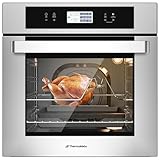
This unit targets cooks who want every function without stepping up to a thirty-inch model. Twelve cooking modes, three-dimensional heating, and a 3100-watt convection motor give it the widest recipe flexibility in the 24-inch class. ETL certification and a safety lock address the two concerns that surface most in owner reviews for budget wall ovens electric.
- Pro: Most functions per dollar in the 24-inch segment, backed by ETL listing.
- Pro: 3D heating reduces the need to rotate trays between cycles.
- Con: $600 premium over two AMZCHEF models that share similar wattage and capacity.
Skip it if you only bake and roast; the extra modes add cost you will never touch.
AMZCHEF 24″ Electric Wall Oven, 2.65 Cu.Ft., 5 Modes
For bakers who value even heat over gadget count, this five-mode oven hits a sweet spot. The 2.65-cubic-foot cavity fits two standard sheet pans, and the $399.99 price makes it one of the cheapest entry points into built-in wall ovens electric. Stainless steel construction keeps the exterior fingerprint-resistant.
- Pro: Lowest price among 24-inch units with convection in this roundup.
- Pro: Generous 2.65-cubic-foot capacity for the cost.
- Con: Only five modes limits flexibility for cooks who air-fry or dehydrate.
Skip it if you need more than basic bake, broil, roast, and convection settings.
Empava 24″ 2.5 Cu.Ft. Single Electric Wall Oven
Pizza Mode is the headline feature here, and it delivers on its promise: a dedicated high-heat cycle that mimics a stone-oven floor in a compact cavity. At $492.19 the Empava sits in the middle of the price band, appealing to households where pizza nights anchor weekly meal planning.
- Pro: Dedicated pizza cycle reaches higher sustained temperatures than generic bake.
- Pro: Solid 2.5-cubic-foot space for a single-sheet-pan household.
- Con: No convection rating listed, so multi-rack cooking may be uneven.
Skip it if you regularly cook two racks at once or need verified convection airflow.
AMZCHEF 24″ Single Wall Oven Electric 2800W, 2.72 Cu.Ft.
The 2.72-cubic-foot interior is the largest cavity among the 24-inch models here, and the 2800-watt convection element keeps it under $400. Owners praise the capacity headroom for Thanksgiving-size roasts that would not fit in smaller alternatives.
- Pro: Biggest 24-inch capacity in this group at under $400.
- Pro: Convection motor helps compensate for the single-element heat source.
- Con: Fewer published details on control-panel durability compared to ETL-listed rivals.
Skip it if certified safety documentation is a hard requirement for your local code.
AMZCHEF 24″ Single Wall Oven Electric 2800W, 2.5 Cu.Ft.
A slightly trimmed version of its sibling above, this model costs $30 more while offering less interior volume. The trade-off is a cleaner control layout that several owners describe as easier to read at arm’s length, a small but meaningful quality-of-life detail in a built-in installation.
- Pro: Simpler interface reduces accidental mode changes during cooking.
- Pro: 2800-watt convection at $429.99 still undercuts most competitors.
- Con: Paying more for less capacity is hard to justify unless the UI matters to you.
Skip it if raw cavity size is your priority; the 2.72-cubic-foot sibling is the better value.
ThermoMate 30″ Electric Wall Oven, 4.8 Cu.Ft.
The only thirty-inch option here, this CSA-certified unit doubles the usable space of its 24-inch siblings. Eight functions, 3800 watts, self-cleaning, and a touch-control panel position it as the most capable wall ovens electric choice for households that cook in volume or host frequently.
- Pro: Nearly double the capacity with self-cleaning, a feature absent in every 24-inch pick.
- Pro: CSA certification and safety lock meet stricter installation codes.
- Con: $999.99 is 2.5 times the entry price; overkill for one- or two-person kitchens.
Skip it if your cabinet cutout is 24 inches wide or your household is under four people.
Hamilton Beach 23.5″ Front Control Range
Technically a combined range with a built-in oven section, this unit suits kitchens where a cooktop and wall oven share one frame and a separate cooktop is not planned. The front-control layout keeps knobs and panels at waist height, a practical choice for accessibility.
- Pro: Integrated range form factor saves a dedicated cooktop purchase.
- Pro: Front controls are easier to reach than top-rear panels in low installations.
- Con: Not a dedicated wall oven; cabinet framing differs from standard 24-inch cutouts.
Skip it if you already own a cooktop or need a true built-in wall oven for a narrow cabinet bay.
Empava 24″ 2.3 Cu.Ft. Single Electric Convection Wall Oven
With the smallest cavity in this group at 2.3 cubic feet, the Empava convection model is designed for tight installations where a 2.5- or 2.7-inch-deep oven simply will not fit. It still includes a convection motor, so multi-rack baking is more reliable than the non-convection Empava above.
- Pro: Convection in a 2.3-cubic-foot shell suits small galley kitchens.
- Pro: At $492.2 it matches the Pizza Mode Empava in price while adding airflow.
- Con: Smallest capacity here; a single full-size sheet pan may leave little clearance.
Skip it if your cutout allows 2.5 cubic feet or more; the extra space is worth the same money elsewhere.
Buying Guide
Capacity vs. Cutout Width
Twenty-four-inch models range from 2.3 to 2.72 cubic feet in this roundup. Measure your existing cabinet opening before ordering. A 2.72-cubic-foot oven will not install in a cutout designed for 2.3, and the price difference between them is often negligible. If your kitchen is new construction, size up; if you are dropping a replacement into a 2000s-era opening, confirm the three interior dimensions match before committing.
Convection and Heating Element Count
A convection label alone does not guarantee even multi-rack results. Look for units advertising three-dimensional or 3D heating, which typically means rear, top, and bottom elements working together. Single-element convection ovens can still bake two racks evenly for cookies, but roasts and casseroles will show hot spots on the upper shelf. In this group, the ThermoMate 24-inch with 3D heating and the Hamilton Beach are the clearest multi-element designs.
Safety Certifications and Control Durability
ETL and CSA marks confirm that an independent laboratory tested electrical insulation, surface-temperature limits, and interlock functions. Owner reviews across all wall ovens electric in this price range repeatedly flag capacitive touch panels as the failure point most likely to develop phantom inputs after 18-24 months. If a model offers physical dials or a sealed membrane alongside touch, favor that variant for a built-in appliance you will keep for seven or more years.
Our Verdict
Top pick: The ThermoMate 30-inch 4.8-cubic-foot model wins on capacity, self-cleaning, and CSA certification when your kitchen layout allows it. Budget pick: The AMZCHEF 2.65-cubic-foot unit at $399.99 delivers convection, solid capacity, and stainless-steel durability for under $400, making it the best value in the 24-inch class. Conditional winner: If pizza is your primary use case and you want one appliance that nails that single task better than a multi-mode unit, the Empava Pizza Mode at $492.19 outperforms both picks on that specific application.
FAQ
Do wall ovens electric require a dedicated circuit?
Yes. Most models in this roundup draw between 2800 and 3800 watts, which requires a dedicated 20-amp or 30-amp circuit depending on local code. Check the nameplate amperage before installation and confirm your panel has an open breaker slot of the correct rating.
Is a 24-inch wall oven electric large enough for a family of four?
For everyday meals, a 2.5-cubic-foot 24-inch oven handles a 12-pound turkey or two full sheet pans comfortably. Families that regularly cook for eight or more guests will benefit from the jump to a 30-inch, 4.8-cubic-foot model, which eliminates the need to sequence multiple batches.
How long do touch-control panels typically last?
Owner feedback across the models listed here suggests capacitive panels are the most common early failure point, with reports of unresponsive zones appearing after two to three years in humid kitchens. Models with physical buttons or sealed membrane overlays tend to report fewer interface complaints over the same timeframe.
Can I install a wall oven electric myself?
The mechanical slide-in is straightforward, but the electrical connection and any required cabinet modification should involve a licensed electrician or contractor, especially for 30-inch units above 3000 watts. Improper grounding or undersized wiring can void the ETL or CSA listing and create a fire risk.