What's inside
As an Amazon Associate I earn from qualifying purchases. This post may contain affiliate links at no extra cost to you.
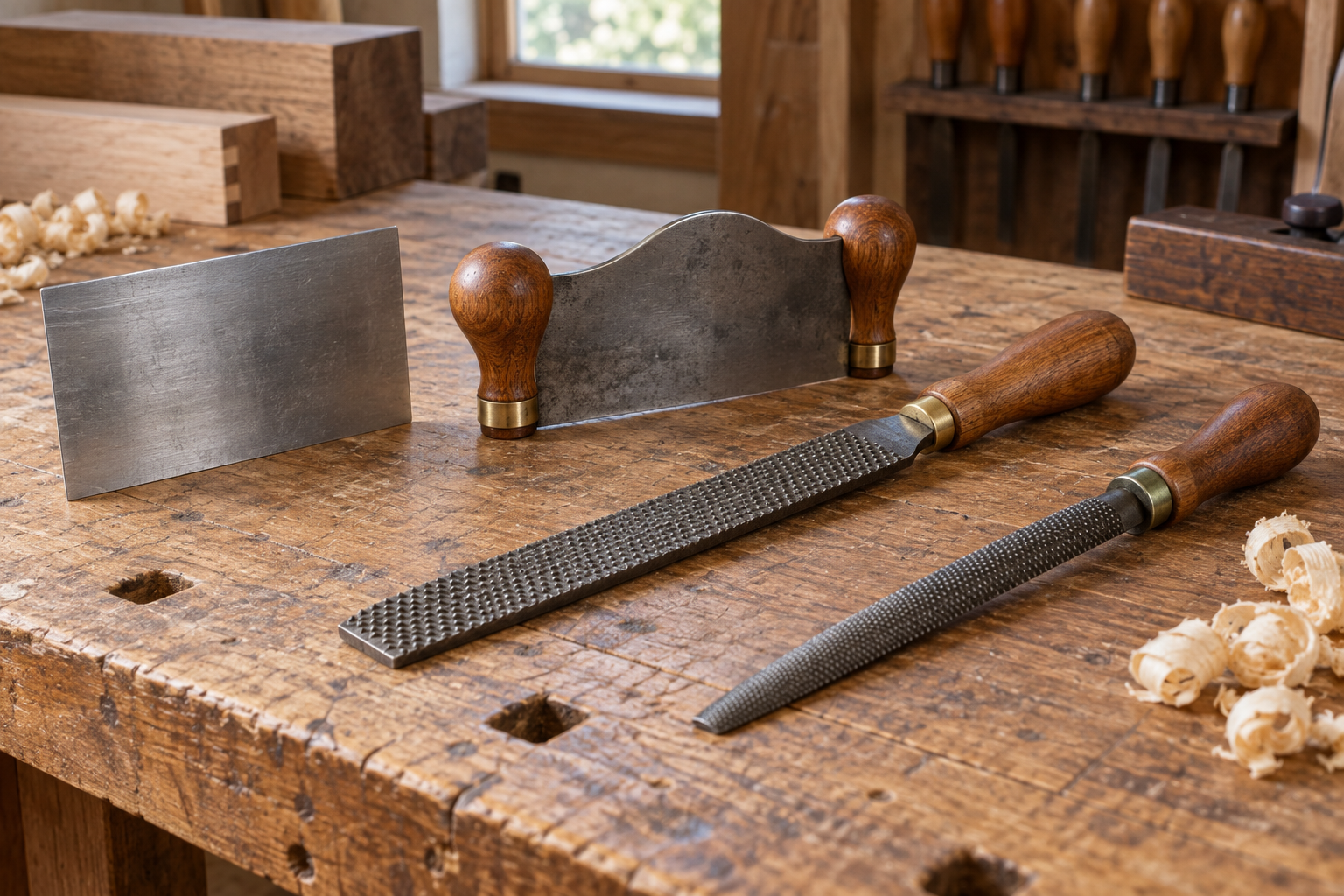
When you need to remove a lot of softwood quickly, a Surform shaver and a wood rasp can both do the job. They are not interchangeable, though. A Surform is usually faster on broad, convex surfaces such as chair seats, rounded edges, and carved blanks. A wood rasp gives better control in corners, on end grain, and during the final shaping stages.
The cheaper option is often fine if you only have one small project. For repeated shaping, the choice comes down to how much stock you need to remove, how accurately you need to control the curve, and how willing you are to clear clogged teeth.
As an Amazon Associate we earn from qualifying purchases at no extra cost to you.


Our Top Picks
How the tools cut
A Surform shaver uses a thin, replaceable perforated blade. Each opening has a cutting edge, and the blade scrapes away small chips as you push it across the wood. It behaves more like a controlled cheese grater than a file. The cutting action is spread across many small holes, so it removes material quickly without requiring the heavy pressure needed by some coarse rasps.
A wood rasp has individually cut teeth arranged across a solid steel surface. A coarse rasp bites more aggressively at first contact, but its teeth leave deeper grooves. The tool can be tilted, angled, and used with its toe or edge for more deliberate work. That makes it easier to approach a pencil line without accidentally flattening a nearby area.
For softwood, both tools cut readily. The difference is that soft fibers can compress under a rasp and collect between its teeth, while a Surform blade can fill with resin and damp fibers. Neither tool is immune to clogging, particularly on pine, spruce, cedar, or construction lumber that is wet or gummy.
Where a Surform shaver is better
Choose a Surform shaver when speed across a relatively open surface matters most. Its broad blade can level high spots over a curved tabletop edge, trim a glued-up panel, or reduce a square blank toward a rounded profile with fewer strokes than a fine rasp.
A typical hand shaver removes a visible amount of softwood in one or two passes, but it is still controllable if you use light pressure. Hold the tool with both hands, keep the blade flat or at a consistent angle, and work from high areas toward your layout lines. On a 12-inch-long edge, a Surform can remove several millimeters of excess material in a few minutes, depending on the wood and blade condition.
It is also relatively cheap to maintain. When the blade stops cutting cleanly, replace it rather than trying to sharpen the perforations. A fresh blade generally produces a more even cut and requires less force. For a homeowner who shapes wood only occasionally, a basic shaver with one spare blade is often better value than buying a large set of rasps.
Where a wood rasp is better
A rasp wins when shape and access matter more than raw removal rate. Its narrower body can reach into inside curves, notches, and transitions that a wide Surform cannot contact evenly. A coarse wood rasp is especially useful for a handle, saddle-like curve, or sculpted joint where you need to remove material from one small zone.
Rasps also give better feedback near a line. You can make short strokes with the front half of the tool, then change the angle to blend the surrounding surface. This reduces the risk of creating a broad flat spot. The trade-off is slower stock removal. On soft pine, a coarse rasp may be quick enough; on a large blank, you will feel the extra effort in your hands and forearms.
Do not confuse a wood rasp with a smooth metal file. A metal file has a finer, more uniform tooth pattern and is easily clogged by softwood. If you want one rasp for general shaping, a coarse or medium wood rasp with a comfortable handle is the appropriate starting point. A half-round profile is more versatile than a flat-only tool because it handles both outside and inside curves.
Surform versus rasp at a glance
| Factor | Surform shaver | Wood rasp |
|---|---|---|
| Stock removal | Fast on broad surfaces | Moderate, especially with coarse teeth |
| Control near a line | Good, but easy to flatten wide areas | Very good with short strokes |
| Inside curves and notches | Limited by blade width | Better, especially with a half-round rasp |
| Surface left behind | Even but visibly scraped | Usually deeper grooves |
| Clogging | Resin and damp fibers fill holes | Soft fibers pack between teeth |
| Maintenance | Clean or replace blade | Brush teeth clean; replacement is less frequent |
| Best value for | Fast general shaping | Detailed or irregular shaping |
The fastest practical workflow
For a large amount of removal, start with the Surform. Mark the target shape with a pencil or scribe line, then add a second line about 1 mm inside it as a safety boundary. Work diagonally across the high area, alternating direction every few strokes. This keeps the cutting pressure from following one set of softwood fibers and helps reveal high spots.
Stop using the Surform when you are roughly 1 to 2 mm from the final profile. Switch to a rasp for controlled blending, then use a medium or fine abrasive to remove the remaining tool marks. Trying to finish the surface with a coarse rasp often wastes time because its grooves can be deeper than the last millimeter you intended to remove.
If the shape is narrow or has tight transitions, reverse the order: use the rasp first, then a finer rasp or abrasive. A Surform can bridge a hollow and cut only the high points, which may be useful for roughing but can also produce an unwanted flat or faceted surface.
Common failures and how to avoid them
Pulling either tool backward can catch fibers and create a sudden gouge. If a stroke feels jerky, stop and inspect the tool rather than adding pressure. On figured or knotty softwood, reduce the stroke length and take lighter cuts. Knots are much harder than the surrounding grain and can deflect a rasp or damage a dull blade.
Clogging is another common problem. Tap a Surform over a scrap board and brush the blade from the back side; do not push your fingers across the cutting edges. For a rasp, use a stiff file card or brass brush. If the wood is wet, resinous, or pressure-treated, expect more frequent cleaning and slower progress.
For most buyers, a Surform is the better first purchase for rapid softwood shaping, particularly if the work involves broad edges or large blanks. Add a half-round coarse rasp when you need tighter control or interior curves. If your projects are small and detailed, skip the shaver and buy the rasp first; the lower removal rate is a fair trade for accuracy.