What's inside
As an Amazon Associate I earn from qualifying purchases. This post may contain affiliate links at no extra cost to you.
Recessed cabinet screws are easy to reach with the wrong bit—until the drill chuck hits the cabinet face, the bit slips out of the recess, or the driver sits at such a steep angle that the screw head strips. Choosing the right driver bit length is mainly a question of clearance, control, and how much torque the bit must transmit.
For most cabinet work, a 2-inch bit is the useful starting point. A 3-inch bit handles deeper recesses and obstructions. Bits longer than 4 inches can solve an access problem, but they flex more and are harder to keep aligned. The best setup is often a short bit in a magnetic bit holder rather than one extra-long bit.
Our Top Picks
 Titan 16189 90-Degree Magnetic Right Angle Drill Attachment1.25 x 1.5 x 5.5 inches0.55 poundsCheck on Amazon


Measure the recess first
Do not choose bit length based only on the screw head’s depth. Measure from the screw head to the nearest obstruction: the cabinet side, face frame, hinge plate, drawer box, or an adjacent panel. Then add enough length for the tool to clear that obstruction while remaining square to the screw.
For example, if a screw is 1-1/4 inches inside a cabinet corner, a 2-inch bit may reach the screw, but the drill body may still collide with the cabinet. A 3-inch bit gives the tool more room to approach straight. If the screw is recessed only 1/2 inch but sits behind a narrow face frame, a 1-inch bit in a compact holder may provide better control than a long bit.
Allow a small margin rather than selecting the exact measured length. A bit that barely reaches the fastener will lose engagement when the driver moves. Add roughly 1/2 inch for ordinary access and closer to 1 inch when you must work at an awkward angle.
How common bit lengths compare
| Bit or setup | Best use | Main advantage | Main drawback |
|---|---|---|---|
| 1-inch insert bit | Open cabinet faces and shallow recesses | Very stiff and easy to control | Needs a holder or compatible chuck |
| 2-inch power bit | General cabinet assembly and hardware | Good reach without much flex | May not clear deep obstructions |
| 3-inch power bit | Recessed screws near corners or frames | More tool clearance | Less rigid and easier to bend sideways |
| 4-inch or longer bit | Deep cavities and blocked access | Reaches where standard bits cannot | Noticeable flex, wobble, and higher stripping risk |
| Right-angle or flexible holder | Obstructed corners and unusual approach angles | Solves clearance without an extremely long bit | Can limit torque and introduce play |
Choose the shortest length that clears the cabinet
Shorter is usually better. A short bit bends less under load, stays more centered in the screw recess, and transfers more of the driver’s torque to the fastener. That matters with cabinet screws, which are often driven into hardwood, plywood edges, or dense face-frame material.
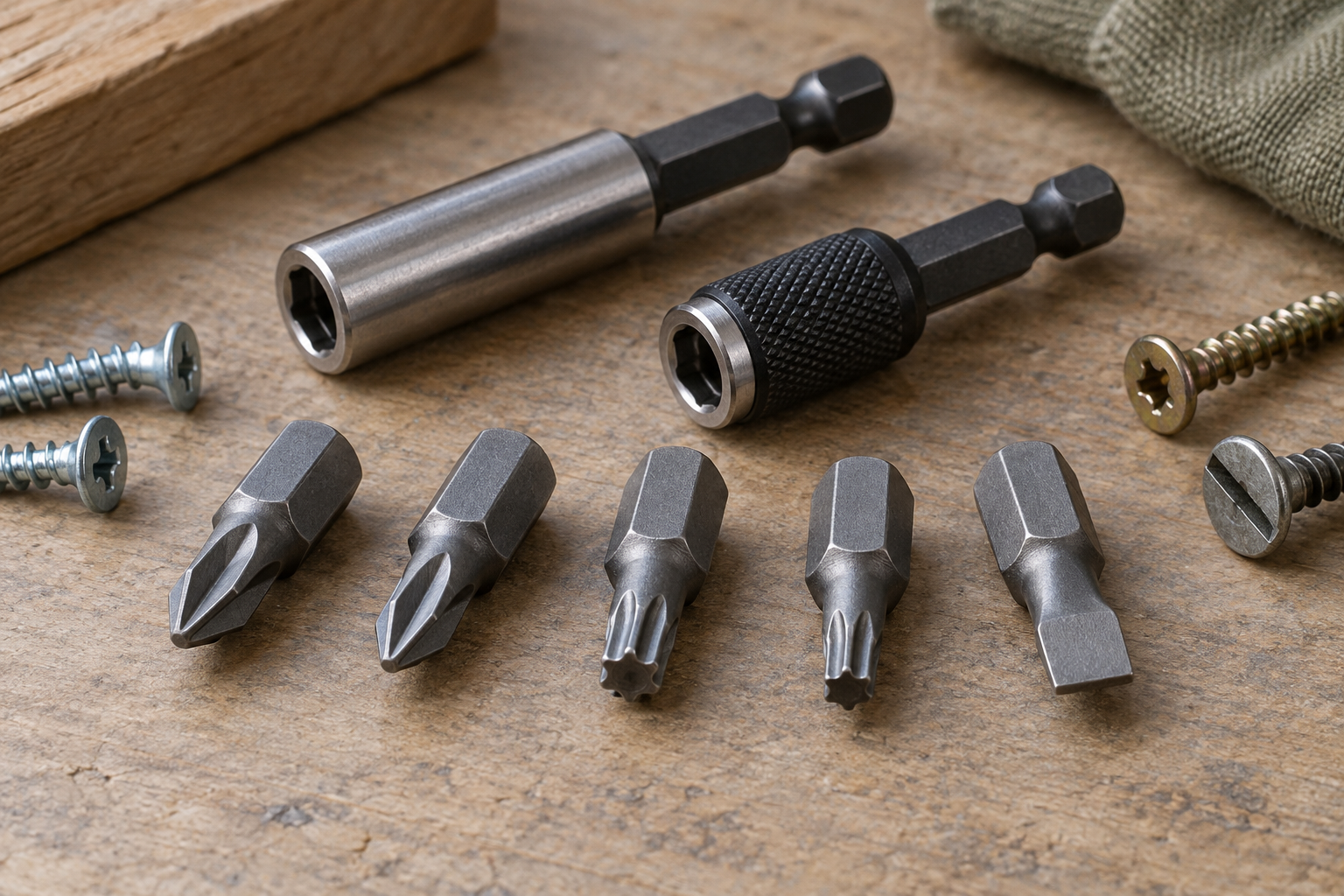
Use a 1-inch insert bit with a magnetic holder when the screw is easy to see and the holder can clear the cabinet. This is often the most precise arrangement. A magnetic 1/4-inch bit holder also lets you swap Phillips, square-drive, and Torx bits without changing the drill chuck.
A 2-inch bit is the practical all-around choice when the screw is recessed but not deeply blocked. It provides enough projection for most cabinet sides while remaining stiff. For screws buried behind a face frame or mounted close to a corner, step up to 3 inches before reaching for an extra-long shaft.
Do not confuse bit length with working reach. A 2-inch bit in a 2-inch magnetic holder may extend nearly 4 inches from the chuck. That combination can be useful, but it also increases wobble. If you need a holder, use the shortest bit that reaches the screw rather than automatically pairing it with a long bit.
Match the bit type to the screw and driver
Use the exact drive style and size. A Phillips #2 bit is not a substitute for a square-drive #2 or a Torx bit, even if it appears to fit. Cabinet screws often use square or star drives because they resist cam-out better. A loose-fitting bit can strip the recess before the screw is fully seated.
For an impact driver, buy bits specifically rated for impact use. Standard chrome or hardened insert bits can snap when exposed to repeated impact pulses. Look for a 1/4-inch hex shank and an impact-rated designation. A impact-rated cabinet screw bit set is worthwhile if you are working through many screws or switching among drive sizes.
A drill/driver is gentler and often gives better control for cabinet installation. Its clutch can stop the screw before it crushes a hinge plate or pulls through a thin cabinet panel. If the screw is already tight or the wood is dense, drill a pilot hole and use a shorter bit where possible.
Control flex, wobble, and stripping
Long bits magnify small alignment errors. A 4-inch bit that is only a few degrees off-center can push hard against one side of the screw recess. The result is a rounded drive, a bent bit, or a screw driven at an angle. This is especially common when fastening inside a base cabinet where the installer cannot keep both hands on the tool.
Keep the driver in line with the screw and start at low speed. Let the bit seat fully before increasing speed. If the bit walks out, stop instead of forcing it. A magnetic holder can retain the bit and make starts easier, but it does not correct a poor angle.
For deep access, consider a right-angle drill attachment when the problem is side clearance rather than depth. These attachments are useful around cabinet corners, but inexpensive versions can have noticeable gear play. Use them at moderate torque, verify the bit remains square, and avoid using a high-impact setting unless the attachment is explicitly rated for it.
When a long bit is worth buying
A 3-inch bit is worth keeping for cabinet backs, corner screws, hinge installation, and fasteners hidden behind face frames. A 4-inch bit makes sense when a fixed obstruction prevents the drill from getting close enough, such as a narrow opening or a deep shelf structure.
Longer than 4 inches is a specialty choice. It can reach through a cabinet opening, but the shaft will flex under pressure. Use low speed, light forward force, and a fully seated drive bit. If the screw requires substantial torque, move the cabinet or remove the obstruction instead of relying on a very long bit.
For occasional repairs, a basic 2-inch and 3-inch impact bit set is usually enough. The cheaper option is fine if you are driving a handful of screws in clear access and using a drill/driver. Spend more on impact-rated bits, a better holder, or a right-angle attachment when the work involves dense wood, dozens of fasteners, or repeated recessed access.