What's inside
As an Amazon Associate I earn from qualifying purchases. This post may contain affiliate links at no extra cost to you.
A flat-head wood screw works best when its head sits flush with the surface. The countersink angle matters because the underside of the head must bear against the sloped walls of the recess. If the angles are a poor match, the screw may stop proud, crush the wood around the hole, or pull the joint out of alignment.
For most wood screws sold in North America, start by matching the countersink to the screw’s specified head angle—commonly 82 degrees. Do not assume every flat-head screw uses that angle: 90-degree screws are also common, particularly in metric hardware and some specialty fasteners. Check the package or manufacturer’s dimensions when available, then test the fit in scrap from the same material.
What the angle means
The countersink angle is the included angle at the tip of the conical recess. It describes the slope on both sides, not the angle of one side alone. An 82-degree countersink has a shallower profile than a 90-degree countersink. That difference is enough to affect contact between the screw head and the wood.
A flat-head screw is not the same as a washer-head or pan-head screw. Its tapered underside is designed to seat in a matching cone. A straight clearance hole lets the shank pass through; the countersink provides space for the head. The hole should be wide and deep enough for the head to sit flush, but not so large that the head loses useful bearing area.
Match the angle to the screw
Read the screw packaging first. If it specifies an 82-degree head, use an 82-degree cutter; if it specifies 90 degrees, use 90 degrees. When the angle is not listed, measure the screw or compare it with a known-angle gauge. A quick test in scrap is often more useful than relying on appearance alone: seat the screw by hand and look for even contact around the head.
An 82-degree screw in a 90-degree recess tends to touch near the top edge of the head rather than along its full sloped underside. A 90-degree screw in an 82-degree recess tends to bear near the outer edge. Either mismatch can leave the head proud or concentrate pressure on a narrow ring of wood. In soft wood, that pressure can crush fibers; in brittle or thin stock, it can split the surface.
| Option | Best fit | Trade-off |
|---|---|---|
| 82-degree countersink | Flat-head screws specified at 82 degrees, common in North America | Not a universal fit for metric or specialty screws |
| 90-degree countersink | Screws specified at 90 degrees and many metric fasteners | Can seat poorly with common 82-degree wood screws |
| Adjustable or multi-angle countersink | Shops that regularly use different screw standards | Costs more and still needs a test fit and careful depth control |
Choose the right cutter
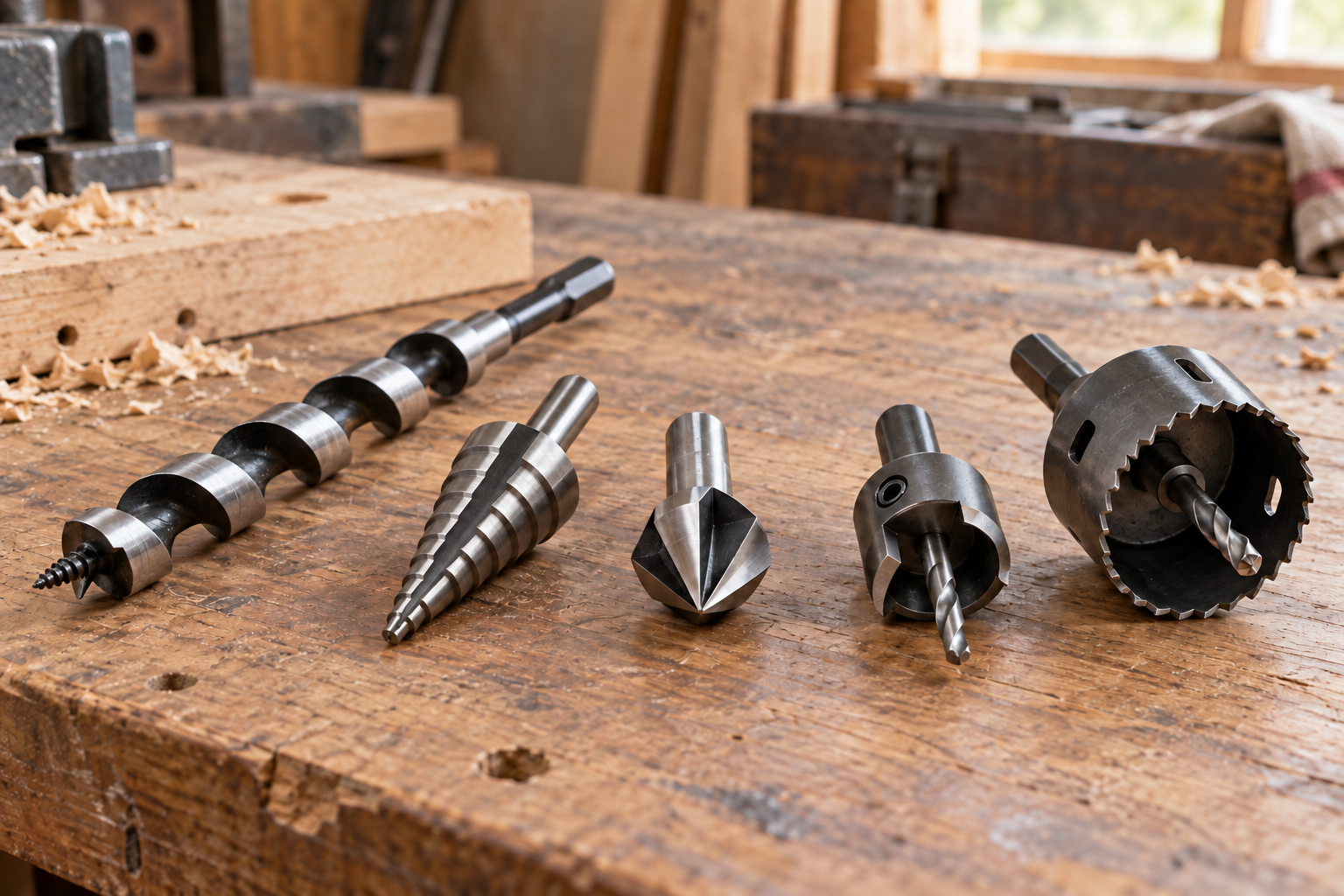
For occasional work with one screw type, a fixed-angle countersink is usually the sensible buy. Match the angle and choose a cutter sized for the screw heads you use. A basic single-flute cutter can work well in wood if it is sharp and you feed it steadily. It is inexpensive, but may chatter more in a handheld drill, especially in hardwood or when the cutting edge is dull.
A multi-flute cutter can leave a smoother recess and may run more steadily, but it costs more and does not eliminate tear-out or the need to control depth. For a mixed fastener collection, an adjustable countersink set can cover more jobs. Check which angles the set actually supports; “adjustable” does not guarantee a true match for every screw standard.
If you are drilling pilot holes and countersinks in the same operation, a countersink bit with a depth stop can save setup time on repeated holes. The trade-off is less flexibility if the pilot size or countersink depth needs to change. Separate bits are often cheaper and easier to tune for one-off work.
Set depth and drill carefully
Mark the required depth on the bit, use a stop collar, or make a test hole in scrap. The screw head should finish flush or just below the surface if the design calls for it. Avoid cutting a deep cone “for safety”: removing too much material weakens the surface and reduces the wood supporting the head. For thin stock, a deep countersink can leave very little material under the head and cause a breakout.
Drill the pilot hole to suit the screw and the wood. As a starting point, the pilot diameter in hardwood should be close to the screw’s root diameter—the solid core between the threads—while softwood often tolerates a slightly smaller pilot. Follow the screw maker’s guidance where possible. Countersinking does not replace a pilot hole, and driving a large screw straight into hardwood can split the workpiece even if the head recess is perfect.
Use moderate speed and light pressure. Let the cutter remove material rather than forcing it. In softwood, check often because the bit can cut deeper than expected in seconds. In hardwood, a dull cutter or excessive speed can burn the recess and make the screw harder to seat. Clamp the work where practical, and keep the drill square to the surface; a tilted countersink makes the head sit crooked.
Check the fit before assembly
Drive one screw into a test piece and inspect the head from the side. It should sit evenly, with no visible gap under one edge. If it stands proud, confirm the recess is deep enough before widening it. If it rocks or seems to touch only at the rim, check the angle match. If the surface fibers crush or split, reduce depth, use a pilot hole, or move farther from the edge.
For painted or filled work, a slight recess may be useful, but do not bury the head so deeply that the screw loses support. On visible joinery, make a fresh test hole whenever the screw size, wood species, or cutter changes. That small check is cheaper than repairing a chipped face or a joint held by a poorly seated fastener.