What's inside
As an Amazon Associate I earn from qualifying purchases. This post may contain affiliate links at no extra cost to you.
Our Top Picks


Twist Drill vs Brad-Point Bit for Drilling Hardwood Without Tear-Out
For clean holes in hardwood, a brad-point bit is usually the better buy. Its center spur locates the hole, while the outer cutting spurs score the fibers before the main cutting edges remove material. That combination greatly reduces wandering and ragged edges.
A standard twist drill can still work, especially for clearance holes, deep holes, and jobs where the back side will not be seen. It is cheaper, more versatile, and often already in your toolbox. The trade-off is that its blunt chisel-shaped tip tends to push into the wood before the cutting lips fully engage. In hardwood, that can leave a chipped exit hole and a rough entry point.
As an Amazon Associate we earn from qualifying purchases at no extra cost to you.


How the Bits Cut Wood
A twist drill is designed primarily for metal, although it drills wood effectively enough. Its point has a short web across the center rather than a sharp locating spur. When you start the drill, the web can skate across a smooth board, particularly on angled grain or finished surfaces. Once it bites, the cutting lips remove material and the spiral flutes carry chips out.
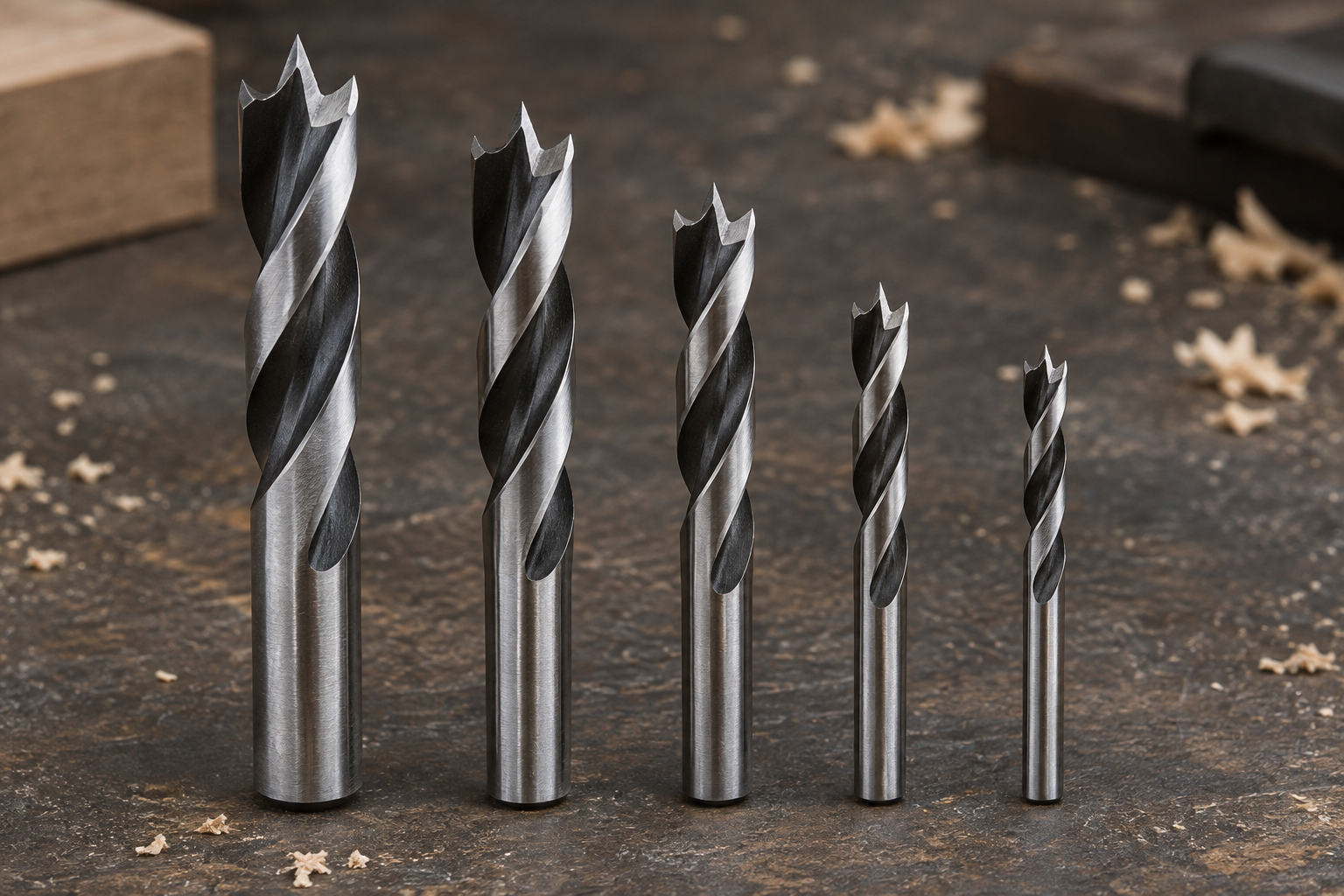
A brad-point bit has three useful features: a sharp center point, two outside spurs, and cutting edges between them. The center point keeps the bit on the mark. The spurs cut the hole’s perimeter, much like scoring a surface before cutting it. This is what prevents many fibers from tearing across the grain as the bit exits.
For the cleanest results, use a sharp brad-point drill bit set rather than a general-purpose twist-bit set. Cheap brad points are not automatically good, but even a modest-quality set usually leaves a cleaner rim than a similarly priced twist drill.
Head-to-Head Comparison
| Feature | Twist drill | Brad-point bit |
|---|---|---|
| Hole entry | May wander on smooth or angled grain | Center spur starts accurately |
| Exit-hole quality | More likely to splinter and tear out | Usually cleaner, especially when sharp |
| Hardwood performance | Works, but needs careful technique | Better control and cleaner edges |
| Materials | Wood, metal, plastic, and other materials depending on the bit | Primarily wood and wood composites |
| Deep holes | Generally better chip clearance | Can clog in deep holes |
| Cost | Often cheaper per bit and more versatile | Usually worth the small premium for visible woodwork |
When to Use Each Bit
Choose a brad point for cabinet parts, furniture, shelving, hardwood trim, and any hole whose rim will remain visible. It is especially useful for holes under about 1/2 inch, where a clean edge matters and a Forstner bit would be excessive. Common sizes from 1/8 to 1/2 inch cover most pilot, dowel, and hardware work.
A twist drill is the practical choice for rough construction holes, hidden fasteners, and drilling through mixed materials. It is also preferable when you may encounter a nail or screw, although neither wood nor brad-point bits should be forced through metal. For a deep hole, a standard twist drill with a long flute may clear chips more reliably than a short brad point.
Do not confuse a brad-point bit with a spade bit. Spade bits are fast and inexpensive for large rough holes, but they commonly leave more tear-out. Forstner bits can produce even cleaner, flatter-bottomed holes, but they cost more, need more force, and are slower in a handheld drill.
Technique Matters More Than the Label
Put a sacrificial scrap of plywood or solid wood tightly behind the workpiece. This supports the fibers as the bit breaks through and is the single most reliable way to reduce exit tear-out. Clamping the workpiece also prevents it from lifting when the bit emerges.
Run a brad-point bit at a moderate speed. As a starting point, use roughly 1,000 to 1,500 rpm for a 1/4-inch bit in hardwood, and about 500 to 800 rpm for a 1/2-inch bit. These are practical ranges, not strict rules; reduce speed if the bit gets hot or stops clearing chips. Withdraw the bit every few seconds on holes deeper than roughly twice the bit diameter.
For a twist drill, make a small starter dimple with an awl or center punch, then begin slowly. A 1/8-inch pilot hole can help larger bits stay centered, but do not assume it will prevent tear-out by itself. Stop drilling when the tip is just about to break through, then finish from the opposite side using the small pilot hole as a guide. This two-sided method often produces a cleaner result than changing bits.
Keep the bit perpendicular to the surface and let it cut rather than forcing it. Excessive pressure makes a twist drill’s web push harder against the wood and increases splintering. A dull brad point is no better: its spurs crush fibers instead of slicing them.
What to Buy
For occasional home repairs, a basic wood drill bit set with twist and brad-point bits gives the best coverage. Buy a brad-point set if most of your work involves visible hardwood. A twist-bit set is fine if you need one kit for wood, plastic, and light metal.
Look for brad points with clearly ground spurs, straight shanks, and sizes marked on the shank or case. Avoid using a large bit in a small cordless drill if the motor stalls; a 1/2-inch bit in dense maple can demand significant torque. For larger clean holes, a Forstner bit set is the upgrade, not a substitute for a brad point in every size.
The Practical Choice
If tear-out is the deciding issue, choose a sharp brad-point bit and back the work with scrap. It gives you better starting accuracy and cleaner edges for only a modest increase in cost. Choose a twist drill when versatility, deep-hole performance, or the lowest purchase price matters more than a perfect rim. With backing support and a two-sided approach, a twist drill can still make respectable holes in hardwood—but it requires more technique and leaves less margin for error.