What's inside
As an Amazon Associate I earn from qualifying purchases. This post may contain affiliate links at no extra cost to you.
Our Top Picks


Short answer: Forstner bits make cleaner flat-bottom holes
Forstner bits usually leave the cleaner, flatter-bottomed hole in hardwood, especially for larger diameters, shallow recesses, and holes that must stop at a precise depth. Their rim cuts the perimeter before the center material is removed, which helps limit tear-out around the edge.
Brad-point bits are the better everyday choice for smaller through-holes. Their center spur starts the bit accurately, and their cutting spurs help make a neat entry. They are generally faster to use, cost less, and are easier to drive with an ordinary handheld drill. The right choice depends less on which bit is “better” than on the hole’s size, depth, and visibility.
As an Amazon Associate we earn from qualifying purchases at no extra cost to you.


How the two bits cut
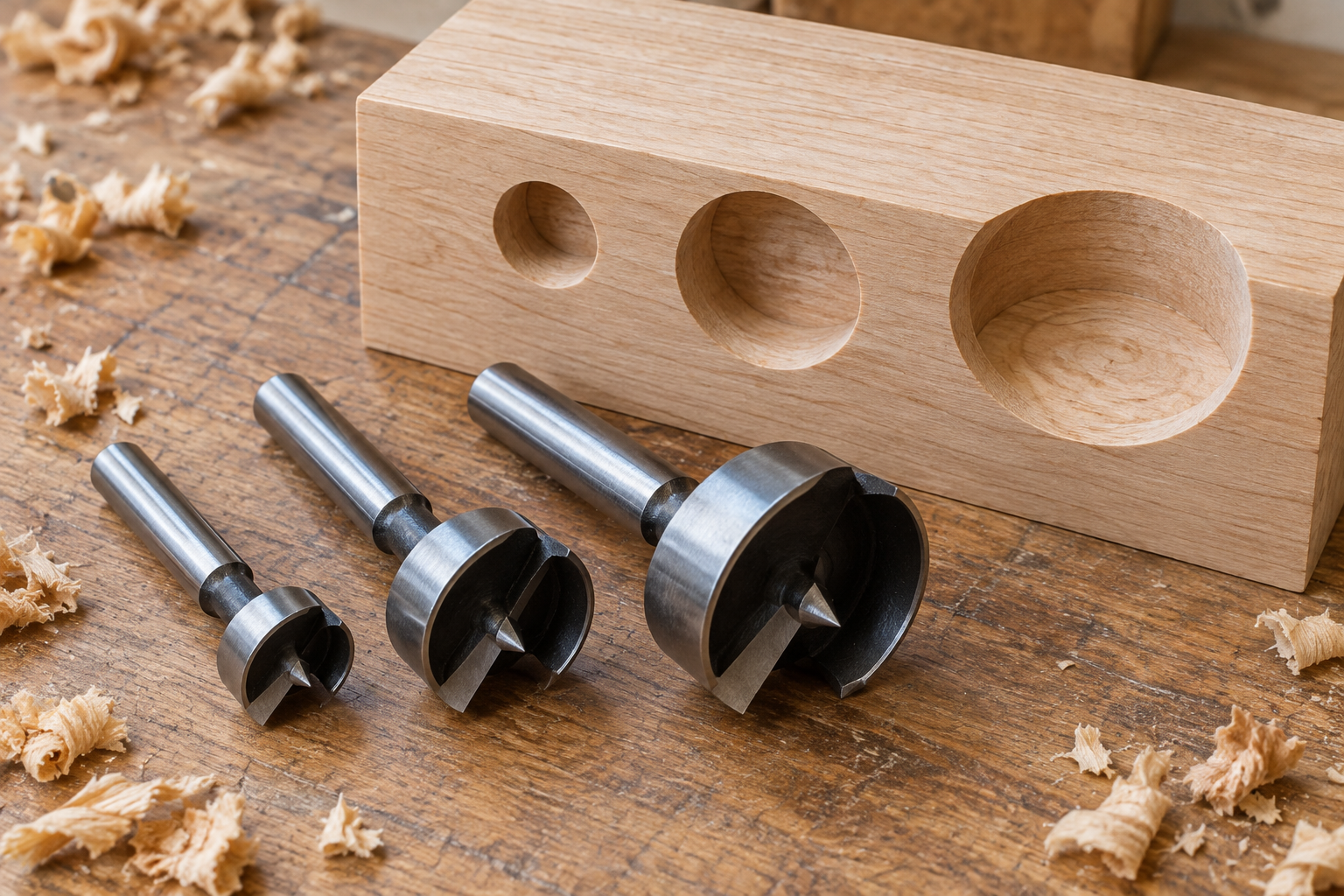
A Forstner bit has a center point, a circular rim, and cutting edges inside that rim. The rim scores the hole’s perimeter as the bit turns; the inner cutters remove the waste. This design can produce a flat-bottomed hole and works well for overlapping holes or holes close to the edge of a board. It does not rely on a long center spur to guide the cut, so a drill press or a steady hand matters.
A brad-point bit has a sharp center spur and two outer spurs, with cutting lips between them. The center spur helps keep the bit from wandering, while the outer spurs score the circumference. It is a good design for straight, accurate holes through stock, but it leaves a pointed bottom. On a deep or large hole, chips can clog the flutes and heat the bit, particularly in dense hardwood.
At-a-glance comparison
| Job or feature | Forstner bit | Brad-point bit |
|---|---|---|
| Best fit | Flat-bottomed recesses, larger holes, overlapping cuts | Accurate through-holes and smaller general-purpose holes |
| Bottom shape | Flat, with a small center mark | Pointed from the center spur |
| Entry edge | Very clean when sharp and well supported | Clean, with a scored perimeter |
| Handheld use | Can grab or wander; needs firm control | Usually easier to start and steer |
| Chip clearing | Withdraw often, especially in deep holes | Withdraw often; flutes can pack with chips |
| Typical trade-off | Slower, more torque, usually higher cost | Faster and cheaper, but no flat bottom |
Which leaves a cleaner hole in hardwood?
For a visible, flat-bottomed recess in maple, oak, or walnut, a sharp Forstner bit has the advantage. Its rim makes a defined cut around the hole, and the flat floor is useful for furniture hardware, plugs, and shallow counterbores. It is also the usual pick when you need a broad, shallow cavity rather than a simple passage through the board.
For a through-hole, a sharp brad-point bit can be just as clean at the entry and is often the more practical choice. The exit face is the weak spot: as the bit breaks through, the remaining fibers can tear out. Clamp a sacrificial backer tightly against the work, or stop when the center point just shows and finish from the opposite side. That two-sided method reduces breakout with either bit.
Neither design rescues a dull cutter, a loose workpiece, or a rushed feed. Hardwood can burn when a bit rubs without cutting, and a clogged bit can tear fibers or overheat. Pull the bit out periodically to clear chips. Forstner bits often need more frequent clearing in deep holes because their cutting action produces a broad plug of waste.
Size, depth, and the drill driving it
For holes around 1/4 to 1/2 inch, a brad-point bit is usually the sensible buy unless the bottom must be flat. It is simpler to control in a handheld drill and commonly available as part of a useful size set. A brad-point bit set for woodworking covers many cabinet, jig, and general workshop jobs without the cost of a full Forstner set.
For larger recesses—say 3/4 inch or wider—or for hardware cups and flat-bottomed pockets, use a Forstner bit. Larger diameters demand more torque, so a drill press is preferable. If using a handheld drill, brace it squarely, clamp the work, use low speed, and keep both hands on the tool. A Forstner bit set is worthwhile if you regularly make furniture or cabinetry; occasional shallow holes may justify buying only the needed diameter.
Depth matters too. A Forstner bit is useful for controlled recesses, but do not assume its geometry will clear chips from a deep blind hole unaided. Mark the target depth on the bit or use a stop, drill in short stages, and lift the bit to clear waste. A brad-point bit can drill a deep through-hole, but its pointed bottom makes it unsuitable when the floor itself needs to be flat.
Common mistakes and when the cheaper bit is fine
Running either bit too fast can burn hardwood. Large Forstner bits are especially demanding: slow the drill, keep the cutter sharp, and avoid leaning hard enough to stall the tool. If the bit chatters, wanders, or needs excessive pressure, check the workholding and sharpness rather than forcing it. A Forstner bit can also skate on a smooth surface before its rim bites; a drill press, a guide, or a small starter mark can help.
For a hidden hole through a board, a brad-point bit is often all you need. It costs less, drills efficiently, and leaves a neat entry when sharp. Choose the Forstner bit when its flat bottom, large diameter, or ability to overlap holes solves a real problem—not simply because it sounds like the premium option. If the hole must be both clean on the exit and precisely placed, add a backer or drill from both sides; changing bit types alone will not guarantee a tear-out-free result.