What's inside
As an Amazon Associate I earn from qualifying purchases. This post may contain affiliate links at no extra cost to you.
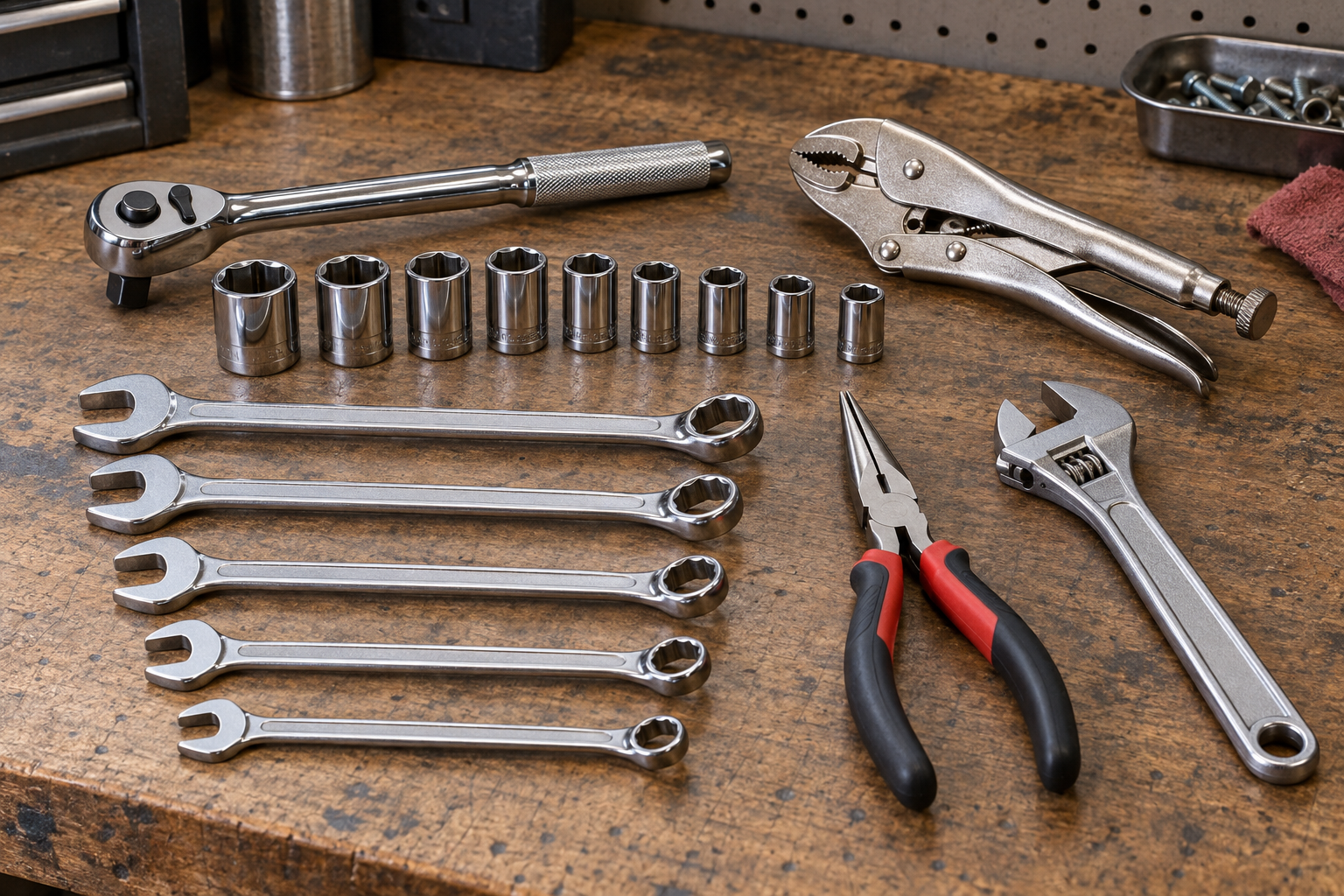
Choosing between a standard combination wrench and a ratcheting combination wrench comes down to access, reliability, and how much time you can afford to spend on each fastener. Both tools have an open end and a box end, but the box end works very differently. A standard wrench must be lifted and repositioned after every turn. A ratcheting wrench turns the fastener while you swing the handle back and forth without removing the box end.
For roadside, farm, construction, and equipment repairs, that difference can matter. It can also create new failure points. A ratcheting wrench is not automatically the better field tool.
As an Amazon Associate we earn from qualifying purchases at no extra cost to you.


Our Top Picks


How the two wrench types work
A combination wrench has an open jaw on one end and a fixed, usually 12-point, box end on the other. The box end surrounds the fastener and applies force to its flats. You lift and reposition the wrench after each partial turn. The open end is quicker to place on a nut, but it is more likely to spread or round the fastener under heavy load.
A ratcheting combination wrench uses a one-way mechanism inside the box end. The wrench drives in one direction and freewheels in the other. Most have a 72-tooth mechanism, although some use fewer or more teeth. A 72-tooth wrench needs roughly 5 degrees of handle movement to engage the next tooth, compared with about 15 degrees for a 24-tooth design.
That small swing is valuable around brackets, hydraulic fittings, engine accessories, and guards where you may have only a few degrees of clearance. It does not make the fastener easier to break loose. The mechanism only saves repositioning time after the fastener has started moving.
Field comparison
| Factor | Combination wrench | Ratcheting combination wrench |
|---|---|---|
| Initial cost | Lower | Higher, often 1.5 to 3 times more |
| Fastener access | Good with the open end; limited swing with the box end | Excellent where swing is restricted |
| Breaking loose tight fasteners | Better suited to heavy force | Use caution; the ratchet can be damaged |
| Debris and weather tolerance | Very high | Lower; grit can affect the mechanism |
| Cleaning and inspection | Simple | More important and sometimes difficult |
| Speed on repeated fasteners | Slow in tight spaces | Usually much faster |
| Best use | General repair, high load, rough conditions | Maintenance and assembly in confined spaces |
Where ratcheting combination wrenches win
The main advantage is reduced motion. If a nut takes 10 full turns and you have only 20 degrees of working room, a standard box wrench may require hundreds of repositioning movements. A ratcheting wrench can keep turning with short strokes. On a machine with several guards or brackets to work around, this can save meaningful time.
They are especially useful for battery terminals, hose clamps, alternator brackets, mower decks, automotive accessories, and equipment assembled with long threaded studs. The box end stays engaged with the fastener, so there is less chance of dropping the wrench into a crowded engine bay.
For this work, look for a ratcheting combination wrench set with clear size markings and a slim head. A 72-tooth mechanism is useful in tight spaces, but head thickness matters just as much. Some compact designs sacrifice strength for access, so avoid treating a thin, fine-tooth wrench like a breaker bar.
Where the standard wrench is the safer choice
A fixed combination wrench has fewer parts to fail. It tolerates mud, metal chips, rain, and poor cleaning far better than a ratcheting mechanism. If the tool will live in a tractor toolbox, service truck, or outdoor equipment shed, that durability is not a minor advantage.
Standard wrenches are also preferable when a fastener is seized or heavily torqued. A ratcheting box end can slip internally, jam, or break if you apply a cheater pipe or strike the handle. Even when the mechanism survives, repair costs can exceed the price difference between the two tools.
Use a standard SAE and metric combination wrench set for lug-related hardware, suspension fasteners, structural brackets, and old machinery where corrosion is common. For final tightening, follow the equipment maker’s torque specification rather than relying on maximum hand force.
Common failure modes and mistakes
The most damaging mistake is using the ratcheting end to break loose a stuck fastener. If it will not move with firm hand pressure, switch to a standard wrench, socket, or breaker bar. Penetrating oil, heat, or controlled impact may be appropriate depending on the surrounding materials and fire risk.
Another problem is dirt inside the ratchet. Fine sand and rust particles can prevent the pawls from fully engaging. That may produce a sudden skip under load, rounding the fastener or injuring your hand. Clean the tool after dirty work and check that the ratchet drives positively in one direction and freewheels in the other.
Neither wrench type is ideal for a badly rounded fastener. A 12-point box end provides speed but has less contact than a six-point socket. When a nut is damaged, use a six-point socket or a dedicated extraction tool. Do not keep increasing force on a slipping wrench.
What should you buy?
For a first or only set, standard combination wrenches are the better value. They cover more repair situations, cost less, and remain dependable when conditions are dirty. A complete metric set from 8 to 19 mm and a common SAE range from 1/4 to 3/4 inch will handle much general maintenance, though vehicle and equipment work may require larger sizes.
If you regularly repair machines in cramped spaces, add ratcheting wrenches after covering the common sizes with standard tools. You do not necessarily need two complete sets. A metric ratcheting wrench set in the sizes you use most can provide the access benefit without duplicating every seldom-used wrench.
Reversible ratcheting wrenches are convenient when the same tool must tighten and loosen fasteners, but their selector adds another exposed part. In harsh field work, a fixed-direction design is often simpler. For maximum versatility, carry both types: use the standard wrench to break loose and final-tighten, then use the ratcheting wrench to run the fastener through its threads.
The practical choice for field repairs
Buy standard combination wrenches when reliability, price, and high-load work matter most. Buy ratcheting combination wrenches when restricted swing and repeated fasteners consume your time. The best field kit is usually not one or the other. It is a dependable standard set, supplemented by ratcheting sizes for the tight spaces where their speed is genuinely useful.