What's inside
As an Amazon Associate I earn from qualifying purchases. This post may contain affiliate links at no extra cost to you.
Our Top Picks
 Starrett Steel Combination Square with Square Head12"1 x 1.4 x 12.3 inches1.22 PoundsCheck on Amazon


Short answer
For repeatable tool setup, a machinist square is usually the better reference: it is compact, rigid, and quick to check against a machine table, fence, or workpiece. A combination square is more versatile. Its adjustable rule can check 90° and 45° angles, measure depth, and mark lines, so it is the more useful single purchase for a general workshop.
If you mainly need to set a table-saw blade or check a drill-press table, buy a machinist square in a size that fits the work. If you want one tool for layout and occasional machine checks, choose a combination square with a locking head and a rule that slides without wobble.
As an Amazon Associate we earn from qualifying purchases at no extra cost to you.


What each square does
A machinist square has a fixed blade set at 90° to a stock. It is designed to check squareness, not to serve as a general measuring rule. Common blade lengths include 2, 3, 4, and 6 inches. Short blades fit tight spaces; longer ones reveal angular error across a wider surface.
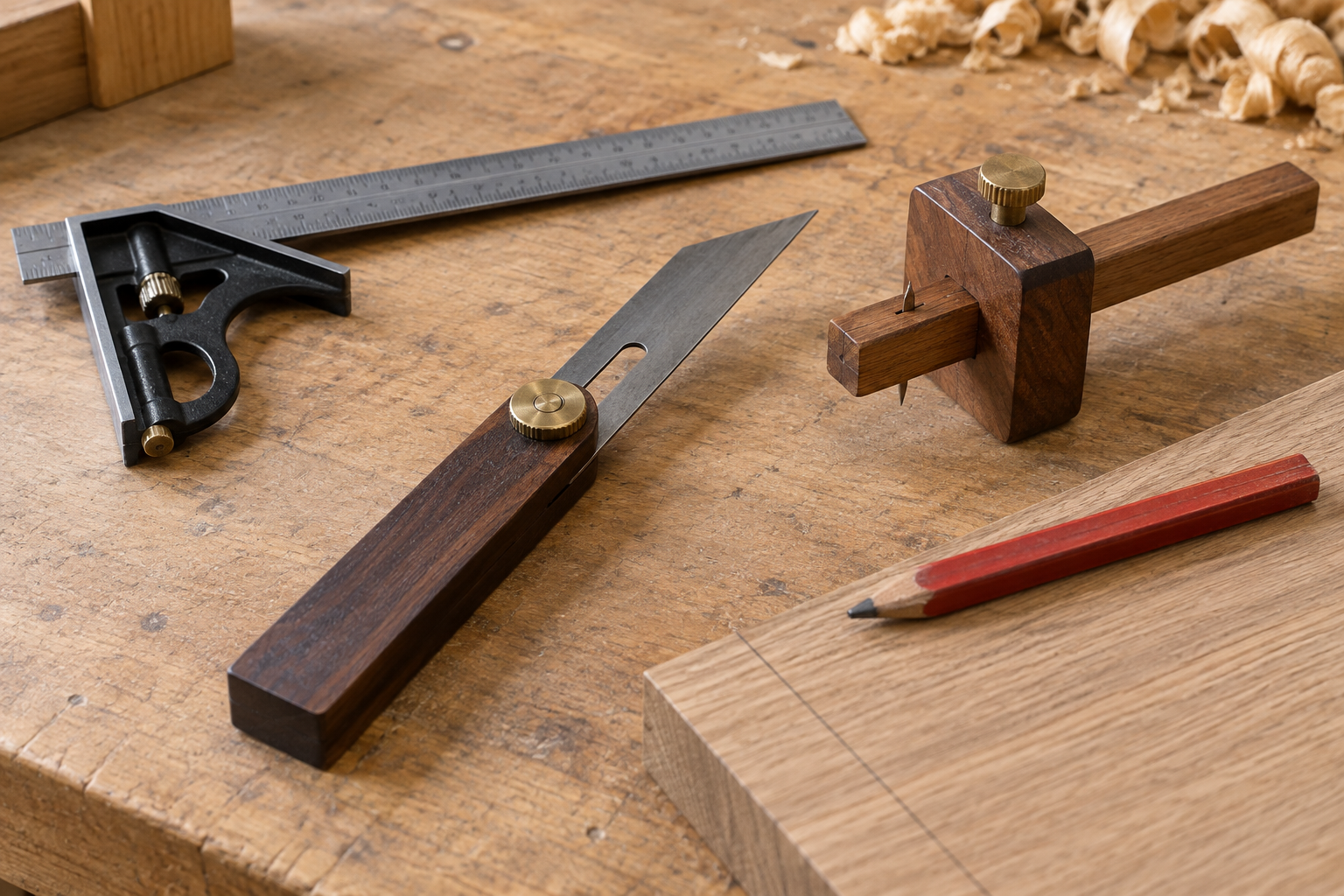
A combination square has a graduated rule and a movable head that locks at a chosen position. Most heads provide a 90° face and a 45° face. Many also include a small level and a scriber stored in the head. Those extras are convenient, though the level is not a substitute for a calibrated machinist’s level.
The key difference for setup is that a fixed square has fewer moving parts to introduce play. A combination square offers more jobs per tool, but its accuracy depends on the rule, head, lock, and fit between them.
Side-by-side comparison
| Factor | Machinist square | Combination square |
|---|---|---|
| Best use | Checking 90° alignment and squareness | Layout, measuring, and general setup |
| Adjustment | Fixed blade and stock | Sliding rule and locking head |
| Angle checks | Usually 90° only | Usually 90° and 45° |
| Reach | Limited by blade length | Rule can be extended or repositioned |
| Common failure mode | Blade or stock is bent or damaged | Rule has play, head slips, or graduations are hard to read |
| Value | Strong choice for dedicated setup checks | Strong choice as a general-purpose shop tool |
Accuracy depends on the job
A square does not make a machine accurate by itself; it gives you a reference. For example, to set a table-saw blade, unplug the saw, place the square against the blade plate rather than a tooth, and compare it with the table. Rotate the blade by hand and check at more than one point. A burr, tooth set, or dirty table can create a false reading.
For a drill press, check the table against the quill or a straight rod held in the chuck. A square against the outside of a drill bit can mislead you because the bit may not sit straight. On a bandsaw, a square helps check the table against the blade, but blade twist and tension also affect the result.
Scale matters. Over a 4-inch blade, a small angular error may be hard to see; over 12 inches, the same error produces a larger gap. A longer combination-square rule can help reveal a tilted fence or workpiece, but only if the head stays locked and the rule is straight. For close machine work, verify a shop square against a known reference or use a dedicated machinist square with a stated tolerance. Do not assume that a low-cost tool is precision-ground just because its packaging says “machinist.”
Where each one falls short
A machinist square is fast and dependable when you need a fixed 90° reference, but it cannot measure from an edge or mark a line at a chosen distance. Its short blade can also miss a gradual bow or twist across a wide surface. A 2-inch square is handy for small parts; it is a poor choice for checking a large saw table.
A combination square covers more tasks, but the sliding head creates a possible source of error. If the rule rocks in the head, the lock shifts when tightened, or the head has been dropped, the tool may not hold a true angle. Check it by drawing a line along the square’s edge, flipping the tool over against the same edge, and drawing a second line. If the lines diverge, the square is out of square or the reference edge is not straight. This test checks the 90° relationship, not the accuracy of every graduation.
Cheap combination squares can still be useful for rough layout and woodworking where a small error is not critical. They are less suitable for setting a machine you expect to hold tight tolerances. A better-made tool costs more, but inspect the fit and locking action rather than buying on price or extra features alone.
What to buy
For dedicated machine setup, consider a machinist square set with sizes suited to both small parts and larger surfaces. A set is useful if you move between a benchtop machine and bigger work, but a single square is enough if your checks are consistent and its blade reaches across the relevant surface.
For a first or only square, a 12-inch combination square offers useful reach for marking and general checks. Look for a clearly etched or engraved rule, a positive lock, and a head that fits snugly without binding. A shorter 6-inch version is easier to handle on small parts, but gives less reach when checking larger setups.
Whichever type you buy, keep the reference faces clean and avoid using the square as a clamp, pry tool, or hammer target. A single drop onto a concrete floor can bend a blade or damage a head enough to spoil setup checks. Re-test it after a fall and periodically during use.
Which is better for tool setup?
A machinist square is better when accuracy and speed at 90° matter more than versatility. It is the straightforward choice for checking small machine parts, fixtures, and table alignment. A combination square is better when setup is only one part of the job and you also need to measure, mark, check 45°, or set a depth.
For many home shops, a decent combination square is enough to get started, especially for woodworking and general maintenance. Add a machinist square when a fixed reference would make repeated checks quicker or when the combination square’s head introduces doubt. The right choice is the one that fits the size and tolerance of the work—not the one with the longest feature list.