What's inside
- The Basic Difference
- Track Saw vs. Circular Saw With Guide Rail
- Beyond Straight Cuts: Dust, Bevels, Plunge Cuts, and Safety
- Track Saw vs Circular Saw With Guide Rail: Pros and Cons at a Glance
- When a Track Saw Is the Better Buy
- When a Circular Saw With a Guide Is Enough
- Guide Options for a Circular Saw
- What Each Setup Really Costs
- Setup for Clean, Safe Cuts
- How to Break Down a Full 4×8 Sheet
- More Track Saws and Circular Saw Guides Worth a Look
- Track Saw vs Circular Saw With Guide Rail: Best Setup by Budget
- Cordless and Corded Track Saws Compared by Rated Cut Depth
- What to Buy
- Frequently Asked Questions
As an Amazon Associate I earn from qualifying purchases. This post may contain affiliate links at no extra cost to you.
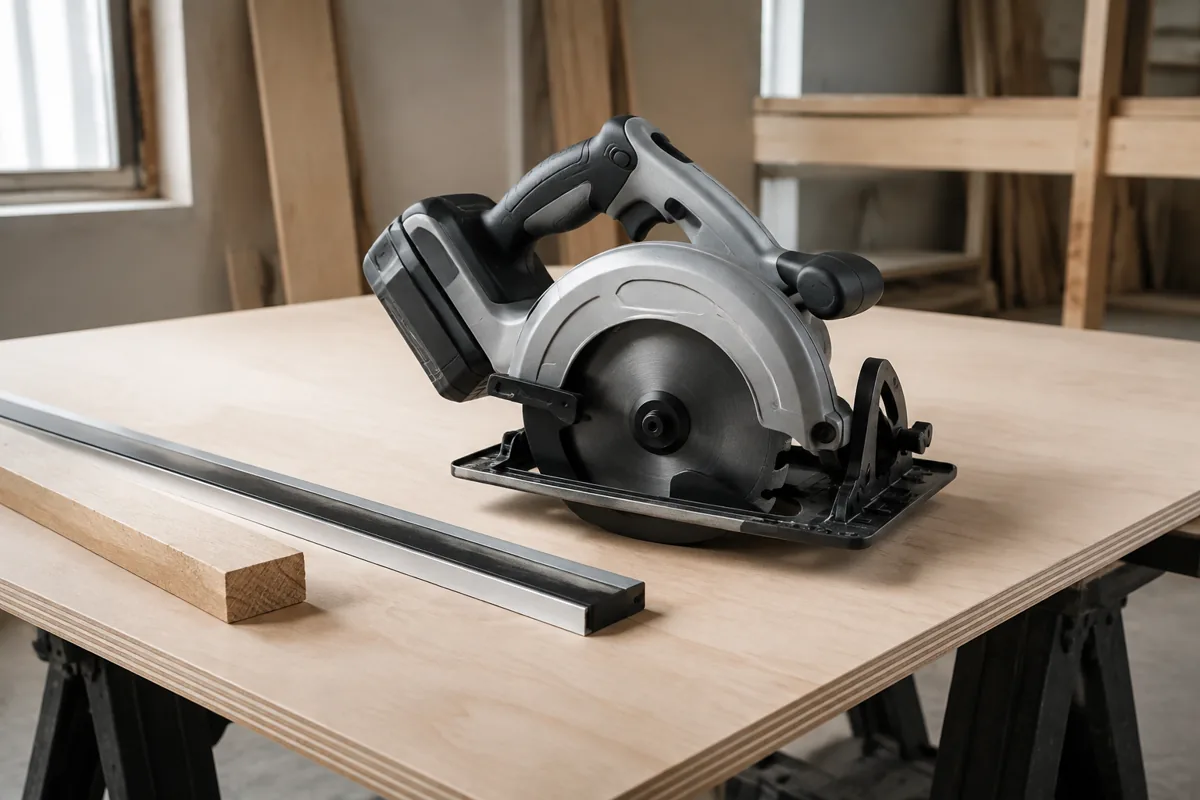
Breaking down a 4-by-8 sheet of plywood is where a guided saw earns its keep. A standard circular saw can do the job accurately with a guide rail, but a track saw is designed around that method from the start. The better choice depends on how often you cut sheet goods, how much accuracy matters, and whether you already own a circular saw.
As an Amazon Associate we earn from qualifying purchases at no extra cost to you.


Updated October 2026 — Track saw vs circular saw with guide rail: buy a track saw if you break down plywood every month or build cabinets, because the splinter strip, enclosed dust port and plunge action give cleaner, repeatable cuts with less setup. If you cut a few sheets a year and already own a circular saw, a guide rail such as the Kreg Accu-Cut or Milescraft 1409 gets you most of the way for far less.
- Best cordless track saw: DEWALT DCS525B · 20V MAX XR · 2-1/8 in. depth at 90° on track · -1° to 48° bevel
- Best corded track saw kit: Makita SP6000J1 · 6-1/2 in. blade · 55-inch rail and case included
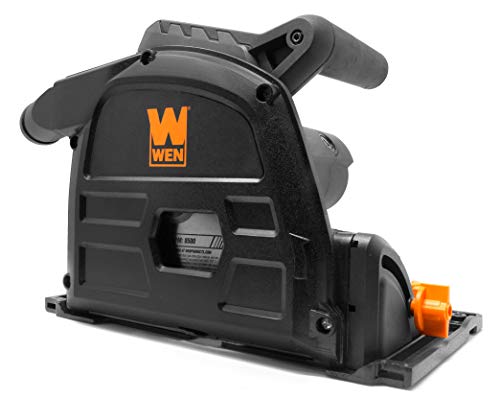
- Best budget track saw: WEN CT1065 · 10-amp corded · 6.5-inch blade · plunge cut
- Best guide for an existing circular saw: Kreg Accu-Cut · sled-mounted saw · no offset math
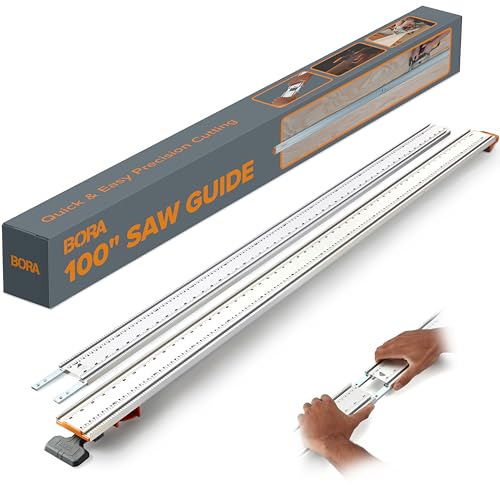
- Best low-cost full-length rip guide: BORA NGX · 100-inch clamp edge
Our Top Picks
 WEN CT1065 10-Amp 6.5-Inch Plunge Cut Sidewinder CircularTrack Saw12 x 6 x 5 inches0 poundsCheck on Amazon


The Basic Difference
A track saw rides on a dedicated rail. The saw’s base engages with the rail, and the rail keeps the blade on a straight path while also showing exactly where the cut will land. Most rails have an anti-slip strip underneath, so they usually stay in place without clamps on a clean, flat panel.
A circular saw with a guide rail uses a separate straightedge or rail. Some systems have a shaped track that accepts a specific saw base; others are simply clamped guides that the saw’s shoe runs against. A bare board clamped to the plywood can also work, but you must account for the distance from the saw’s shoe to the blade.
That distinction matters. A track saw is a purpose-built sheet-goods tool. A circular saw is a general-purpose tool adapted for accurate panel cutting.
Track Saw vs. Circular Saw With Guide Rail
| Factor | Track saw | Circular saw with guide rail |
|---|---|---|
| Cut accuracy | Excellent, with minimal setup | Good to excellent, depending on the guide |
| Splinter control | Usually excellent on the track edge | Good with the right blade and guide |
| Typical depth | Often about 2 inches at 90 degrees | Usually about 2-1/2 inches at 90 degrees |
| Best use | Repeated, clean, precise sheet cuts | General construction and occasional panel breakdown |
| Cost | Higher initial cost | Lower if you already own the saw |
| Speed of setup | Fast once the rail is positioned | More measuring, clamping, and alignment |
Beyond Straight Cuts: Dust, Bevels, Plunge Cuts, and Safety
The table above covers the headline differences, but several practical details decide how each setup feels once a full sheet is lying on foam or across sawhorses.
Accuracy and Repeatability
A track saw’s base is shaped to fit its rail, and most designs include adjustable cams or guides that take out side-to-side play. Once that adjustment is set, the blade follows the same path on every cut, and the trimmed splinter strip shows exactly where the kerf will land. A circular saw running against a clamped straightedge depends on you keeping the shoe pressed against the guide for the full length of the cut. A small drift away from the edge, most often near the far end of an 8-foot rip, shows up as a slight bow or a gap that grows along the joint. Guide systems that hold the saw in a sliding sled reduce that problem, which is why they sit between a bare straightedge and a dedicated track saw in both price and accuracy.
Tear-Out on the Top and Bottom Faces
The rubber splinter strip on a track saw rail presses veneer fibers down right at the blade, which is the main reason track-saw edges on plywood look so clean on the top face. With a plain straightedge there is nothing holding the fibers at the cut line, so many people cut with the show face down when using a standard circular saw. The underside depends on support and blade choice for both tools. On expensive veneered panels, a shallow scoring pass about 1/8 inch deep followed by a full-depth pass is a common way to reduce chipping. As noted in the setup section below, test the orientation on scrap with your own blade.
Dust Collection
Most track saws enclose the upper blade and route dust to a port sized for a shop vacuum or dust extractor. With a vacuum connected, much of the fine dust is captured at the source, which matters if you cut sheet goods in a finished garage, a basement, or an occupied house. A typical circular saw throws dust out of the side or back of the guard. Some have a port or an adapter, but the open lower guard limits how much they can collect, so plan on cutting outdoors or cleaning up afterward.
Plunge Cuts and Cutouts
A track saw’s spring-loaded plunge action lets you start a cut in the middle of a panel, which is useful for sink openings, vent cutouts, and stopped cuts. A circular saw can only start mid-panel by tipping it forward on the shoe with the guard retracted, a technique that carries a real kickback risk and is best avoided unless you are experienced with it.
Bevel Cuts
Both tools tilt for bevels, commonly up to about 45 degrees. The difference is where the cut lands. Track saws are designed so the blade pivots at the rail edge, so a beveled cut still follows the splinter strip. When a standard circular saw tilts, the blade moves relative to the shoe, so the offset you measured for square cuts no longer applies and the guide must be repositioned or re-measured for every bevel angle.
Kickback Control
Many track saws include a riving knife behind the blade to keep the kerf from closing, and some systems add an anti-kickback catch that engages the rail if the saw starts to move backward. With a standard circular saw, kickback prevention relies more on setup: support the panel so the kerf stays open, keep the saw square to the guide, and never lift or twist the saw mid-cut.
Corded or Cordless
Both tool types come in corded and battery versions. A cordless track saw removes the most common annoyance on long rips, which is the cord catching on the end of the rail or the edge of the sheet. Battery runtime is rarely a problem for breaking down a few sheets of 3/4-inch plywood, but corded saws are still a sensible choice for long sessions in dense material such as MDF. Many cordless track saws are sold as bare tools, so if you already own batteries from the same brand, staying on that platform keeps the cost down considerably.
Track Saw vs Circular Saw With Guide Rail: Pros and Cons at a Glance
If you only want the short version of the track saw vs circular saw with guide rail decision, these lists show what each setup gives you and what it costs you in space, money and setup time.
Track saw: pros and cons
Pros
- Splinter strip at the cut line gives the cleanest edge on veneered plywood.
- No shoe-to-blade offset to measure, so the rail edge sits on the layout mark.
- Enclosed blade and a dust port that connects to a shop vacuum.
- Plunge action for sink cutouts, vent openings and stopped cuts.
- Rail packs flat for storage and travel, and rails can be joined for longer rips.
Cons
- Higher entry cost once the saw, rail and clamps are added up.
- Rail profiles are not universal, so check fit before mixing brands.
- Less depth than a 7-1/4 inch circular saw and a poor tool for rough framing cuts.
Circular saw with a guide rail: pros and cons
Pros
- Much lower cost if you already own a circular saw.
- The same saw still handles framing, thick stock and rough cuts.
- Sled-style guides such as the Kreg Accu-Cut and Milescraft 1409 bring cut-line accuracy close to a track saw.
- Long clamp-style edges like the BORA NGX 100-inch cover a full 8-foot rip in one setup.
Cons
- Plain straightedges need shoe-offset measuring and constant side pressure.
- Little or no dust collection and more tear-out on the show face.
- No true plunge action, so mid-panel starts are riskier.
Most buyers fall on one side of a simple line: cut sheet goods monthly or build cabinets and a track saw earns its price; cut a few sheets a year and a guide for the saw you own is the better value.
When a Track Saw Is the Better Buy
Choose a track saw if you regularly cut cabinet panels, shelving, doors, or large plywood parts where a 1/16-inch error creates problems. The rail’s splinter guard is trimmed by the blade on its first use, giving you a visible cut line. Put that edge on the waste side of the layout line and position it directly on the cut mark.
Track saws also make plunge cuts safer and more controlled. You can set the blade depth, place the rail, plunge into the panel, and stop at a marked point. That is useful for cutting a large panel to length without starting the blade over an unsupported edge.
For regular cabinet work, a track saw with guide rail is usually worth the extra money. It reduces layout work and gives more repeatable results. Long rails can be joined with connectors, although a joined rail needs to be aligned carefully or the saw may bump at the seam.
The main drawbacks are price and ecosystem lock-in. Rails are not universally interchangeable, and adding a second rail, clamps, or a replacement splinter strip can increase the total cost. A track saw is also less convenient than a standard circular saw for rough framing cuts, short lumber cuts, and work where perfect edges are irrelevant.
When a Circular Saw With a Guide Is Enough
If you already own a good circular saw, a guide rail may be the economical answer. For breaking down plywood into manageable pieces, a straight guide can produce cabinet-grade results when the blade is sharp and the setup is sound. The saw itself may also have more cutting depth than a track saw, which helps when cutting thick stock or stacked material.
A circular saw guide rail is most practical for occasional projects: a workbench top, garage cabinets, subfloor panels, or a few sheets of construction plywood. If your existing saw has a stiff, flat shoe and little side-to-side play, it can follow a guide reliably.
The failure mode is usually not the saw. It is guide positioning. If you measure from the wrong edge of the shoe, every cut can be off by the same 1/8 inch or more. Make a test cut, measure the result, and mark the guide’s actual blade position. With a homemade guide, cut the guide edge using the same saw so its edge represents the blade path.
Guide Options for a Circular Saw
“Circular saw with a guide rail” covers several very different products. Knowing which type you are buying explains most of the difference in price and accuracy.
- Shop-made straightedge: A straight strip of plywood or MDF glued to a wider base, then trimmed with your own saw so the base edge shows the exact cut line. It costs only scrap material and can be very accurate, but it is heavy, can warp with humidity, and only matches the saw and blade used to trim it.
- Clamp-style straightedge: An aluminum rail with built-in clamps that grip the panel edges, often sold in lengths from about 24 inches to 100 inches. The saw’s shoe runs against the edge, so you must measure or mark the shoe-to-blade offset for every cut.
- Track-style guide system: The circular saw is fastened to a sled or base plate that rides on a dedicated rail, often with a splinter strip and anti-slip backing. This setup comes closest to a real track saw and removes the offset measurement, though it adds weight to the saw and needs checking for compatibility with your saw size and blade side.
- Rip or edge guide: A guide that rides along the factory edge of the sheet for cutting repeated strips, typically up to about 24 inches wide. It is fast for shelving strips, but it can only be as straight as the edge it follows.
What Each Setup Really Costs
The saw price is only part of the bill. Rails, connectors, clamps, and spare splinter strips can move a “budget” setup closer to the next tier than expected. The cost column below uses tier words because street prices change often; check current listings before you buy.
| Setup | Relative cost | What you get | Extra costs to plan for |
|---|---|---|---|
| Shop-made guide plus an existing circular saw | Low | Accurate cut-line edge for one saw and blade | A good plywood blade, clamps, storage space |
| Clamp-style straightedge | Low | Full-length rips with no separate clamps | Offset measuring on every cut, blade upgrade |
| Track-style guide system for a circular saw | Low to mid-range | Splinter control and no offset math | Expansion rail for full 8-foot rips |
| Budget corded track saw | Mid-range | Plunge action and dust port at a low entry cost | Second rail, connectors, clamps |
| Premium corded track saw kit | Premium | Saw, case, and roughly a 55-inch rail | Longer rail or second rail for rips |
| Premium cordless track saw | Premium | No cord on the rail, same-brand battery platform | Batteries, charger, and rails if not bundled |
For most people, the deciding number is not the saw price but the total for a system that can rip a full 8-foot sheet. Price the rail lengths you actually need before comparing tools.
Setup for Clean, Safe Cuts
Support the plywood continuously or in several places so the waste does not pinch the blade. Foam insulation boards are excellent for this because they support the entire sheet and allow the blade to pass slightly below the plywood. Set the blade depth only about 1/8 inch deeper than the panel. Excess depth increases the chance of hitting supports and can worsen tear-out.
Use a fine-tooth plywood or finish blade for veneer-faced panels. A 40-tooth blade is a reasonable general choice; a 60-tooth blade can leave a cleaner edge but cuts more slowly and generates more heat. Keep the finished face oriented according to the saw and blade manufacturer’s guidance, and test on scrap because different blade geometries reverse the usual chip-out pattern.
Clamp the guide when there is any chance it will move. Anti-slip strips lose grip on dust, rough plywood, and dirty work surfaces. Keep the saw’s shoe fully engaged with the rail before starting, let the blade reach full speed, and advance at a steady rate. Forcing the saw can cause burning, wandering, or a kickback when the kerf closes.
How to Break Down a Full 4×8 Sheet
Whichever tool you choose, a consistent sequence keeps parts square and reduces wasted plywood.
1. Plan the cut list first. Sketch the sheet and decide which cuts reduce it to manageable pieces soonest. Many cut lists start with a crosscut or a rip that splits the sheet in half, so the heavy, floppy part of the job ends early. If you plan to finish parts on a table saw, leave them about 1/8 inch oversize.
2. Account for the kerf. Every cut removes the width of the blade. Mark the waste side of each line with an X so the guide edge or splinter strip always goes on the correct side.
3. Establish a reference edge. Factory edges are usually straight but can be dented or slightly off square. Trim a thin strip from one long edge if your parts need to be square, then measure everything from that new edge.
4. Position the guide at both ends. With a track saw, set the splinter strip on your marks at each end of the cut. With a straightedge, measure the offset at both ends. Checking only one end is the most common cause of tapered parts.
5. Use a rail long enough for the cut. The saw needs a few inches of rail before the panel and after it. A crosscut across 48 inches needs a rail of roughly 55 inches or more, and a full 96-inch rip calls for about 106 inches or more, usually two joined rails or one long clamp-style edge.
6. Check square after the first crosscut. Measure the diagonals of the first large part. Equal diagonals confirm the cut is square before you repeat the setup on the rest of the sheet.
7. Label parts as they come off. Mark each piece with its name and the show face. On cabinet projects, this prevents cutting a second panel from a sheet you meant to save.
More Track Saws and Circular Saw Guides Worth a Look
The picks at the top of this guide focus on DEWALT and Makita track saws. If you want a lower entry cost, or you would rather keep using the circular saw you already own, these alternatives cover the other price tiers.
Kreg Accu-Cut Circular Saw Track — Best for Upgrading a Circular Saw

The Accu-Cut is the closest a standard circular saw gets to track-saw behavior. Your saw mounts to a sled that rides the track, so there is no shoe-to-blade offset to measure, and the listing highlights straight, cross, rip, and angled cuts on plywood and sheet goods. This version includes track clamps and is described as having extra grip on slick surfaces such as melamine. The base track handles crosscuts across a sheet’s 48-inch width, and the maker sells an expansion pack for longer rips.
Pros:
- Works with a circular saw you may already own
- Sled design removes offset measuring
- Clamps included for slippery panels
Cons:
- Full 8-foot rips need the separate expansion pack
- Saw-plus-sled is heavier than a dedicated track saw
BORA NGX 100-Inch Clamp Edge — Best Low-Cost Guide for Full-Length Rips
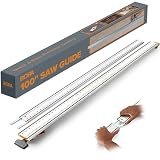
The BORA NGX is a clamp-style aluminum straightedge long enough to span a full 8-foot sheet in one setup. Its integrated clamping action grips the panel edges, so no separate clamps are needed, and the saw’s shoe runs along the edge. That makes it fast for ripping construction plywood, subfloor panels, and garage-shelving stock. Because it is a plain guide rather than a captured track, you will need to measure or mark the shoe offset, as described earlier, and splinter control depends on your blade and technique.
Pros:
- Long enough for full 96-inch rips
- Built-in clamping, no extra hardware
- Works with most circular saws
Cons:
- Offset measuring on every setup
- No splinter strip at the cut line
WEN CT1065 Plunge Track Saw — Best Budget Corded Track Saw
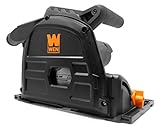
For buyers who want a real plunge-cut track saw without premium pricing, the WEN CT1065 is a 10-amp corded saw with a 6.5-inch blade and a sidewinder layout. The saw is sold without a rail, and WEN sells its own 100-inch track separately, so budget for at least one rail of 55 inches or longer before comparing it with kits that include one.
Pros:
- Lowest entry price for true plunge cutting
- Corded power for long sessions
- Good fit for occasional cabinet and furniture work
Cons:
- Rail is sold separately
- Less refined adjustment and fit than premium systems
Makita SP6000J1 Plunge Saw Kit with 55-Inch Rail — Best Corded Kit for Cabinet Work

The SP6000J1 bundles Makita’s corded 6-1/2-inch plunge circular saw with a 55-inch guide rail and a stackable tool case, so it is ready to crosscut a full 48-inch sheet out of the box. It suits woodworkers who cut sheet goods every week and prefer the unlimited runtime of a cord over a battery platform. If you already own Makita 18V batteries, compare it against the cordless Makita pick at the top of this guide.
Pros:
- Rail and case included in the kit
- Corded power for dense material and long sessions
- Rail length covers full-width crosscuts
Cons:
- Premium price
- Second rail needed for 8-foot rips
Milwaukee M18 FUEL 2831-20 — Best Cordless Track Saw for Milwaukee Battery Owners

- Blade: 6-1/2 in., 20mm arbor; brushless M18 FUEL motor with variable speed
- Depth: 2-1/4 in. at 90° and about 1-9/16 in. at 45° on the track
- Bevel: -1° to 48° with stops at 22.5° and 45°
- Dust port: fits 1-7/8 in. hoses; adjustable rail cam
- Sold as a bare tool; guide rail purchased separately
Milwaukee’s track saw is reported to accept Festool- and Makita-pattern rails, and Milwaukee also sells its own 31-, 55- and 106-inch rails, so a large ecosystem of rails and accessories is available. Confirm fit with the maker before mixing brands; the saw has an adjustable cam to dial in rail fit. That matters if you plan to add a long rail, a rail square or a parallel guide later.
Pros: deepest rated cut on the track in this group; shares the common rail profile; micro-adjust depth stop. Cons: bare tool plus rail adds up quickly; retailers list different top speeds, so check the spec sheet.
Skip it if… you are not already on the M18 battery platform; buying batteries and a charger pushes it into premium-kit territory.
Ryobi ONE+ HP PTS01B — Best Entry Cordless Track Saw With Rails Included

- Blade: 6-1/2 in., 5/8 in. arbor, up to 4,300 RPM; 18V brushless
- Depth: 1-15/16 in. at 90° and 1-7/16 in. at 45° on the track
- Bevel: -1° to 48°
- In the box: 40-tooth blade, two 27.5 in. tracks (55 in. joined), riving knife and track clamp
- Dust port: fits 1-1/4 in. and 1-7/8 in. hoses
The Ryobi is the cheapest way to get a cordless plunge saw with enough included rail to crosscut a 4×8 sheet. Its rails use a Ryobi-only profile, though, so Festool-pattern accessories will not fit.
Pros: rails, blade and clamp included; runs on common ONE+ batteries. Cons: proprietary rails; less depth than the Milwaukee or DEWALT; reviewers note weaker dust collection.
Skip it if… you expect to cut hardwood or thick stock often; a pro-grade saw handles it more easily.
Milescraft 1409 TrackSawGuide — Best Track-Style Guide for 7-1/4 Inch Circular Saws

- Fits most left- or right-blade circular saws up to 7-1/4 in.; not most worm-drive or rear-handle saws
- Cut length: 50 in. out of the box; optional 1408 GuideRails extend it for 8-foot rips
- Cut depth: about 1-3/4 in. to 2 in., depending on the saw
- Aluminum saw base and rails with anti-slip strips and a red splinter strip
- Includes two rail sections, two TrackClamps and saw clips
Like the Kreg Accu-Cut, the Milescraft mounts your saw to a base that rides the rail, so the cut lands on the strip instead of an offset you have to measure. It fits common 7-1/4 in. sidewinders, which keeps more depth than a 6-1/2 in. track saw.
Pros: keeps your existing saw; splinter strip at the cut line; low entry cost. Cons: extensions needed for full rips; no enclosed dust collection.
Skip it if… your saw is a worm drive; check Milescraft’s compatibility chart first.
Track Saw vs Circular Saw With Guide Rail: Best Setup by Budget
Best under $150: circular saw plus a guide
- Shop-made guide: scrap plywood or MDF · trimmed with your own saw · zero offset
- BORA NGX 100-inch: clamp-style edge · full 96-inch rips · built-in clamps
- Kreg Accu-Cut / Milescraft 1409: sled-mounted saw · splinter strip · about 50-inch base cut
What to expect at this tier:
- Straight, square cuts on construction plywood with a good 40- to 60-tooth blade
- More tear-out on veneered faces unless you score first or cut face-down
- Little dust collection; plan to cut outside or vacuum afterward
- Extra rail sections or clamps needed for full 8-foot rips
Best $150–$450: entry track saws and bare cordless tools
- WEN CT1065: corded · 10 amps · 6.5-inch blade · plunge cut
- Ryobi ONE+ HP PTS01B: 18V · 1-15/16 in. depth on track · 55 in. of rail included
- Milwaukee M18 FUEL 2831-20 / DEWALT DCS525B: bare tools · about 2 in. or more of depth on the track
What to expect at this tier:
- True plunge cuts and a dust port that works with a shop vacuum
- Rails often sold separately on pro bare tools; budget one 55-inch rail minimum
- Splinter-strip cut lines that make layout faster than offset measuring
Best $450 and up: complete pro track saw systems
- Makita SP6000J1: corded · 55-inch rail · stackable case
- DEWALT DWS520K: corded TrackSaw kit · DEWALT rail system
- Makita XPS01PTJ: 18V X2 (36V) · brushless · 5.0Ah kit
What to expect at this tier:
- Tighter rail fit with adjustable cams and less side play
- Riving knives and anti-kickback features as standard
- Rail profiles shared across several brands, opening up accessories
Cordless and Corded Track Saws Compared by Rated Cut Depth
| Saw or guide | Power | Blade | Depth at 90° | Depth at 45° | Bevel range |
|---|---|---|---|---|---|
| DEWALT DCS525B | 20V MAX XR | 6-1/2 in. | 2-1/8 in. on track | 1-5/8 in. on track | -1° to 48° |
| Milwaukee M18 FUEL 2831-20 | 18V | 6-1/2 in. | 2-1/4 in. on track | about 1-9/16 in. on track | -1° to 48° |
| Makita XPS01 | 18V X2 (36V) | 6-1/2 in. | 2-3/16 in. off rail | 1-9/16 in. off rail | -1° to 48° |
| Ryobi ONE+ HP PTS01B | 18V | 6-1/2 in. | 1-15/16 in. on track | 1-7/16 in. on track | -1° to 48° |
| Festool TS 55 FEQ | Corded, 1,200W | 160mm (6-1/4 in.) | 1-15/16 in. on rail | 1-7/16 in. on rail | -1° to 47° |
| Milescraft 1409 + 7-1/4 in. circular saw | Your saw | Up to 7-1/4 in. | about 1-3/4 to 2 in. | Depends on saw | Depends on saw |
Brands quote depth differently: some list it with the saw on the rail, others without. Rails take up a few millimeters, so compare on-track numbers where possible. Every saw here clears 3/4-inch plywood easily, even at 45°.
What to Buy
Buy a track saw if you expect to break down sheet goods every month, need repeatable cabinet parts, or dislike measuring a guide offset for every cut. A longer rail—around 55 to 75 inches—is more useful for crosscutting a full-width sheet than a short rail, while two shorter rails are easier to store.
Buy a circular saw straight-edge guide if your work is occasional and you already have the saw. Put the savings into a quality blade, solid supports, and clamps. Those accessories often improve the result more than replacing a serviceable saw.
If you are starting from nothing and expect to make only a few plywood cuts, the circular saw remains the sensible cheaper option. If inaccurate cuts, repeated setup, and damaged veneer will cost more than the tool upgrade, a track saw pays for itself through faster layout and fewer ruined panels.
Frequently Asked Questions
Can a circular saw be used as a track saw?
Yes, with the right guide. A clamp-style straightedge or a shop-made guide lets a circular saw cut straight lines in plywood, and a track-style system that holds the saw in a sled gets closer still. What a circular saw cannot fully match is the track saw’s splinter strip at the cut line, its enclosed dust collection, and its controlled plunge action.
Is a track saw worth it for occasional plywood cuts?
Usually not. If you break down a few sheets a year, a good plywood blade and a clamp-style guide or track-style guide system for your existing circular saw will give clean, straight results for much less money. A track saw starts to pay off when you cut sheet goods every month, build cabinets, or work in spaces where dust control matters.
What length of rail do I need for a 4×8 sheet of plywood?
For crosscuts across the 48-inch width, a rail of about 55 inches or longer is the practical minimum because the saw needs some rail before and after the panel. For a full 96-inch rip, plan on about 106 inches or more, which usually means two shorter rails joined with connectors or a long clamp-style guide.
Do track saw rails work with other brands of saws?
Sometimes. Several major brands use similar rail profiles, so some saws can ride on another brand’s rails with adjustment. Fit, side play, and splinter-strip alignment can differ, though, so confirm compatibility in the saw’s manual before mixing brands, and trim the splinter strip with the saw you will actually use.
Can a track saw cut 2x lumber or thick stock?
A track saw handles 3/4-inch plywood and 1-1/2-inch dimensional lumber, but the rail reduces the usable depth slightly, so check the depth listed for cuts made on the rail. For thicker stock or framing work, a 7-1/4-inch circular saw is the better tool.
What blade should I use for cutting plywood with a track saw?
Use a fine-tooth blade intended for sheet goods and fine finish cuts, in the size and arbor specified by your saw’s manufacturer. Many track saws use a 6-1/2-inch blade with a specific bore, so replacement blades can be harder to find and cost more than common circular saw blades. Keep a spare on hand for long projects.
Do I still need a table saw if I buy a track saw?
Not for breaking down sheet goods, which is where a track saw excels. A table saw is still faster for cutting many narrow parts to the same width, because you set the fence once instead of positioning a rail for every piece. Many woodworkers combine the two: break the sheet down with a guided saw, then trim parts to final size on the table saw.
Is a track saw more accurate than a circular saw with a guide rail?
Usually yes, mainly because the saw base locks onto its rail with adjustable cams. A circular saw against a plain straightedge can drift if you ease pressure near the end of an 8-foot rip; a sled-style guide such as the Kreg Accu-Cut narrows that gap considerably.
Which cordless track saw cuts deepest on the rail?
Among popular 6-1/2 in. models, the Milwaukee M18 FUEL 2831-20 lists the most depth on the track at 2-1/4 in. at 90°. The DEWALT DCS525B lists 2-1/8 in., and the Ryobi PTS01B lists 1-15/16 in.
Can you use a track saw without the track?
Most plunge-style track saws can run off the rail, but the cut then depends on your hand. The splinter guard, rail cams and anti-kickback features are built around rail use, so freehand cuts are best kept for rough work and checked against the saw manual.
Are track saws safer than table saws for sheet goods?
For full sheets, many woodworkers find a track saw easier to control because the panel stays still while the blade travels along the rail, and the upper blade is mostly enclosed. Any saw can cause injury, and safety features vary by model, so use eye and hearing protection, support the offcut and follow the manual.
Is a track saw better than a circular saw for cutting plywood?
For clean, repeatable cuts on plywood a track saw is usually better because of its splinter strip, dust port and fixed rail position. A circular saw with a good guide is still enough for rough breakdown, shop furniture and construction plywood where edge finish matters less.