What's inside
As an Amazon Associate I earn from qualifying purchases. This post may contain affiliate links at no extra cost to you.
For full 4-by-8 plywood, rail length is not just a matter of matching the sheet’s 96-inch side. The right choice depends on whether you are crosscutting or ripping, how accurately you need to start and finish the cut, and whether you want to move one long rail or join shorter rails.
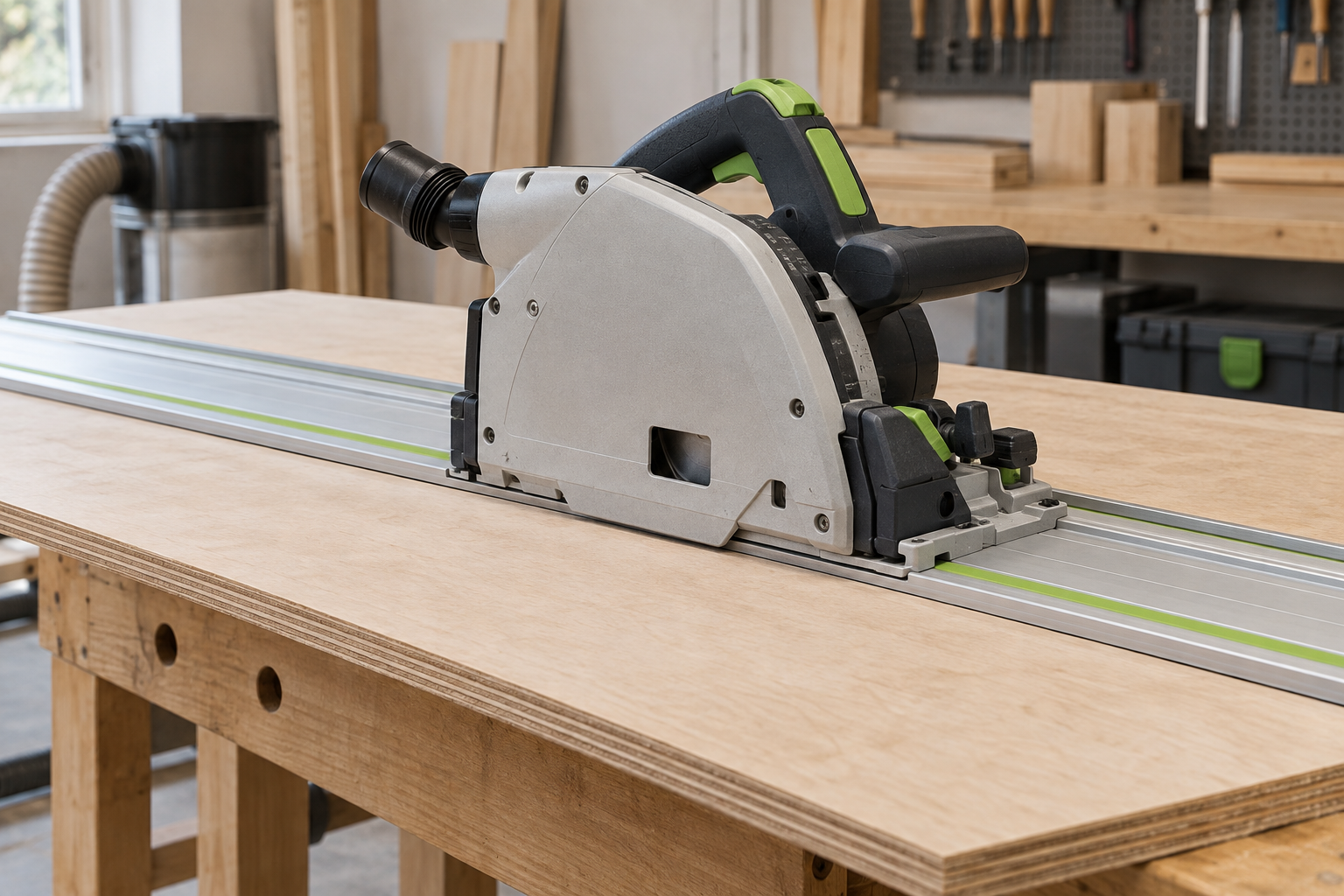
In most shops, a track saw rail between 55 and 75 inches is the best compromise. A 55-inch rail handles crosscuts across a 48-inch sheet and is easier to store. A 75-inch rail gives more support for long crosscuts and can cut much of a sheet lengthwise, but it still does not cover the entire 96-inch edge. For regular full-sheet ripping, two connected rails or a dedicated 96-inch rail make more sense.
The Basic Rule for Rail Length
Choose a rail that extends past the intended cut at both ends. The saw needs room to enter the track, plunge fully, and exit without running out of rail while the blade is still cutting. A rail that ends exactly at the sheet edge is usually too short in practical use.
For a crosscut across the 48-inch width, a rail around 55 inches is normally sufficient. It provides roughly 3 to 4 inches of extra length at each end, depending on the saw and the exact setup. A 59-inch or 62-inch rail provides more comfortable margins.
For a cut along the 96-inch length, one standard rail is rarely enough. Even a 75-inch rail will leave a substantial section uncut. You can finish the cut by repositioning the rail, but that introduces a second alignment operation and creates a visible risk of a step or kink in the cut.
If your goal is a clean, continuous 96-inch rip, buy a track saw rail connector kit and join two compatible rails, or choose a purpose-made long rail.
Rail Lengths Compared
| Rail length | Best use on 4-by-8 sheets | Main advantage | Main drawback |
|---|---|---|---|
| ~55 inches | Crosscuts across the 48-inch width | Light, affordable, easy to store | Too short for a continuous 96-inch rip |
| ~75 inches | Long crosscuts and shorter rips | More support and fewer repositioning jobs | Still short for a full-length rip |
| Two 55-inch rails | Full-length rips and long cuts | Flexible; also works as two short rails | Connector alignment takes care |
| ~96-inch rail | Continuous full-length ripping | No mid-cut rail joint | Expensive, awkward to transport and store |
Choosing a Rail for Crosscutting
Crosscutting means cutting across the 48-inch width of a standard sheet. This is the easiest full-sheet operation for a track saw. A 55-inch rail is usually enough, and it is often the sensible starter size if you break sheets into cabinet parts, shelving, or smaller panels.
Do not measure only the cut line. Account for the saw’s plunge position and the rail’s non-cutting ends. Place the guide so the blade enters the waste side of the sheet, not directly at the edge. If the saw cannot start with its base fully supported on the rail, it may tip or plunge unevenly.
A longer rail is useful when cutting thick or heavy panels because the added contact area reduces rocking. It also gives you more freedom to position clamps. The trade-off is handling: a 75-inch rail is more likely to bump walls, door frames, and the edge of the sheet while you set up.
For occasional plywood breakdown, a 55-inch track saw rail is generally the cheaper option that does the job. There is little benefit in buying a 96-inch rail if nearly all your cuts are across the sheet.
Ripping the 96-Inch Edge
Ripping a full sheet from end to end is where rail length matters most. A single 55-inch rail requires at least one repositioning. A 75-inch rail may let you cut most of the length, but stopping and moving it still risks a mismatch.
Two connected rails are usually the most practical solution. They let you keep each rail manageable while providing enough length for the full cut. The joint must be straight and tight. If the rails are even slightly misaligned, the saw can bump at the connector, the blade can wander, or the cut can show a small change in direction.
Before cutting a valuable panel, join the rails on a flat surface and run your fingers across the underside. The guide strips should form one continuous plane. Tighten the connector screws gradually, alternating between them. Do not force a rail straight against a badly assembled connector; loosen it, realign it, and try again.
A dedicated 96-inch rail avoids the joint entirely, but storage is a serious issue. It needs a long wall, rack, or protected vertical space. It is also easier to bend or damage during transport. Unless you routinely break down sheet goods in a production setting, connected shorter rails are usually the better value.
Check Compatibility Before Buying
Rail length is useless if the rail does not fit your saw. Brands use different guide profiles, anti-tip features, splinter strips, and connector systems. Some saws physically sit on another manufacturer’s rail but do not track correctly or retain the intended safety features.
Confirm the saw and rail are compatible, including the correct compatible guide-rail connector. Also check whether the rail includes a splinter guard. A worn or trimmed strip can make the guide’s marked edge inaccurate, especially after changing to a different blade or saw.
For long cuts, use a sacrificial foam sheet beneath the plywood. It supports the panel without interfering with the blade and lets you place the rail anywhere on the top face. Make sure the foam is thick enough that the blade will not reach the floor or workbench.
When to Buy Longer or Shorter
Buy the shortest rail that safely covers your most common cut. It costs less, takes less room, and is easier to position accurately. A 55-inch rail is a strong choice for crosscutting 4-by-8 sheets, while a 75-inch rail suits users who make longer panel cuts and want more support.
Buy two matching rails if full-length rips are routine. This is normally more versatile than one 96-inch rail: use them joined for cabinet sides and long rips, or separately for crosscuts and smaller panels. Buy a full-length rail only when uninterrupted, repeatable 96-inch cuts justify its storage and handling disadvantages.
Whatever length you choose, mark the cut line, measure from the rail’s guide edge rather than its physical end, and make a test cut in scrap. Those few minutes prevent the most common failure: a perfectly straight cut in the wrong location.