What's inside
As an Amazon Associate I earn from qualifying purchases. This post may contain affiliate links at no extra cost to you.
The short answer
A track saw’s splinter guard usually reduces tear-out better for long, straight cuts with the saw it was made for. Its edge marks the blade’s cut line and supports the surface fibers right beside the kerf. A zero-clearance insert can do a similar job on a table saw, but it helps only at the insert opening; it does not support the whole cut edge.
These are not interchangeable accessories. Choose based on the saw and cut: a track saw guard for sheet goods and guided cuts, a zero-clearance insert for table-saw work. Either can still leave chips if the blade is dull, the workpiece is unsupported, or the cut direction pulls fibers away from the show face.
How each accessory controls tear-out
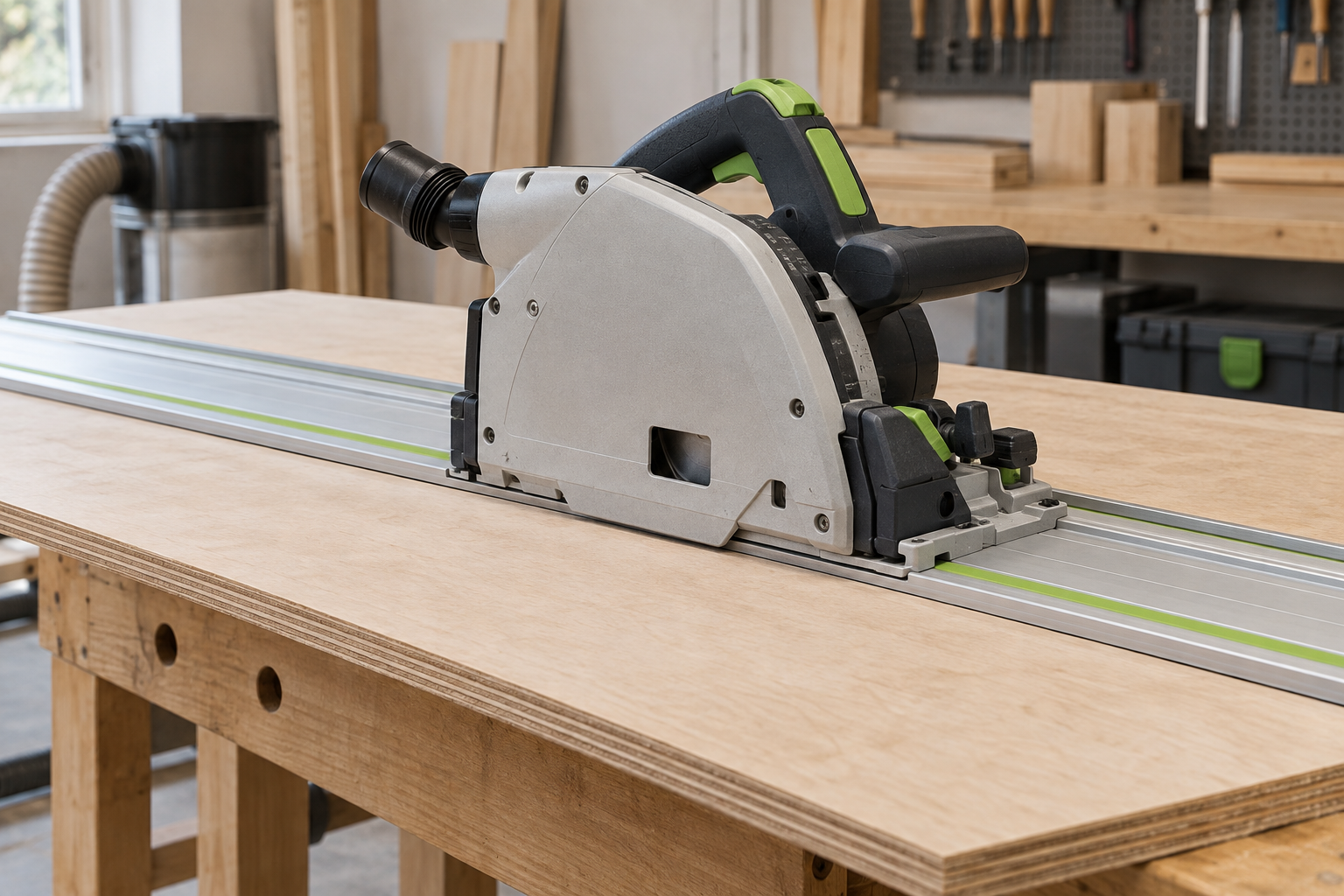
A track saw splinter guard is a sacrificial strip along the track’s edge. On its first use, the blade trims the strip flush to that particular saw’s cut line. During later cuts, the strip presses down close to the blade as the saw travels along the track. This limits the unsupported distance where top-surface fibers might break away.
A zero-clearance insert is a table-saw throat plate with a narrow blade slot. The blade cuts that slot, leaving little space around the teeth. That close support helps reduce chips at the top surface as the stock passes over the table. It is especially useful for crosscuts and narrow parts, where the factory opening may leave more material unsupported.
Neither accessory makes a poor setup harmless. A guard worn wider than the blade’s cut, an insert with an oversized slot, or a blade that has built up pitch can all reduce the benefit.
Head-to-head comparison
| Factor | Track saw splinter guard | Zero-clearance insert |
|---|---|---|
| Best fit | Long cuts guided by a track saw | Table-saw ripping and crosscutting |
| Where it supports fibers | Along the track edge beside the cut | At the table opening around the blade |
| Setup | Trim the guard to the saw’s cut line; replace it as it wears | Make a blade-width slot in a suitable insert |
| Common limitation | Does not protect a cut made away from the track edge | Does not provide continuous support along a long workpiece edge |
| Typical trade-off | Convenient for breaking down sheet goods, but guards are consumable | Can be inexpensive to make, but inserts are blade- and setup-dependent |
When the track saw guard is the better choice
For a 4-by-8-foot plywood sheet, the track saw guard is generally the more useful tear-out control. It supports the cut edge for the full length of the track, while the workpiece can stay on foam insulation or another sacrificial surface. The track also helps keep the saw on the intended line. That combination is practical for cabinet panels, doors, and other large parts that are awkward to feed across a table saw.
Buy a compatible track saw splinter guard if the original strip is ragged, has gaps, or no longer aligns with the blade. Fit and trim it according to the saw maker’s instructions. Guards are usually specific to a track system, and a misaligned or poorly fitted strip can give a misleading cut-line reference.
The guard is not a substitute for holding the panel securely. If the sheet sags, shifts, or vibrates as the saw passes, the fibers can still chip. Support the whole panel, keep the offcut from pinching the blade, and use a sharp blade suited to plywood or veneered material. For especially delicate veneer, test the setup on a scrap from the same sheet.
When a zero-clearance insert is the better choice
On a table saw, a close-fitting insert is a sensible low-cost improvement for crosscutting solid wood or cutting sheet goods where the stock travels over the blade opening. It can also reduce small pieces dropping into the cabinet. If you make inserts from suitable material, they are relatively cheap to replace when a different blade or bevel angle requires a different slot.
A table-saw zero-clearance insert must fit the saw and sit level with the table. Before cutting the slot, check the saw’s instructions and make sure the insert is appropriate for the blade and operation. Never force an insert into the opening, and do not use a homemade plate that is loose, cracked, or too thin to sit securely. A bevel cut may need a separate insert; widening the slot for a tilted blade removes some of the zero-clearance advantage.
Its main limit is easy to miss: the insert supports the wood at the blade, but it cannot press down on the whole surface like a track guard alongside a guided cut. It also does not prevent tear-out caused by lifting the stock, feeding too quickly, or using a blade with damaged teeth.
Get better results from either option
Match the blade to the material and cut. Fine-tooth plywood blades can leave a cleaner edge in veneered panels than general-purpose blades, but they may cut more slowly. A dull blade tends to crush and pull fibers instead of severing them cleanly. Check that the blade is clean and sharp before blaming the accessory.
For a track saw, put the face that matters upward when the saw’s tooth path and cutting direction favor a clean top surface, and confirm the result on scrap. Saw and blade geometry affect which face chips more, so do not assume every setup behaves the same way. For a table saw, keep stock flat against the table and fence, use the appropriate push devices, and follow the saw manufacturer’s safety instructions. Do not remove guards or defeat safety features to fit an insert.
Which one should you buy?
If you already own a track saw and routinely cut panels, replace a worn guard first; it is the direct, convenient fix for ragged edges along track-guided cuts. If most of your work happens on a table saw, a correctly fitted zero-clearance insert is the more relevant and often cheaper upgrade. A basic zero-clearance insert blank can be economical if your saw supports one and you are comfortable making the opening safely.
If you rarely see tear-out, keep the factory insert or existing guard and spend nothing until a real cut shows a problem. For demanding veneer work, neither accessory guarantees a perfect edge: test on offcuts, adjust the blade and support, and consider a scoring method or a different cut sequence if the visible face still chips.