What's inside
As an Amazon Associate I earn from qualifying purchases. This post may contain affiliate links at no extra cost to you.
Working inside a cabinet changes what matters in a screwdriver. There is rarely enough room to stand squarely behind the fastener, the screw may be recessed beside a hinge, and a dropped tool can disappear into a full drawer. In that setting, a short screwdriver and a ratcheting screwdriver solve different problems.
A stubby screwdriver set is the better choice when access is extremely tight and you need a simple, compact tool. A compact ratcheting screwdriver is more useful when the fastener is reachable but there is not enough swing room to turn a normal handle repeatedly.
As an Amazon Associate we earn from qualifying purchases at no extra cost to you.


Our Top Picks
What the Two Tools Actually Do
A stubby screwdriver has a short handle, usually about 1 to 2 inches long, with a short shaft or an integrated bit holder. Its main advantage is overall length. You can use it between a cabinet wall and a hinge, inside a narrow drawer box, or behind a face frame where a conventional 7-inch screwdriver will not fit.
The compromise is leverage. A small handle gives you less turning force and less room for your palm. It is excellent for removing lightly tightened screws and installing hardware, but it is uncomfortable when a screw is seized, overdriven, or buried in a hard material.
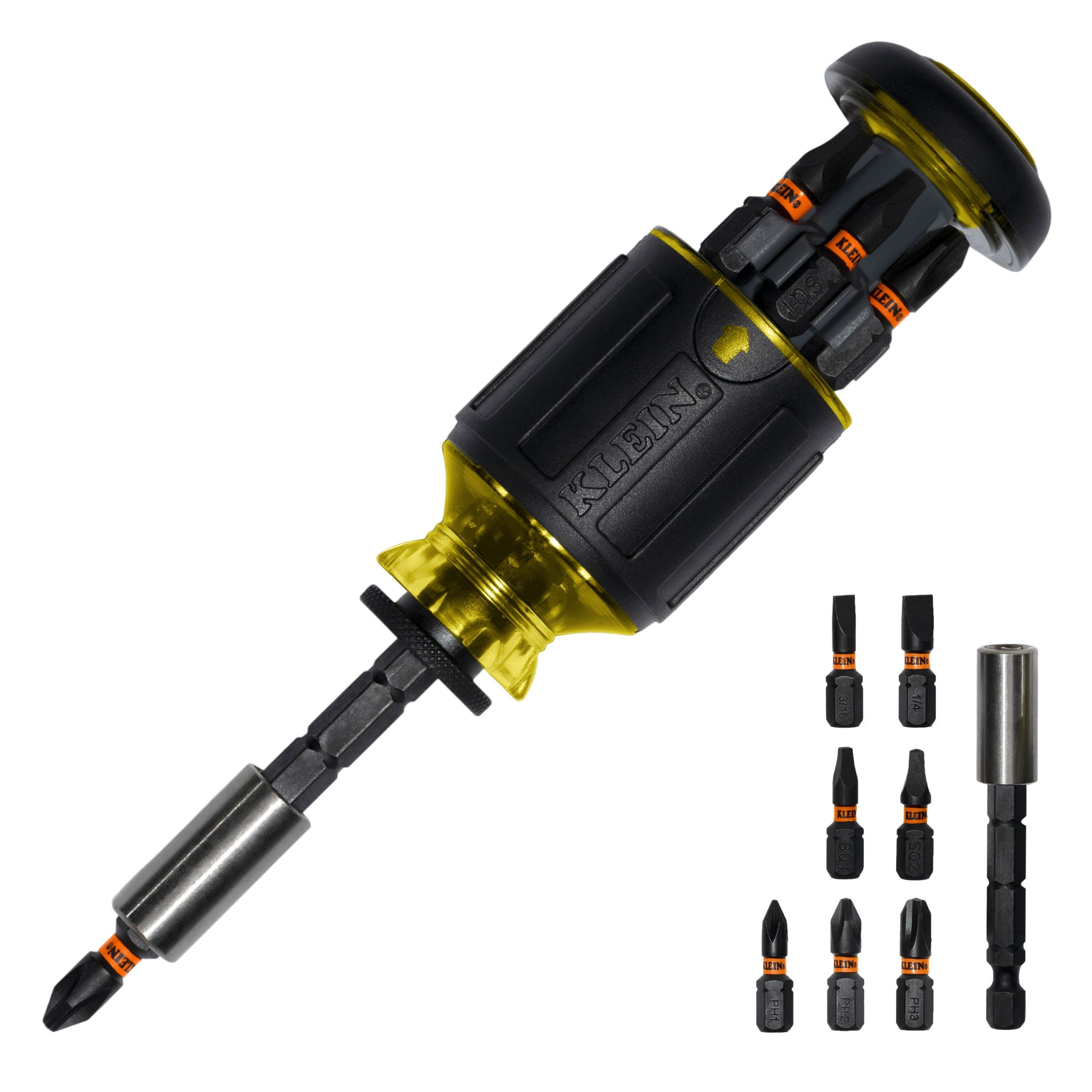
A ratcheting screwdriver uses an internal mechanism that lets the handle turn the bit in one direction while the handle swings back without unscrewing. Most have a forward, reverse, and locked setting. The ratchet does not create more torque by itself; it lets you apply torque through repeated short strokes.
That makes it useful in cabinets where you have only 15 to 30 degrees of handle movement. However, a ratcheting mechanism adds length, weight, and parts that can fail or collect sawdust. Some compact ratcheting drivers are nearly as short as a stubby, but many are 5 to 7 inches long and will not fit where a true stubby can.
Head-to-Head Comparison
| Feature | Stubby screwdriver | Ratcheting screwdriver |
|---|---|---|
| Typical overall length | 1 to 3 inches | 4 to 7 inches; compact versions can be shorter |
| Best access | Very tight spaces and shallow clearances | Restricted swing room with adequate handle clearance |
| Speed on repeated turns | Slow; reposition the bit or your hand | Fast; ratchet permits short backstrokes |
| Torque and control | Limited by the small grip | Usually better, especially with a full-size handle |
| Durability | Few parts and little to break | Ratchet mechanism can wear, jam, or strip |
| Typical price | Low | Moderate to high, depending on bit storage and mechanism |
When a Stubby Screwdriver Wins
Choose a stubby when clearance is the deciding factor. A cabinet hinge screw may sit only 2-1/2 inches from the adjacent cabinet wall. A normal screwdriver cannot stay aligned, while a stubby can be held nearly parallel to the wall. The same applies to drawer slides, corner braces, shelf pins, and screws behind plumbing cutouts.
A stubby is also the safer choice when you need to keep the bit aligned with a soft or damaged Phillips recess. Because the tool is short, your hand is close to the fastener and you can feel when the bit starts to cam out. That matters on cabinet hardware, where #6 and #8 screws often have shallow heads and strip easily.
Its limitations show up when screws are tight. You may get only 5 to 10 inch-pounds of practical hand torque before the small grip becomes uncomfortable, particularly with wet or greasy hands. For predrilled cabinet hardware, that is usually enough. For a screw driven into hardwood without a pilot hole, it may not be.
When a Ratcheting Screwdriver Wins
Use a ratcheting driver when the fastener is accessible but your wrist cannot complete a full rotation. Inside a cabinet, you may have room for a 5-inch handle but only a few inches of side-to-side movement. The ratchet turns that limited motion into steady progress.
This is especially helpful for installing multiple hinges, drawer-slide screws, or shelf standards. A screw that takes six full turns can often be installed with a dozen short ratchet strokes instead of repeatedly lifting and resetting a stubby. The time savings become noticeable after 10 or 20 screws.
A full-size ratcheting handle also gives better grip and torque. That does not make it suitable for forcing a badly stuck screw: the bit can still slip, the screw head can strip, or the cabinet material can tear out. Switch to a correctly sized bit, press firmly in line with the screw, and use a regular heavy-duty screwdriver or drill when the fastener needs serious force.
Bit Selection and Common Failures
For cabinet work, prioritize a driver with a firm bit holder and commonly used Phillips #2, square-drive #2, and Torx bits. Many cabinet screws use square-drive heads, while European hinge hardware commonly uses Pozidriv or Phillips-style recesses. A Phillips bit in a Pozidriv screw may appear to fit but can slip under moderate pressure.
Magnetic bit retention is useful, but it is not a substitute for a locking holder. If the tool will be used overhead or deep inside a cabinet, a locking bit holder reduces the chance of dropping a bit behind a finished panel. Keep a spare bit nearby; worn tips are a common reason for cam-out.
Ratcheting drivers can fail in three practical ways: the selector can move under load, the teeth can slip when too much force is applied, or dust can make the mechanism feel gritty. A stubby has fewer failure modes, but its fixed bit or short shaft may be awkward if you need to change between several drive types.
Which One Should You Buy?
Buy a stubby first if your main problem is physical clearance. It is inexpensive, compact, and often all you need for tightening cabinet pulls, adjusting hinges, and installing light-duty hardware. The cheaper option is fine here because those jobs generally involve small screws and modest torque.
Buy a ratcheting screwdriver if you regularly assemble cabinets, install drawer slides, or work in narrow spaces where a normal handle fits but cannot swing. Look for a compact body, a positive three-position selector, a comfortable grip, and bits that lock securely. If you can afford only one tool and your cabinets provide at least 4 inches of handle clearance, a compact ratcheting driver is the more versatile choice.
For very tight areas, the best setup is not either-or: keep a stubby for access below about 2-1/2 inches and a ratcheting driver for repetitive work. If a screw is stripped, seized, or driving into solid hardwood, stop forcing either hand tool. Drill a pilot hole, use an extractor, or switch to a drill/driver with a clutch set low enough to avoid damaging the cabinet.