What's inside
As an Amazon Associate I earn from qualifying purchases. This post may contain affiliate links at no extra cost to you.
Our Top Picks
 DEWALT DCH273P2 20V Max Brushless SDS Rotary HammerOne Size19.29 x 11.93 x 4.72 inches11.68 poundsCheck on Amazon
 DEWALT DCH293B 20V Max XR Brushless 1-1/8” L-ShapeOne Size15.3 x 4 x 10.6 inches8.7 poundsCheck on Amazon
 VEVOR 1-9/16 Inch SDS-Max Rotary Hammer Drill1-9/16 in18.1 x 4.5 x 10.7 inches16 poundsCheck on Amazon


The short answer
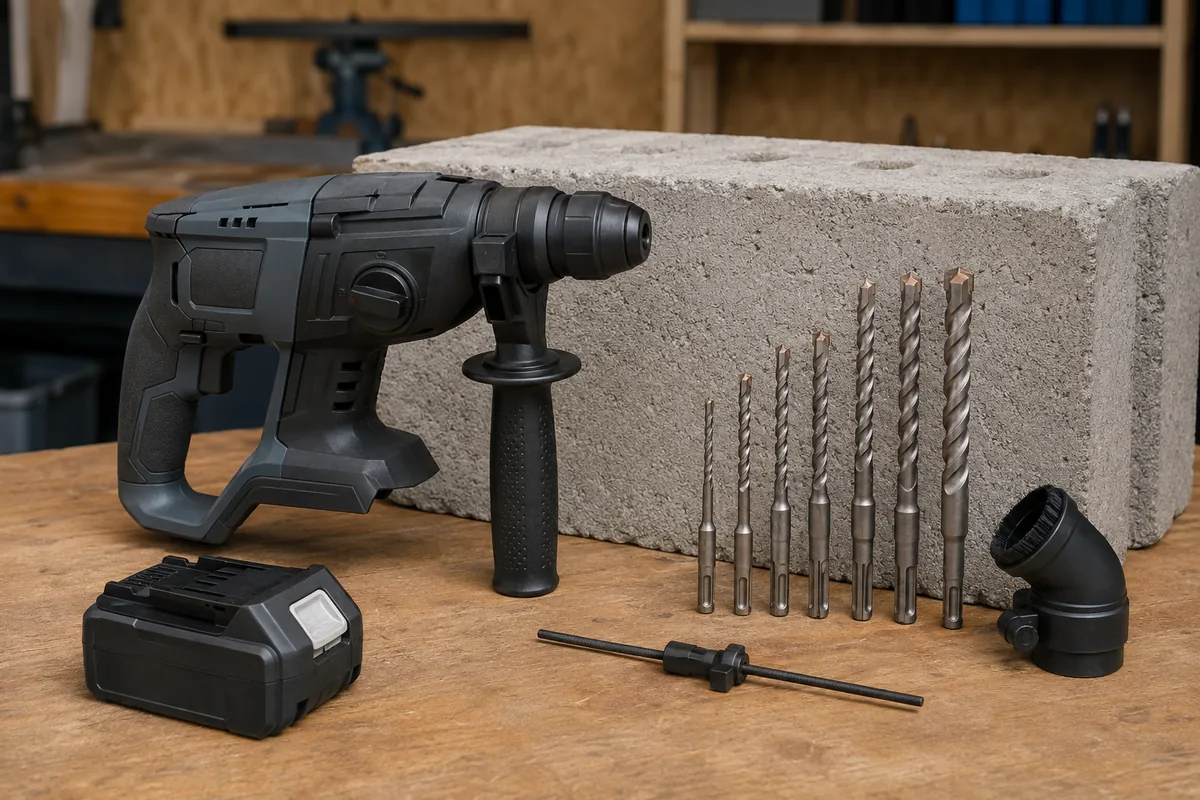
For drilling ordinary holes and doing modest chipping in rebar-free concrete, an SDS-Plus rotary hammer is usually the better fit. It costs less, weighs less and accepts the bits most homeowners and general contractors need. SDS-Max earns its keep when the work calls for larger holes, heavier chisels or long stretches of demolition—not simply because the concrete is concrete.
“Rebar-free” removes one reason to choose a heavier tool, but it does not tell the whole story. Concrete strength, aggregate, hole diameter, drilling depth and daily workload all affect the choice. A 1/2-inch anchor hole is a very different job from a 2-inch core or breaking out a thick slab.
As an Amazon Associate we earn from qualifying purchases at no extra cost to you.


What the systems mean
SDS-Plus and SDS-Max describe different bit-shank systems. SDS-Plus shanks are about 10 mm across; SDS-Max shanks are about 18 mm. The larger shank helps SDS-Max tools transmit more impact energy and handle bigger bits and chisels. The systems are not interchangeable: a Plus bit will not lock into a Max chuck, or vice versa, unless you use an adapter. Adapters can add length and wobble, so they are not a good substitute for matching the bit to the tool.
Rotary hammers also differ from ordinary hammer drills. A rotary hammer uses a piston mechanism to strike the bit, making it more effective for repeated concrete drilling. For this comparison, assume both tools are rotary hammers with a hammer-drill mode, not drill drivers with a hammer setting.
SDS-Plus vs SDS-Max at a glance
| Factor | SDS-Plus | SDS-Max |
|---|---|---|
| Best-fit work | Small to medium holes; light or occasional chipping | Large holes; heavy, sustained chipping and demolition |
| Typical bit range | Commonly around 1/4 to 1 inch for routine drilling; some tools allow larger bits | Commonly used for holes above about 1 inch and large chisels; check each tool’s rated capacity |
| Tool weight | Often roughly 5 to 10 lb | Often roughly 12 to 20 lb or more |
| Handling | Easier overhead and in tight spaces | More tiring to position and control, especially overhead |
| Cost and accessories | Lower tool and bit cost; broad selection | Higher upfront cost; large bits and chisels also cost more |
These are useful ranges, not hard limits. Manufacturers rate tools differently, and some Plus hammers can drill larger holes in favorable conditions. Check the manual’s recommended drilling range, not just the maximum diameter printed in a listing. Running a small hammer at its stated maximum for a long time can be slow, hot work that wears the tool and operator.
When SDS-Plus is enough
Choose SDS-Plus for common fastening and installation jobs: anchor holes, Tapcon-style screw holes, small plumbing penetrations and occasional removal of tile or mortar. Many routine concrete anchors need holes between about 1/4 and 3/4 inch. In sound, rebar-free concrete, a suitable Plus hammer and sharp bit can handle these without the bulk of a Max machine.
It is also the sensible choice if you drill only a few holes at a time. A typical Plus hammer is easier to hold against a wall, carry up a ladder and control when a bit breaks through. That matters: a heavy hammer can twist sharply if a large bit binds, and fatigue makes that reaction harder to manage.
If you need a general-purpose hammer for occasional concrete work, compare SDS-Plus rotary hammer kits. Check whether the kit includes a depth stop, side handle and a useful set of bits; a case full of small accessories is not a substitute for the right bit diameter and length.
When SDS-Max is worth the weight
SDS-Max makes sense when you regularly drill large-diameter holes, use long bits, or spend substantial time chipping concrete. It has more impact capacity for demanding work, and the larger shank is better suited to heavy chisels. A crew removing a thick concrete landing or making repeated penetrations for large services may save time with Max even if the concrete contains no steel.
There is a trade-off: bigger tools are harder to handle, cost more, and can be excessive for small holes. They also transfer substantial force. Use the supplied side handle, keep a firm stance and avoid forcing a bit that has stopped advancing. If the bit jams, release the trigger and clear the obstruction rather than leaning harder into the tool.
For recurring large-hole work or heavier chipping, look at SDS-Max rotary hammers. Compare weight, impact energy, vibration control and the manufacturer’s recommended bit range. A higher wattage figure alone does not tell you how quickly a tool will drill a particular hole.
Match the tool to the hole and task
For a handful of 3/8-inch anchor holes, SDS-Max is unnecessary. For repeated holes around 1-1/2 inches or more, especially deep ones, an SDS-Plus hammer may be slow or outside its recommended range. Between those cases, use the specific tool’s rated capacity and consider how many holes you will drill in a day. A one-off oversize hole may justify renting a Max hammer; buying one for a rare task is often poor value.
Chipping follows the same logic. Removing a small patch of tile adhesive or knocking off a raised edge is reasonable Plus work with an appropriate chisel. Breaking a slab into manageable pieces calls for SDS-Max, a demolition hammer or a concrete saw, depending on the area and finish required. A rotary hammer is not automatically the fastest choice for every demolition job.
Avoid common failures
Use a sharp masonry bit and let the hammer do the work. Excessive pressure can slow drilling, overheat the bit and strain the tool. Withdraw the bit occasionally from deep holes to clear dust; packed dust increases friction and can trap the bit. Wear eye, hearing and respiratory protection, and control concrete dust with extraction or a suitable wet method where appropriate.
Rebar-free does not mean hazard-free. Check for buried electrical, water and heating lines before drilling, and confirm that a hole will not weaken a structural member or violate an anchor’s edge-distance requirements. If a bit suddenly binds, stop and investigate instead of twisting the tool free while it is running.
Make the buying decision
For most rebar-free concrete jobs around a home or small site, buy or borrow SDS-Plus. It covers common anchor holes and light chipping with less cost and fatigue. Step up to SDS-Max when large holes, heavy chiseling or sustained daily use are central to the work. If the job sits on the boundary, renting the larger hammer for a day is a practical way to compare speed and handling before committing to the heavier system.