What's inside
As an Amazon Associate I earn from qualifying purchases. This post may contain affiliate links at no extra cost to you.
A riving knife and a splitter both help keep a table-saw cut from closing behind the blade and pinching the workpiece. That can reduce kickback, but the parts are not interchangeable in every setup. The practical difference is where each one sits, whether it moves with the blade, and whether it gets in the way when you change cuts.
As an Amazon Associate we earn from qualifying purchases at no extra cost to you.


Quick answer: the riving knife is easier for frequent setup changes
For ordinary through-cuts, a riving knife is usually easier to live with. It stays close to the blade and rises, lowers, and tilts with it, so you generally do not have to reposition it when changing blade height or bevel angle. A traditional splitter is fixed behind the blade. It can work well for basic cuts, but may need to be removed for some operations and may not stay correctly aligned after adjustments.
Neither device makes a saw kickback-proof. Use the guard and anti-kickback pawls when the cut allows them, keep the work supported, and stand out of the direct line behind the blade.
How they work
As a board is sawn, internal stress or pressure from the operator can make the kerf—the slot left by the blade—close. If the wood grips the back of the blade, the teeth can lift or throw the workpiece toward the operator. A riving knife or splitter occupies that kerf behind the blade, helping keep the two sides of the cut apart.
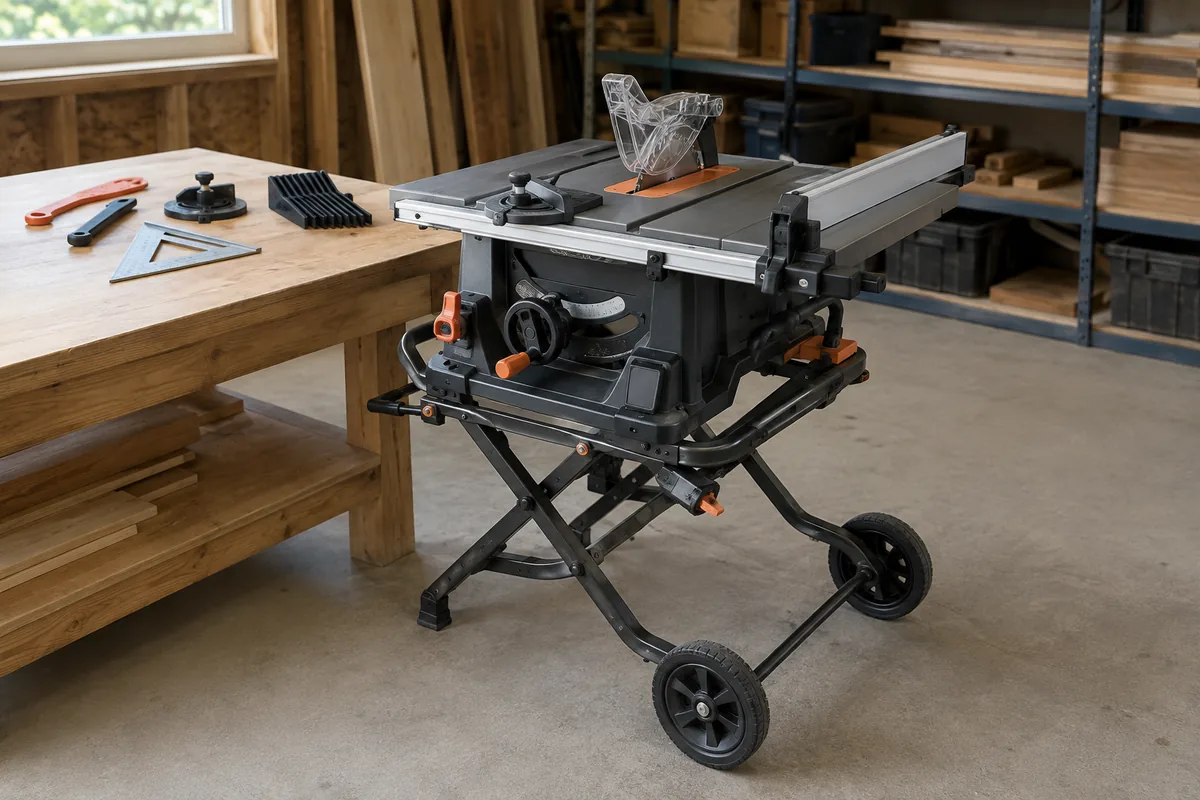
A riving knife is mounted to the saw’s arbor assembly, close behind the blade. Because it moves with the blade, it can remain in place for many non-through cuts, such as a groove that stops short of the far edge. It must be matched to the blade and set so it does not extend above the blade teeth in a way that interferes with the work.
A splitter is typically attached to the saw’s throat plate or another fixed part of the table. Its position does not follow blade-height or bevel adjustments. Some saws use a simple splitter without a guard; others have a guard assembly built around it. The design matters: “splitter” can describe several different setups, so check the saw manual rather than assuming all models behave alike.
Riving knife vs. splitter at a glance
| Feature | Riving knife | Fixed splitter |
|---|---|---|
| Moves with blade height | Yes | No |
| Follows blade tilt | Yes, on designs intended for bevel cuts | Usually no |
| Convenience for routine cuts | High; often stays installed | Good for compatible cuts; may need removal or adjustment |
| Non-through cuts | Often supported by a low-profile knife; check the manual | May obstruct the cut or require removal |
| Main setup concern | Correct thickness, alignment, and installation | Alignment with blade and clearance through the cut |
Which is easier in real shop use?
If you switch between blade heights, bevels, and workpieces throughout a job, a riving knife usually saves steps. With a fixed splitter, a blade-height change can leave the splitter sitting too low or in the wrong relationship to the blade. On a bevel cut, a fixed part may no longer track the blade’s path. You then have to verify clearance, use a compatible guard or splitter setup, or remove the part if the saw’s instructions allow it.
That convenience matters most for a mixed workload: ripping lumber, making bevel cuts, and occasionally cutting grooves. A low-profile riving knife can remain installed for some non-through cuts, reducing the temptation to run the saw with the safety parts removed. It is not universal, though. Some knives are intended only for through-cuts, and some operations require a separate setup, such as a zero-clearance throat plate or a suitable auxiliary fence.
A fixed splitter can be simpler if you mostly make one kind of through-cut and rarely change blade height or angle. Once aligned, it has no moving linkage to adjust. The trade-off is that “simple” can turn into an obstacle when the cut changes. Removing it too casually, then forgetting to reinstall it, defeats its purpose.
Fit, alignment, and common failure modes
Thickness is important. The knife or splitter must fit within the kerf made by the blade without being so thin that the wood can squeeze around it. A part that is thicker than the kerf can bind the workpiece; one that is too thin may not hold the kerf open reliably. Check the blade’s kerf and the safety part’s specifications, especially if you change from a full-kerf blade to a thin-kerf blade.
Alignment matters just as much. A misaligned riving knife can push the board sideways or rub against it. A splitter that is not centered behind the blade can snag the work or fail to keep the kerf separated. Before cutting, unplug the saw for adjustments, then follow the manual’s alignment procedure. With the saw off, confirm that the blade turns freely by hand and that the workpiece has clearance.
Never force stock past a part that catches. Stop, disconnect power, and find the cause. A warped board, a closing kerf, incorrect alignment, or a mismatched blade-and-knife combination can all create trouble. A riving knife also does not replace a push stick, proper support, or a fence set parallel to the blade.
What to buy—or keep using
If you are buying a table saw, a model with a properly fitted riving knife is the more convenient choice for varied work. Compare the included guard and knife options, and confirm that the knife can be installed for the cuts you actually make. For a general search, browse table saws with a riving knife, then verify the specifications and manual for any saw you consider.
If your saw came with a splitter and it is intact, aligned, and suitable for your routine cuts, there is no automatic need to replace it. It can be a reasonable, cheaper arrangement for straightforward through-cutting. Do not, however, install a universal aftermarket part without checking that it fits the saw and blade. Search for table saw splitter replacements only after identifying your saw’s mounting system and required dimensions.
The practical choice
Choose a riving knife for convenience if your work involves frequent blade adjustments, bevels, or cuts where a low-profile knife can remain installed. Keep a splitter if it suits your saw, stays aligned, and handles the through-cuts you make without repeated removal. The safer setup is the one compatible with the cut and kept correctly installed—not simply the one with the more modern name.