What's inside
As an Amazon Associate I earn from qualifying purchases. This post may contain affiliate links at no extra cost to you.
What the parts do
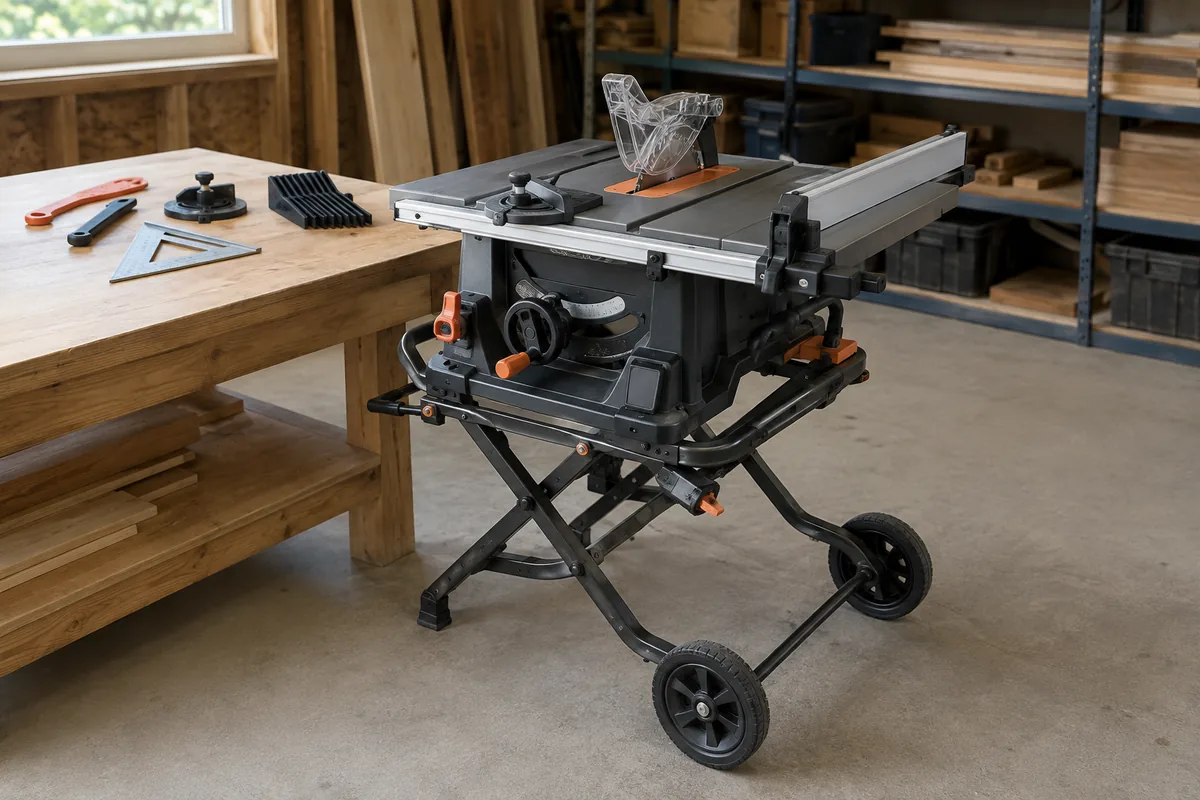
A riving knife and a splitter both sit behind the saw blade to keep a cut kerf from closing onto the blade. That matters because pinching can stall the workpiece or throw it back toward the operator. Neither device replaces a blade guard, push stick, or careful feeding technique; each addresses one part of the hazard.
The key difference is how each part relates to the blade. A riving knife moves up and down with the blade assembly, staying close behind it as blade height and bevel angle change. A splitter is fixed to the saw’s table or guard assembly. It can do the same basic job on a straight, full-depth cut, but its position does not track the blade.
As an Amazon Associate we earn from qualifying purchases at no extra cost to you.


Which reduces binding more effectively?
For general table-saw work, a properly fitted riving knife is usually more effective. It stays close to the blade as you raise, lower, or tilt it, so there is less unsupported space for the kerf to close around the rear teeth. That close, consistent fit also makes it useful on bevel cuts, where a fixed splitter may no longer line up correctly.
That advantage depends on using the right knife for the cut. A full-height knife may interfere with a dado stack or a non-through cut; a low-profile knife is designed to remain in place for some such operations. Check the saw manual for compatible setups. Removing the knife when it is unsuitable is not a reason to make a risky cut carelessly: use the specified guard or other procedure, and do not improvise a substitute that can contact the blade.
A splitter can still reduce binding effectively when it is aligned, firmly mounted, and used for the cuts it was designed for. Its weakness is not that it fails to separate wood; it is that it is less adaptable. If a cut changes the blade angle or height enough to create a gap or misalignment, the splitter may not protect the kerf as well.
Riving knife vs. splitter
| Feature | Riving knife | Splitter |
|---|---|---|
| Mounting | Moves with the blade assembly | Fixed to the table or guard assembly |
| Blade-height changes | Stays close to the blade | May leave a larger gap or sit too high or low |
| Bevel cuts | Usually follows the blade angle | May not remain aligned |
| Through-cuts | Strong choice when correctly installed | Can work well on compatible straight cuts |
| Non-through cuts | Requires a compatible low-profile knife or approved setup | May interfere; depends on design |
| Retrofit practicality | Often difficult if the saw was not designed for one | Can be a practical option on some older saws |
Fit and clearance matter
Do not choose by the label alone. Compare the thickness of the knife or splitter with the saw blade’s kerf. The separator must be thick enough to keep the cut open, but it must also be thinner than the kerf so the workpiece does not bind against it. A mismatch can create drag, push the stock off line, or make feeding harder. Check the blade and separator specifications rather than assuming every factory blade will suit every replacement.
Alignment is just as important. With the saw unplugged, inspect whether the separator sits in line with the blade and does not rub it. A bent splitter, loose bracket, or poorly installed riving knife can create contact or steer the workpiece. Follow the manufacturer’s setup instructions and verify clearance through the blade’s range of movement before switching the saw on.
Wood condition still matters. Internal stress can make a kerf close even when the separator is present; twisted, bowed, or wet stock can shift during a cut. A riving knife cannot straighten a board or prevent every kickback. Support long stock, stand out of the likely kickback path, and use a fence and push device suited to the operation.
What to buy or retrofit
If you are buying a saw for routine ripping and crosscutting, favor a model with a riving knife that can stay installed for the operations you do most. Look for easy, tool-free removal and reinstallation only if the manual supports it; convenience affects whether the safety part actually gets used. Compare table saws with riving knives by checking the included knife options, blade compatibility, and guard arrangement—not just the feature name.
For an older saw, do not assume a universal riving-knife conversion exists. The mounting point must move with the arbor assembly, and the part needs to match the saw and blade. If that is not possible, a properly designed splitter may be a sensible lower-cost option for compatible straight cuts. Search for a table saw splitter safety device only after confirming it fits your saw and does not interfere with the blade guard or workpiece.
When the cheaper option is fine
A splitter can be adequate if your saw’s design supports it, you mainly make ordinary through-cuts, and it stays aligned as installed. If the saw already includes a sound splitter-and-guard assembly, replacing it solely to get a riving knife may not be worth the cost. But if you often change blade height, make bevel cuts, or find yourself removing a fixed splitter because it obstructs the work, a riving-knife-equipped saw is the more practical safety design.
Before any cut, use the correct blade, keep the guard and separator in place when the operation allows, and feed steadily without forcing the stock. If a workpiece starts to pinch, stop the saw and wait for the blade to stop before backing it out or changing the setup. A riving knife reduces one common cause of binding more consistently; good setup and sound work habits remain essential with either design.