What's inside
As an Amazon Associate I earn from qualifying purchases. This post may contain affiliate links at no extra cost to you.
The Metabo HPT C10FCGS and Skil MS6305-00 are both corded 10-inch miter saws aimed at home shops, but they serve different jobs. The Metabo is a basic, non-sliding saw for crosscuts and trim. The Skil adds a sliding rail and a shadow-line cut guide, making it more useful for wider stock. That extra capacity matters only if your projects need it: a larger saw takes up more room and costs more.
As an Amazon Associate we earn from qualifying purchases at no extra cost to you.


Our Top Picks
 POWERTEC Portable Miter Saw Stand w/ Quick-release Mounting1PK49 x 16.25 x 8.25 inchesCheck on Amazon
 SKIL 10" Dual Bevel Sliding Compound Miter Saw-MS6305-0010''35.43 x 22.44 x 14.17 inches39.4 poundsCheck on Amazon



At a glance
| Feature | Metabo HPT C10FCGS | Skil MS6305-00 |
|---|---|---|
| Saw type | 10-inch, non-sliding compound miter saw | 10-inch, sliding compound miter saw |
| Motor rating | 15 amps | 15 amps |
| Maximum crosscut width | About 5-1/2 inches at 90 degrees | Up to about 12 inches at 90 degrees |
| Bevel range | Up to 45 degrees left | Up to 48 degrees left and right |
| Cut guide | Laser guide | LED shadow-line guide |
| Best fit | Trim, narrow boards, occasional cuts | Wider boards and more varied projects |
Specifications can vary by retailer listing or package, so confirm the exact capacity and included accessories before ordering. Neither saw is a substitute for checking the cut against a square or test piece; guides help with alignment but do not correct a fence or workpiece that is out of square.
Capacity: the main difference
The C10FCGS uses a conventional pivoting head, without sliding rails. Its roughly 5-1/2-inch crosscut capacity at 90 degrees handles common trim, small framing pieces and narrow boards. It is not the right choice for cutting a 1×10 across its full width in one pass. You can sometimes flip a board to finish a cut, but that adds setup risk and can leave a mismatch at the cut line.
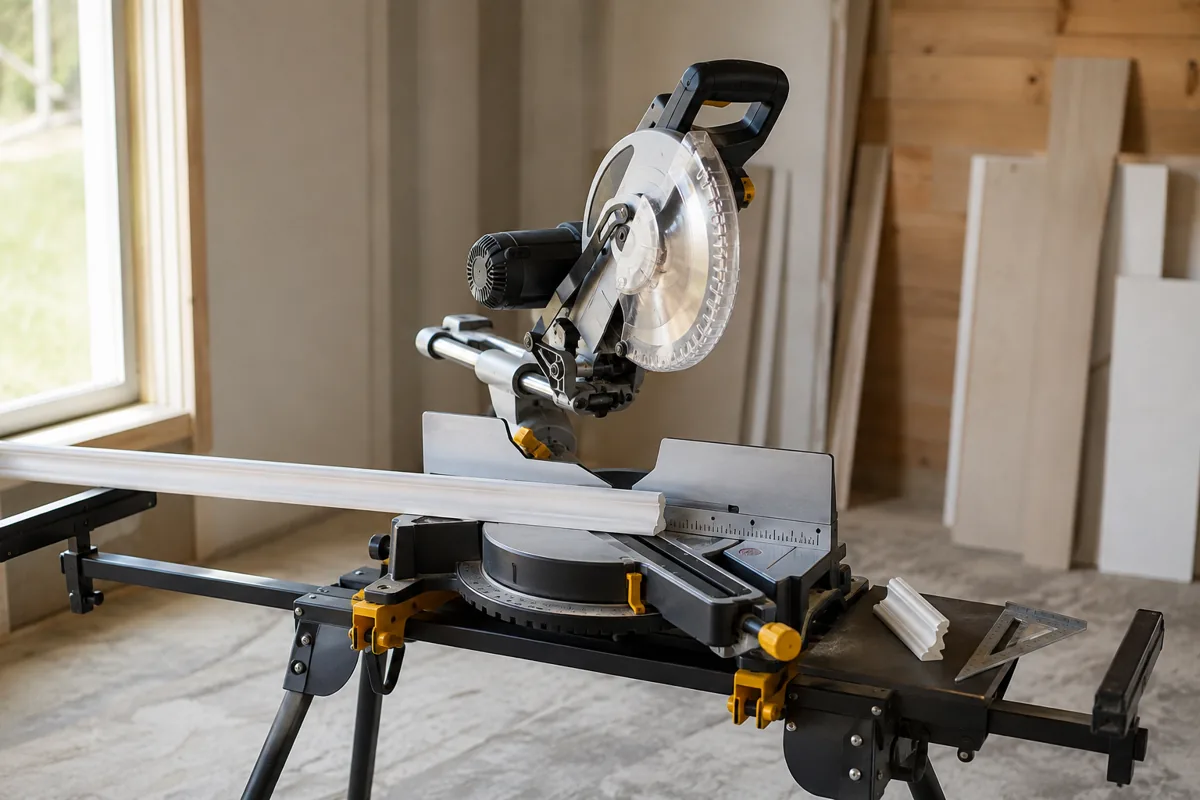
The MS6305-00’s sliding head reaches across wider stock, with a listed 90-degree crosscut capacity of about 12 inches. That can save time on shelving, wider baseboards and panel-edge work. The trade-off is a longer, deeper footprint: the rails need clearance behind the saw, and the head must travel smoothly without hitting a wall or shop equipment. Measure the space with the saw fully extended, not just the width of its base.
Both are 15-amp corded saws. On either one, a dull or inappropriate blade, a slow feed, or a long extension cord can contribute to rough cuts and bogging. Use a sharp blade suited to the material, support long stock at table height, and let the motor reach speed before entering the work.
Accuracy, bevels and guides
The Metabo’s laser projects a line to help position a cut. Laser visibility can be poor in bright light, and the line needs to be checked against the blade’s actual kerf. A laser that is slightly out of alignment can be more misleading than useful; make a test cut and adjust or disregard the line if it does not match.
The Skil uses an LED shadow line, which shows the blade’s width as a shadow on the workpiece. It avoids the separate alignment question of a projected laser line, but still depends on lighting and a clean, correctly installed blade. For either saw, set the miter and bevel using the saw’s scales as a starting point, then verify important angles with a reliable square and scrap.
The Skil’s bevel range extends to 48 degrees on both sides, while the Metabo bevels left up to 45 degrees. The wider, dual-direction range is convenient for trim and compound cuts because it may avoid turning a long workpiece. For straightforward 90-degree crosscuts and common 45-degree miters, the Metabo’s range is usually enough.
Garage setup and dust control
A miter saw throws fine dust toward the operator and behind the fence. The included dust bags on saws in this class collect some chips, but should not be treated as shop-vac replacements. A shop vacuum with a suitable hose and a well-positioned hood or enclosure can improve collection, though sliding saws are particularly awkward to capture because dust escapes around the moving head. Wear eye and hearing protection either way.
Mount the saw securely, keep both hands clear of the blade path, and support stock that extends beyond the table. A loose board can shift during the cut; a long unsupported board can also tip and pinch the blade. If the saw will live on a small bench, the Metabo’s simpler head and lack of rearward slide travel make it easier to accommodate. If you need a stand or additional support, compare folding miter saw stands and check that the mounting pattern fits your saw.
Which one makes sense?
Choose the Metabo HPT C10FCGS if your work is mostly narrow trim, small boards and occasional crosscuts, and you value a compact, straightforward saw. It is the sensible budget option when its limited width capacity matches the material you actually cut. Paying for a slider that stays parked is poor value.
Choose the Skil MS6305-00 if you regularly cut stock wider than about 5-1/2 inches, want more bevel flexibility, or expect projects to include shelves and broader trim. Its sliding capacity is the practical advantage, not a promise of greater precision. Sliding rails add moving parts and require space, careful support, and a smooth pull through the cut. For repeated cuts in wide stock, a 10-inch sliding compound miter saw is the more capable category.
Before buying either, check current pricing, included blade, warranty terms and return policy. If you already own a compatible sharp 10-inch blade, that may affect the value comparison; otherwise, a finer-tooth 10-inch crosscut saw blade can improve finish on trim compared with a general-purpose blade. For a garage workshop with limited space and modest needs, the Metabo is enough. For wide boards, the Skil��s slide is a real capability upgrade—provided you have room to use it.