What's inside
As an Amazon Associate I earn from qualifying purchases. This post may contain affiliate links at no extra cost to you.
Our Top Picks
 SKIL 10" Dual Bevel Sliding Compound Miter Saw-MS6305-0010''35.43 x 22.44 x 14.17 inches39.4 poundsCheck on Amazon


Quick verdict
The Bosch GCM18V-08N and DeWalt DCS361 are compact 7¼-inch cordless sliding miter saws aimed at trim, flooring and other finish work. Both trade the capacity and long-run convenience of a larger corded saw for easier transport. The right choice depends less on brand loyalty than on the cuts you make, the batteries you already own and whether you need a bare tool or a ready-to-work kit.
Choose the Bosch if its broader cutting capacity and Bosch 18V battery platform suit your work. Choose the DeWalt if you already use DeWalt 20V MAX batteries and its capacity covers your stock. Neither is a sensible replacement for a larger saw when you regularly cut wide framing lumber or thick material.
As an Amazon Associate we earn from qualifying purchases at no extra cost to you.


What the specifications mean on the job
| Feature | Bosch GCM18V-08N | DeWalt DCS361 |
|---|---|---|
| Blade | 7¼ inches | 7¼ inches |
| Power platform | Bosch 18V | DeWalt 20V MAX |
| Cutting layout | Sliding, single-bevel | Sliding, single-bevel |
| Advertised crosscut capacity at 90° | Up to 8 inches | Up to 8 inches |
| Maximum miter range | Up to 47° left and right | Up to 45° left and right |
| Weight | About 31 lb bare | About 30 lb bare |
Specifications can vary by market and configuration, so check the manual for the exact capacity at a particular bevel and miter setting. The headline 8-inch crosscut figure is a straight-cut maximum, not a promise that the saw will handle every 2-by-8 cleanly in every setup. Blade condition, material thickness and support all matter.
Capacity and cut quality
Both saws use a sliding rail to move the blade through wider stock than a fixed-head 7¼-inch saw can handle. That makes them useful for baseboard, casing, small shelving parts and flooring. Their single-bevel heads tilt in one direction; for the opposite bevel, you have to turn the workpiece or reset the saw. That is manageable for occasional cuts, but it slows repetitive trim work compared with a dual-bevel saw.
The Bosch’s slightly wider miter range gives it an edge for unusual angle work, but most household trim jobs stay within common corner angles. For accurate miters, the more important habits are supporting long stock at blade height, keeping it firmly against the fence, and making a test cut before cutting finished pieces. A poorly supported board can shift as the blade exits, leaving a gap that no adjustment to the saw will fix.
These are compact saws, not heavy production machines. A 7¼-inch blade has less cutting depth than a 10-inch blade, and repeated cuts in dense hardwood will drain batteries faster than trimming pine. If your regular job involves thick posts, wide framing lumber or long runs of hardwood, compare larger saws before buying. A 10-inch sliding miter saw is a better category to consider when capacity matters more than portability.
Battery and portability
The 18V and 20V MAX labels describe competing battery platforms, not a meaningful 2-volt performance gap: DeWalt’s 20V MAX packs are 18V nominal. In practice, the battery you already own is often the deciding factor. A bare saw can look like the cheaper deal, then cost more than a kit once you add a compatible battery and charger.
Runtime depends on battery capacity, blade sharpness, stock and cut rate. Small packs keep the saw lighter but may need frequent changes during a full day of crosscuts. Larger packs usually make more sense for production work, though they add weight to a tool you may be carrying between rooms. Bring a spare if you expect to cut all day without access to charging.
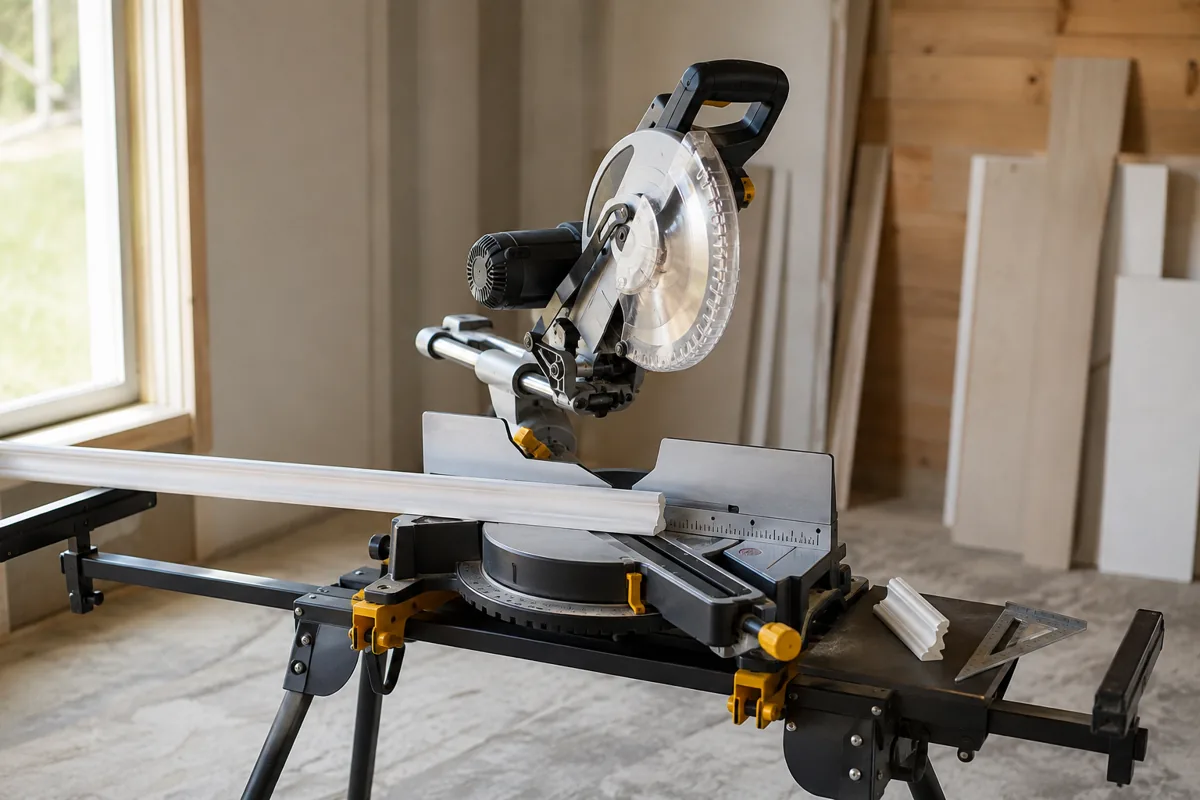
At roughly 30 pounds bare, either saw is movable by one person, but neither is effortless to carry with a battery attached. Check how the rails, handle and fence fit your vehicle and work area. A compact stand or stable bench is also worth planning for: balancing long trim on the saw’s short table is a common cause of inaccurate cuts and pinched blades.
Which one should you buy?
Buy the Bosch GCM18V-08N if you have Bosch 18V batteries, value its wider miter range, or want a compact saw for finish work that occasionally pushes the limits of a 7¼-inch blade. Before buying, confirm that your usual stock fits the published capacity for the cuts you need.
Buy the DeWalt DCS361 if your shop already runs on DeWalt 20V MAX batteries and its capacity is enough for your work. Paying extra for the Bosch makes little sense if you mainly cut standard casing and baseboard, and both saws can do that job well when set up correctly. For a homeowner making a few dozen cuts a year, the less expensive saw that matches an existing battery system is usually the practical choice.
If neither battery platform fits your tools, compare the total price of the saw, battery and charger rather than the bare-tool price. Search for a cordless 7¼-inch sliding miter saw with the battery system you plan to keep using. If you need repeated cuts beyond these saws’ capacity, step up to a larger blade instead of forcing a compact saw through work it was not designed to handle.
Getting accurate, safe cuts
Before cutting, confirm that the workpiece sits flat against the table and fence and cannot rock. Support long pieces on both sides at the same height as the saw table. Let the blade reach full speed before entering the wood, and wait for it to stop before lifting the head. Never pull a sliding blade through the work from the fence toward you; follow the saw’s manual for the correct slide-cutting sequence.
Check blade condition if cuts burn, wander or tear out. A dull or dirty blade makes the motor work harder and can worsen battery runtime. For clean finish cuts, use a sharp blade suited to the material and make a test cut in scrap. These small checks matter more than a narrow difference in advertised capacity—and help either saw deliver the accuracy a compact miter saw is bought for.