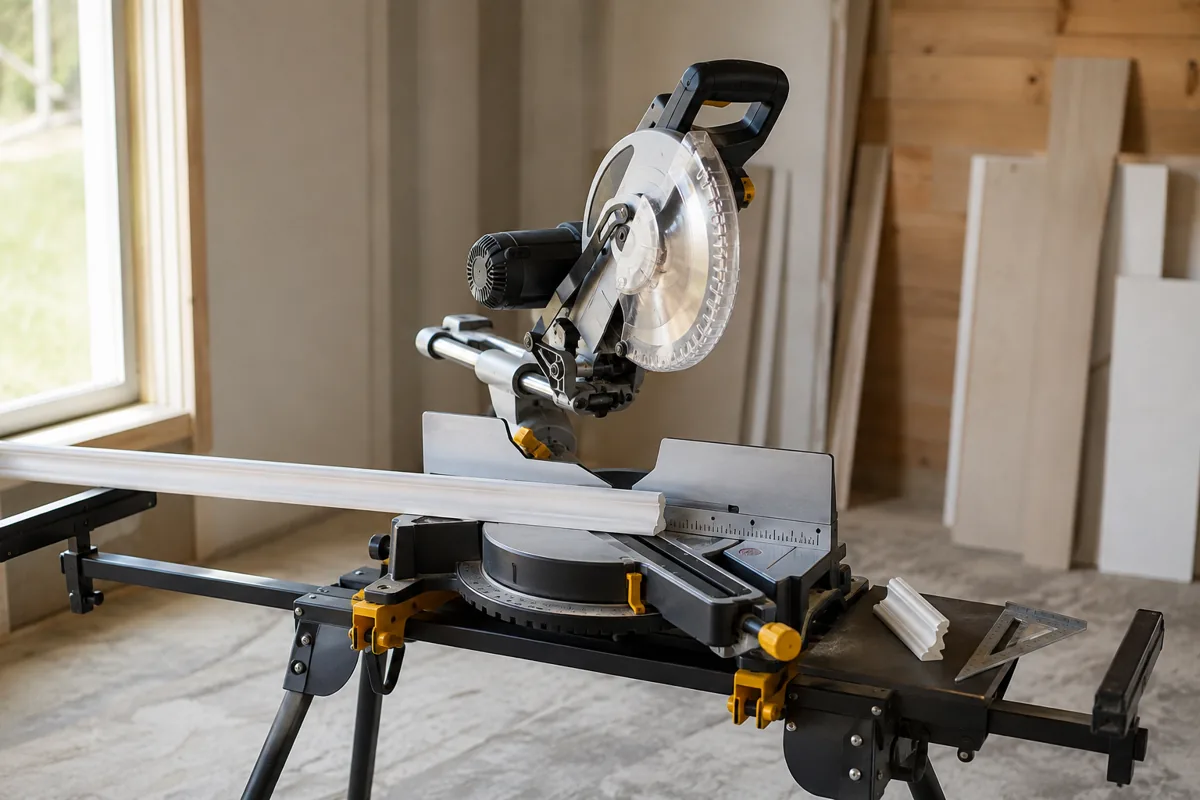
What's inside
As an Amazon Associate I earn from qualifying purchases. This post may contain affiliate links at no extra cost to you.
For flooring work, a compact sliding miter saw needs to do more than make a clean 90-degree cut. It must handle repeated crosscuts, narrow trim, wide flooring boards, and angled cuts without becoming awkward to carry or difficult to keep accurate. The Makita LS0815F and Bosch GCM8SJL occupy the same general class: 8-1/2-inch, or 216mm, sliding compound miter saws with enough capacity for most laminate, engineered wood, hardwood, and trim jobs.
The Bosch generally offers more cutting capacity and a stronger slide mechanism. The Makita is lighter, simpler, and often the better value when portability matters. There is also an important buying detail: the GCM8SJL is primarily a Bosch Professional model sold in markets outside North America, so check its voltage, plug, warranty, and available replacement parts before ordering.
As an Amazon Associate we earn from qualifying purchases at no extra cost to you.



Our Top Picks

Makita LS0815F vs Bosch GCM8SJL: key specifications
| Feature | Makita LS0815F | Bosch GCM8SJL |
|---|---|---|
| Blade diameter | 8-1/2 inches (216mm) | 8-1/2 inches (216mm) |
| Motor output | About 1,400W; approximately 5,000 rpm | About 1,600W; approximately 5,500 rpm |
| Typical 90-degree crosscut capacity | About 12 inches, depending on material and setup | About 12-1/4 inches wide and 2-3/4 inches deep |
| Bevel range | Up to 45 degrees left | Up to 47 degrees left and right on common versions |
| Weight | Roughly 35 pounds | Roughly 37 pounds |
| Dust collection | Rear dust port and supplied collection bag | Rear dust port and supplied collection bag |
Exact capacities can vary by regional version, blade choice, and whether the workpiece is supported against the fence or laid flat. Treat the figures above as buying guidance, not permission to cut at the absolute limit without checking the manual.
How they perform on flooring
Both saws are well suited to flooring crosscuts. A 216mm blade cuts typical 8-inch or 10-inch flooring boards in one pass, and the sliding rails provide enough travel for wide planks. For engineered wood and laminate, use a sharp blade with a high tooth count—typically 60 to 80 teeth for a fine finish. The blade supplied with either saw may be adequate for rough framing but can chip decorative flooring surfaces.
The Bosch has the advantage when cutting thick hardwood or wide boards repeatedly. Its 1,600W motor gives it more reserve when the blade enters dense oak, maple, or ash. That does not make it immune to burning: pushing too quickly, using a dull blade, or allowing the offcut to pinch the blade will still cause scorching and rough edges.
The Makita’s motor is not underpowered for normal flooring. It is a sensible choice for laminate, engineered boards, pine, painted trim, and occasional hardwood. Its lower weight is useful when the saw must move from room to room or up stairs. For a flooring installer making hundreds of cuts each day, the Bosch’s greater capacity and more substantial sliding action are more persuasive than the modest weight difference.
Accuracy, controls, and common failure points
The Makita has a familiar layout with positive miter stops, a straightforward bevel adjustment, and a compact sliding assembly. It is quick to set for repeated 90-degree cuts. Its main limitation is the single-direction bevel design: if a project calls for opposite compound angles, you must reposition the workpiece or turn the saw setup around. That creates more opportunities for a flipped or misread cut.
The Bosch is more flexible for compound work because its bevel system commonly tilts both left and right. That matters for stair nosing, angled thresholds, and trim that must meet cleanly at awkward corners. The Bosch also has a longer sliding capacity, but long rails need clearance behind the saw. In a narrow room, the saw can be less convenient than its capacity suggests.
Neither saw should be trusted straight from the box for finish flooring. Check the blade against the fence with a reliable square, verify the 45-degree bevel, and inspect the throat plate for movement. A saw that is only one degree out at a miter can leave a visible gap across a wide plank. Recheck accuracy after transporting the tool, especially if the slide has been locked and unlocked repeatedly.
Dust collection and jobsite handling
Both models collect some dust through a rear port, but neither is a substitute for a vacuum. The supplied bags catch larger chips while fine laminate and hardwood dust escapes around the blade guard and slide mechanism. For indoor flooring work, connect a small shop vacuum for power tools and use a dust extractor adapter if needed.
The Bosch’s front-mounted sliding arrangement is designed to reduce the rear clearance needed in a room. That is helpful near a wall, although the rails and linkage still need space to travel. The Makita is compact and easy to carry, but its rear slide movement must be planned around walls, doors, and flooring stacks.
For laminate, use a sacrificial support or zero-clearance insert where practical. Small offcuts can drop into the throat plate, wedge behind the blade, or chip the finished edge. Hold narrow pieces with a clamp rather than your hand. A sliding saw is especially unforgiving when a short offcut shifts during the return stroke.
Which saw is the better buy?
Choose the Makita LS0815F if you want a lighter saw for renovation work, mostly make square crosscuts, and do not need regular two-way bevel cuts. It is the better fit for a homeowner or finish carpenter who values uncomplicated controls and easy transport. If the Makita is substantially cheaper, it is the sensible purchase for a single flooring project or occasional use.
Choose the Bosch GCM8SJL if you regularly cut thick hardwood, need maximum capacity from an 8-1/2-inch saw, or make compound cuts from both bevel directions. The extra motor reserve and more capable bevel arrangement can save time over a large installation. Before buying, confirm that you are getting the correct regional voltage and a usable warranty; an imported saw is a poor bargain if a damaged switch or worn slide requires hard-to-find parts.
Whichever model you choose, budget for a quality 216mm fine-finish miter saw blade, stable work support, and hearing and eye protection. Those accessories have more effect on flooring results than a small difference in no-load speed. For very wide planks, unusually thick stock, or production-level work, step up to a larger 10-inch saw rather than forcing either compact model beyond its rated capacity.