What's inside
As an Amazon Associate I earn from qualifying purchases. This post may contain affiliate links at no extra cost to you.
For a 12-inch sliding compound miter saw, bevel range is only half the story. The saw must also hold a long workpiece securely while the head tilts, and its fences must clear the motor housing without creating a gap where trim can tip. The Bosch GCM12SD and Makita LS1219L take different approaches: Bosch uses its Axial-Glide arm and a compact front-to-back mechanism, while Makita uses a conventional-looking rail system with a particularly refined fence arrangement.
As an Amazon Associate we earn from qualifying purchases at no extra cost to you.


Our Top Picks


Bevel range and adjustment
The Bosch GCM12SD bevels 47 degrees left and right. The Makita LS1219L reaches 48 degrees in both directions. On paper, that one-degree difference is insignificant. Neither saw is intended for unusual 50- or 55-degree bevel work, and both cover the angles normally used for baseboard, casing, framing, and furniture parts.
The more useful difference is how the adjustment feels. Bosch uses a front-mounted bevel control, so you do not have to reach behind the saw to release the head. It has commonly used positive stops, including 0, 33.9, and 45 degrees, with a bypass for settings between the stops. The 33.9-degree setting matters when cutting crown molding flat.
Makita also provides front access to the bevel control and has positive stops at the common crown and framing angles. Its bevel scale is easy to see from the operator’s position. Both saws are dual-bevel models, meaning you can tilt left or right without flipping the workpiece. That is a major time saver when matching opposing trim pieces.
In practical use, the Makita’s extra degree is not a buying reason by itself. Choose based on the stop layout, control placement, and how easily you can return the head to a true zero. A saw that reaches 48 degrees but needs repeated adjustment after transport is less useful than one that locks accurately at 45.
Fence design and workpiece support
Bosch’s fence system is tall and sliding, with independent left and right sections. The fences move out of the way for bevel cuts and can be positioned close to the blade for small parts. That adjustability is helpful when cutting narrow trim, but it creates another maintenance point: both fence sections must be aligned accurately. If one side is slightly out of square, a long casing cut can show a visible gap.
The GCM12SD’s Axial-Glide mechanism is its defining design feature. The arms fold through a compact linkage rather than extending far behind the saw on long rails. This saves shop depth and keeps the saw relatively easy to place against a wall. The head movement is smooth, but the linkage should be kept clean. Dust packed into the joints can make the action feel rough or affect repeatability.
Makita’s LS1219L uses dual steel rails and sliding fences designed to give the blade and motor clearance during bevel cuts. The fences are tall enough for common baseboard and casing work, and they can be adjusted for the angle being cut. The system feels rigid when locked, which is important because a tall workpiece can push against the fence as the blade exits.
The Makita generally offers more crosscut capacity on paper, with up to roughly 15 inches at 90 degrees depending on the cutting configuration. Bosch lists about 14 inches at 90 degrees. Those figures are not directly comparable in every setup: molding position, fence placement, and whether the cut is made against a stop can change the usable capacity. Both saws can handle wide shelving and trim, but neither replaces a table saw for breaking down full sheets.
| Feature | Bosch GCM12SD | Makita LS1219L |
|---|---|---|
| Bevel direction | Dual bevel, left and right | Dual bevel, left and right |
| Maximum bevel | 47° left/right | 48° left/right |
| Bevel control | Front-mounted release and lock | Front-access adjustment and lock |
| Fence design | Independent sliding fence sections | Sliding fences with bevel clearance |
| Approximate 90° crosscut capacity | 14 inches | 15 inches |
| Rear clearance | Low, due to Axial-Glide arm | Requires rail clearance behind the saw |
| Blade size | 12 inches | 12 inches |
Where the designs can cause trouble
With either saw, do not assume the factory fence setting is perfect after shipping. Check the fence against the blade with a reliable square, then verify a 45-degree bevel cut on scrap. A fence that is square at the rear but opens slightly toward the front can pinch or deflect the workpiece as the blade enters.
Sliding-fence saws also invite a common mistake: leaving the fence too close to the blade when making a bevel cut. The blade or blade guard can contact the fence, especially with a stacked dado-like accessory or an incorrectly installed blade. Move the fence only as far as necessary, lock it firmly, and rotate the head through its travel with the motor off to confirm clearance.
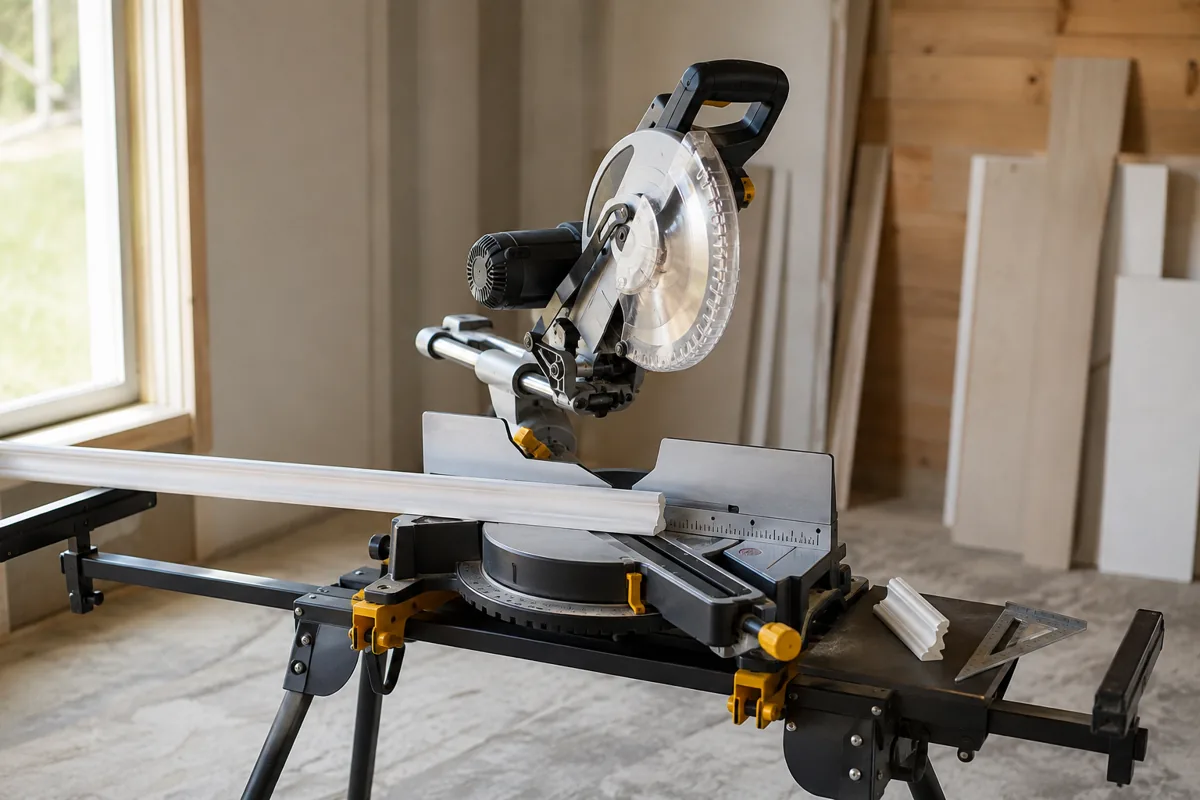
Long boards should be supported at the same height as the saw table. Without side support, a board can pivot downward during the cut, pulling the cut line out of square or trapping the blade. A dedicated miter saw stand with material supports is useful for installation work, while fixed shop users can build level extensions.
Which saw fits your work?
Buy the Bosch if rear space is limited, you move the saw frequently, or you value its compact Axial-Glide arm and front bevel controls. Its 47-degree range is sufficient for almost all ordinary trim and framing work. The Bosch is also a sensible choice when the saw will live on a crowded bench where conventional rear rails would hit a wall.
Buy the Makita if maximum crosscut width, a rigid-feeling rail system, and a clear bevel scale matter more than compact storage. The LS1219L is a strong fit for a trim carpenter cutting wide casing and baseboard, provided there is room behind the saw for rail travel. Its laser can help with rough positioning, but it does not replace test cuts or a correctly calibrated scale.
For occasional home projects, either saw is more capability than necessary. A cheaper 10-inch dual-bevel saw is fine if your stock is normally under about 6 inches wide and you do not need the larger 12-inch blade capacity. Spend the difference on a sharp 12-inch fine-finish miter saw blade and proper work support. For professional trim work or wide crosscuts, the Bosch’s compactness and the Makita’s capacity are meaningful advantages—not just specification-sheet differences.