What's inside
As an Amazon Associate I earn from qualifying purchases. This post may contain affiliate links at no extra cost to you.
A framing square and a machinist square can both help you check a right angle, but they are built for different scales and tolerances. For a small metal part or a carefully set machine, a machinist square is usually the more reliable choice. For laying out studs, rafters, sheet goods, and other large work, a framing square is more practical—and accurate enough when you check it before use.
As an Amazon Associate we earn from qualifying purchases at no extra cost to you.


Our Top Picks
 Johnson Level & Tool CS9 Steel Framing Square16" x 24"24 x 19 x 0.06 inches1.4 poundsCheck on Amazon


The short answer
Choose a machinist square when the work is small and a slight error matters: fitting parts, setting a vise, checking a cut edge, or squaring a machine setup. Its short, rigid blade is easier to hold against a reference face, and better-quality examples are made to tighter tolerances.
Choose a framing square for construction layout and long cuts. Its long legs reach across boards and panels, and its markings support common layout tasks. It is not automatically inaccurate; it is simply harder to use as a precision check on a small part. For repeatable checks on larger woodworking, a large engineer’s or carpenter’s square may bridge the gap.
What each square is designed to do
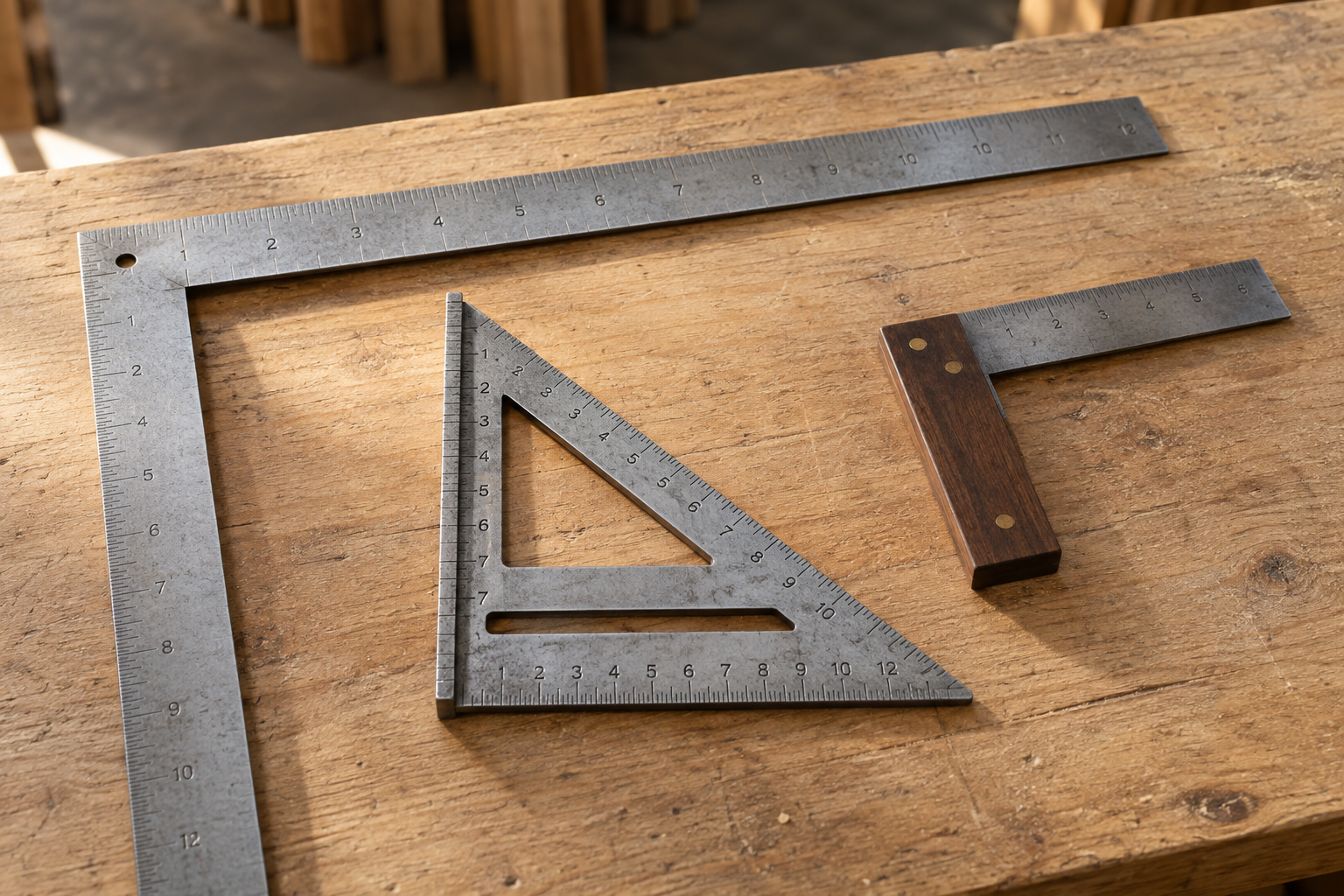
A machinist square, also called an engineer’s square, typically has a short steel blade set at 90 degrees to a thicker stock. Common sizes have blades around 2 to 12 inches long. The stock bears against the work while the blade shows whether an edge is square. Small sizes are convenient on parts, though a short blade checks only a short section at a time.
A framing square is a broad, flat L-shaped tool, commonly with legs around 24 by 16 inches. It gives you a long reference for laying out cuts on lumber and panels. Its size is an advantage on a sheet or stud, but a disadvantage on a small component: it can rock on bumps, catch on an edge, or be awkward to keep seated.
Side-by-side comparison
| Factor | Machinist square | Framing square |
|---|---|---|
| Best scale | Small parts, machine setups, metalwork | Lumber, panels, construction layout |
| Typical blade length | About 2–12 inches | About 16–24 inches per leg |
| Ease of seating | Good on a clean, flat reference face | Good on broad stock; cumbersome on small parts |
| Precision potential | Higher with a ground, inspected tool | Adequate for building work if checked |
| Main failure risks | Damaged edge, burr, poor-quality blade | Warp, bent leg, burr, inaccurate graduations |
| Typical value | Worth paying for when tolerance matters | Low-cost option often works for rough layout |
How to check 90 degrees reliably
Do not assume a square is accurate because it looks straight or has a familiar brand. Seat its stock firmly against a known straight edge, such as a machined surface or a verified reference edge. Draw a fine line along the blade, flip the square over against the same edge, and draw a second line. If the lines diverge, the tool or reference edge is not square. A visible gap of 1 mm over 100 mm is a meaningful error for joinery or machine setup; the same error over a long framing member may be unimportant depending on the cut and assembly.
This flip test finds error, but it does not identify which surface is wrong. Repeat it with a second reference edge or a square you trust. Also inspect for dirt and burrs. A tiny chip trapped between the stock and work can create a noticeable gap at the blade tip. Clean both surfaces, use light pressure, and avoid pushing a thin blade hard enough to flex it.
For a framing square, check both legs for flatness and damage, especially around the heel and corners. A square that has been dropped or stored loose in a truck can bend. For a machinist square, protect the blade edge from knocks and rust; a ding can prevent full contact even if the angle itself remains correct.
Which should you buy?
If you work mainly on small metal parts, cabinetry details, or machine adjustments, buy a machinist square sized for the work. A 4- or 6-inch blade is a useful general size; a larger blade reaches farther but is easier to misalign if the workpiece edge is short. Look for a ground blade and stock, clear construction, and a stated accuracy tolerance. A precision grade costs more, but the premium is useful only if your work and measuring setup can take advantage of it. Compare ground machinist squares by size and stated tolerance rather than appearance alone.
For framing, deck work, or general site layout, a basic framing square is usually fine. Check it on arrival and again after a hard drop. If it passes the flip test and lies flat, there is little reason to pay for a precision tool when you are marking ordinary lumber. A steel framing square is a sensible choice for broad layout; a lightweight alternative may be easier to carry but can be more vulnerable to flex or damage.
If you regularly need accurate right angles across a 12- to 24-inch workpiece, neither tool is a perfect substitute for choosing the right size and grade. A short machinist square cannot reveal a gradual error across a long edge, while a framing square’s large legs may not be sufficiently flat or precise for close-fitting work. Consider a larger precision square or verify the layout with a reliable measurement method.
Mistakes that make either tool seem unreliable
The most common mistake is checking an angle against an edge that is already out of square. Another is reading the graduations as proof of accuracy: markings help with layout, but they do not certify the 90-degree corner. Paint, rust, sawdust, and a raised burr can all hold the stock off the work. Finally, do not compare squares by eye from several feet away. Use a fine pencil or scribe line, consistent contact, and a reference surface you have checked.
For a small precision job, a verified machinist square gives the more dependable 90-degree check. For construction-scale work, a checked framing square is the more useful tool—and often the cheaper, entirely adequate one.