What's inside
As an Amazon Associate I earn from qualifying purchases. This post may contain affiliate links at no extra cost to you.
Start With the Chuck, Not the Bit
A rotary hammer bit must match the tool’s chuck system before diameter, length, or brand matters. The most common mistake is buying a bit that fits the hole size but has the wrong shank. A 1-inch masonry bit with an SDS-plus shank will not lock into an SDS-max chuck, and an SDS-max bit will not fit an SDS-plus tool.
Look at the tool’s manual, the label near the chuck, or the manufacturer’s specifications. Search terms such as “SDS-plus,” “SDS-max,” “spline,” or “1-1/8-inch hex” usually identify the system. If the tool uses a conventional three-jaw drill chuck, it may be a drill/driver or hammer drill rather than a rotary hammer. Those tools use round-shank masonry bits, not rotary hammer bits.
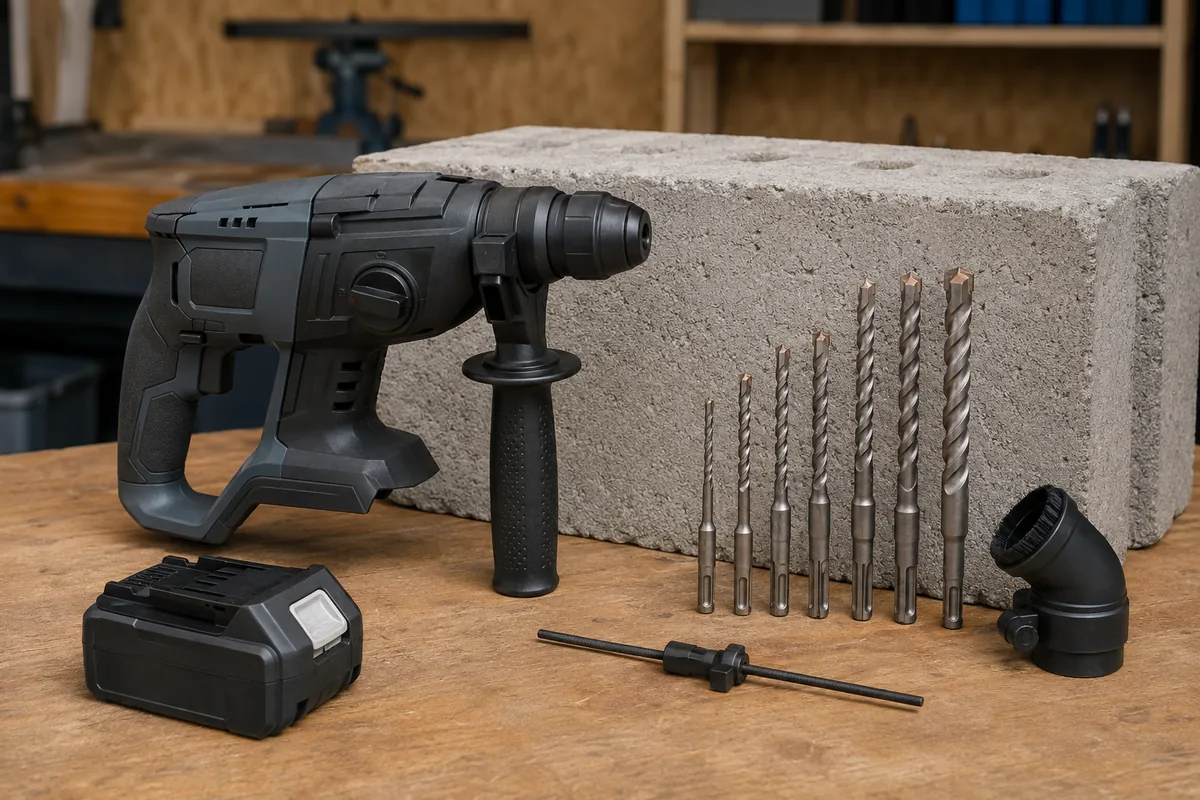
When buying replacement accessories, start with a SDS-plus rotary hammer bit set or the correct larger system only after confirming the chuck marking.
The Main Rotary Hammer Shank Systems
| Shank system | Typical tool class | Common bit range | Best use |
|---|---|---|---|
| SDS-plus | Compact rotary hammers, usually 5/8 to 1 inch | 5/32 to about 1-1/4 inches | Anchors, electrical work, plumbing, light demolition |
| SDS-max | Heavy rotary hammers, commonly 1-3/4 to 2-1/2 inches | About 1/2 to 2 inches and larger | Large holes, concrete work, chiseling |
| Spline | Older or specialized heavy hammers | Often similar in size to SDS-max tools | Heavy drilling and demolition |
| 1-1/8-inch hex | Large demolition hammers | Large core bits and chisels | High-impact demolition and oversized holes |
The size ranges overlap, but the shanks do not. A 3/4-inch hole can be made with an SDS-plus or SDS-max tool, yet the bit must still match the chuck. SDS-plus and SDS-max are different physical systems with different slot patterns, collar dimensions, and retention mechanisms.
SDS-Plus: The General-Purpose Choice
SDS-plus is the most common system for homeowners, remodelers, electricians, and plumbers. The shank is roughly 10 mm across and has two open drive slots plus two closed retention grooves. The chuck accepts the bit without a key; push it in until the locking balls engage, then pull back on the bit to confirm it is retained.
These tools are well suited to holes for concrete anchors, Tapcon-style fasteners, conduit, and small pipe penetrations. A compact SDS-plus hammer is also easier to control overhead and generally costs less than a heavy SDS-max model. For occasional holes up to roughly 1 inch, buying an SDS-plus tool and bits is usually the cheaper and more practical route.
Do not judge the system by the bit’s cutting diameter. A 1-inch SDS-plus bit and a 1-inch SDS-max bit are not interchangeable. SDS-plus bits also have less steel and lower impact capacity, so forcing them into extended heavy chiseling or repeated large-hole work can bend the shank or damage the tool’s hammer mechanism.
SDS-Max, Spline, and Hex Systems
SDS-max shanks are substantially larger and are designed for high-impact rotary hammers. They are the right choice for repeated holes over about 1 inch, deep drilling in hard concrete, and serious chiseling. The trade-off is weight, price, vibration, and accessory cost. A large SDS-max hammer is excessive for installing a dozen small anchors.
Spline shanks appear on many older heavy-duty rotary hammers. They use longitudinal splines to transmit torque and are not the same as SDS-max. A spline bit can look close enough to tempt a mistake, but it will not properly lock into an SDS-max chuck. Match the exact system listed on the tool, even if the bit diameter is appropriate.
Large demolition hammers may use a 1-1/8-inch hex shank or another hex size. These tools are often designed mainly for chisels and breakers rather than drilling. A hex bit requires a matching hex chuck; it cannot be installed in SDS-plus or SDS-max by appearance alone. If you need this category, shop specifically for 1-1/8-inch hex rotary hammer bits.
How to Check a Bit Before Buying
Read the package for the exact shank designation. “For rotary hammers” is not enough. The label should say SDS-plus, SDS-max, spline, or a specific hex size. If purchasing loose bits, inspect the shank: SDS systems have machined grooves and slots, while spline and hex shanks have visibly different profiles.
Measure the bit diameter and working length separately. A bit advertised as 3/4 by 12 inches may have a 12-inch overall length but only 7 or 8 inches of cutting length. For a hole that must pass through a 6-inch wall, allow room for dust clearance and tip protrusion. A bit that is too short can leave an incomplete hole; one that is unnecessarily long is harder to keep straight and costs more.
For deep holes, use a bit at least 2 inches longer than the required hole depth when possible. Withdraw the bit periodically to clear dust. Packed dust increases friction, slows drilling, and can overheat both the carbide tip and the hammer.
Adapters Are a Compromise, Not a Conversion
Adapters can let a rotary hammer accept a round drill bit or another accessory, but they change the tool’s behavior. A chuck adapter adds length, runout, and another wear point. It is acceptable for occasional drilling in wood or metal when the tool is switched to rotary-only mode, but it is a poor substitute for a dedicated drill.
Never use a standard round-chuck adapter for hammer drilling unless its manufacturer explicitly rates it for impact. Ordinary keyed or keyless chucks can loosen, crack, or eject under repeated hammer blows. Even impact-rated adapters reduce available capacity and may not be suitable for large bits.
Another common failure is inserting an SDS bit without checking retention. Some movement is normal: SDS bits need axial clearance to hammer. Excessive wobble, failure to lock, damaged grooves, or a bit that pulls out by hand indicates a worn chuck or damaged shank. Stop using it. A loose bit can damage the tool and produce an oversized, crooked hole.
Choosing the Cheapest Suitable System
For light concrete work, the cheaper option is usually an SDS-plus rotary hammer and a small set of quality carbide-tipped bits. Buy individual bits when you need only one or two sizes; inexpensive mixed sets often include short bits or duplicate sizes you will not use.
Move to SDS-max when the job requires many large holes, deep drilling, or sustained chiseling. Do not buy a heavy hammer merely because its maximum diameter looks impressive. The larger tool can tire you faster, cost considerably more per bit, and be less controllable around tile, block, or thin slabs.
Before placing the order, confirm four things: the chuck system, the bit diameter, the usable cutting length, and whether the accessory is rated for hammer mode. That checklist prevents the most expensive mismatch: a bit that technically fits the project but cannot physically lock into the tool.