What's inside
As an Amazon Associate I earn from qualifying purchases. This post may contain affiliate links at no extra cost to you.
Flattening a narrow hardwood edge sounds like a quick job, but the wrong tool can turn a straight edge into a shallow scallop or a burnished, uneven mess. A hand plane and a belt sander can both remove material, but they do it in very different ways. For most narrow edges—such as a board edge being prepared for glue-up—the hand plane is the better finishing tool. A belt sander is faster when the edge is badly out of square or needs substantial material removed, but it demands more control than many people expect.
As an Amazon Associate we earn from qualifying purchases at no extra cost to you.


Our Top Picks


Which Tool Fits the Job?
A sharp hand plane cuts a controlled shaving across the high spots. Properly set up, it can produce a flat, straight edge with a surface ready for glue. A belt sander removes wood with abrasive grit moving continuously over the work. That makes it useful for correcting rough stock, but it also makes it easy to remove too much wood at the beginning or end of the pass.
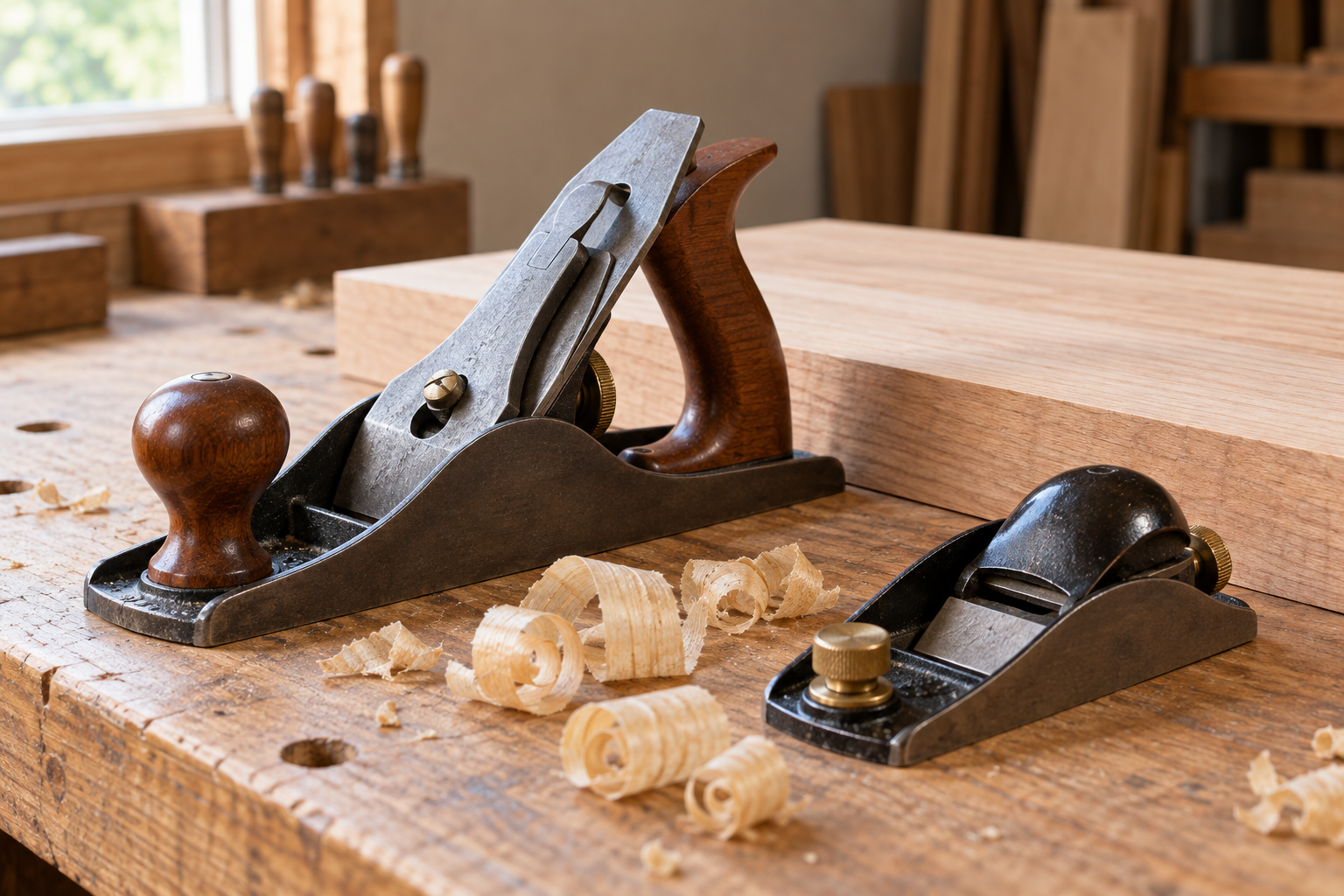
For an edge less than about 36 inches long and only slightly uneven, choose a low-angle block plane or a longer bench plane. A block plane is easier to control on a narrow edge, while a No. 5-style jack plane or similar bench plane bridges dips more effectively on longer boards. If the edge has obvious saw marks, twist, or more than roughly 1/16 inch of material to remove, a belt sander may save time during the initial correction.
| Factor | Hand plane | Belt sander |
|---|---|---|
| Best use | Final flattening and straightening | Fast stock removal and rough correction |
| Typical control | High, once sharp and adjusted | Moderate; pressure and speed change the cut |
| Surface quality | Clean, potentially glue-ready | Requires sanding; can show dips and scratches |
| Noise and dust | Quiet, produces shavings | Loud and dusty, even with extraction |
| Common failure | Tear-out or a hollow edge from poor technique | Rounded ends, low spots, burns, or oversanding |
| Learning curve | Higher setup requirement | Lower entry barrier, higher risk of uneven results |
Using a Hand Plane on a Narrow Edge
Start by checking the edge with a straightedge and marking the high spots with a pencil. Clamp the board so the edge is accessible, but do not crush it with excessive vise pressure. On a narrow board, support the work close to the area being planed. Vibration makes it difficult to keep the sole flat.
The blade must be sharp enough to shave end grain from a scrap without force. Set the iron for a light cut—about 0.005 to 0.015 inch for a finishing pass. Begin with the plane tilted slightly so one corner leads, then gradually use the full blade as the edge becomes uniform. Keep downward pressure over the sole rather than pressing hard on the front or rear. At the end of the stroke, maintain pressure over the board; lifting the plane early can leave a dipped section.
Plane with the grain whenever possible. On figured hardwood, grain direction can change along the edge, so inspect the fibers rather than relying only on the board’s length. Tear-out often indicates a dull iron, an overly deep cut, or a direction that runs against the grain. A higher cutting angle plane, such as a bevel-up plane with a steeper blade bevel, can help on difficult grain, but it will not compensate for a dull edge.
For a glue joint, check the result with winding sticks or a straightedge and test the edge against its mating board. A perfectly polished edge is not required; straight and square matter more. If you can see light under a straightedge over a 24-inch span, keep correcting before moving to glue.
Using a Belt Sander Without Rounding the Edge
A belt sander is the cheaper option if you already own one and the edge only needs rough correction. Use a narrow belt sander when possible, fitted with fresh belts in the 80- or 100-grit range for removal. Coarser 60-grit abrasive cuts faster but creates deeper scratches and increases the chance of gouging hardwood. Keep a 3-by-21-inch belt sander supported with both hands; compact sanders can be easier to manage on a small edge.
Mark the edge with pencil lines before starting. Run the sander in long, even passes, using only the machine’s weight. Do not stop in one place, and do not rock the tool. The front and rear of the belt leave the work first, which encourages a hollow center or rounded ends if you linger. Start the sander before touching the wood and lift it away before switching it off.
Keep the sander’s platen flat against the edge. A soft or worn platen can make the belt conform to small irregularities, while excessive pressure slows the belt and increases heat. Hardwood can burn surprisingly quickly, especially with a clogged belt. If the surface turns brown or develops a glossy strip, stop and replace or clean the abrasive rather than pressing harder.
For a glue joint, stop belt sanding at about 1/32 inch from the final line. Switch to a plane or a rigid sanding block for the last correction. If you finish entirely with the belt sander, use a long block and inspect for dips under a straightedge. Sanding with a power tool may make an edge feel smooth while leaving it unsuitable for a tight joint.
The Most Reliable Workflow
When the edge is only mildly uneven, skip the belt sander: mark the high spots, plane them down, and check square frequently with a combination square. That is faster overall than repairing a belt-sander hollow.
When the board is rough, use the belt sander for controlled roughing, then change to a sharp plane for straightening. Keep a combination square and straightedge beside the bench. Check every few passes rather than trusting the tool’s feel.
Wear eye and hearing protection with either method. With a belt sander, add a properly fitted dust mask or respirator and connect dust extraction if available. The hand plane costs less to operate and is quieter, but buying a cheap plane with a warped sole or poor blade can be frustrating. A modest plane with a flat sole and a sharpened iron is usually a better purchase than an expensive plane that is never adjusted correctly.
What Should You Buy?
Choose a hand plane if the edge must be straight, square, and glue-ready, especially on expensive hardwood where mistakes are costly. Choose a belt sander if speed matters, the edge is visibly rough, or you already have one for broader shop work. For occasional DIY projects, the belt sander is fine when followed by careful inspection and hand finishing. For repeated joinery, the hand plane is the more economical and dependable tool—not because it removes wood faster, but because it gives you a better chance of removing exactly the wood you intended.