What's inside
As an Amazon Associate I earn from qualifying purchases. This post may contain affiliate links at no extra cost to you.
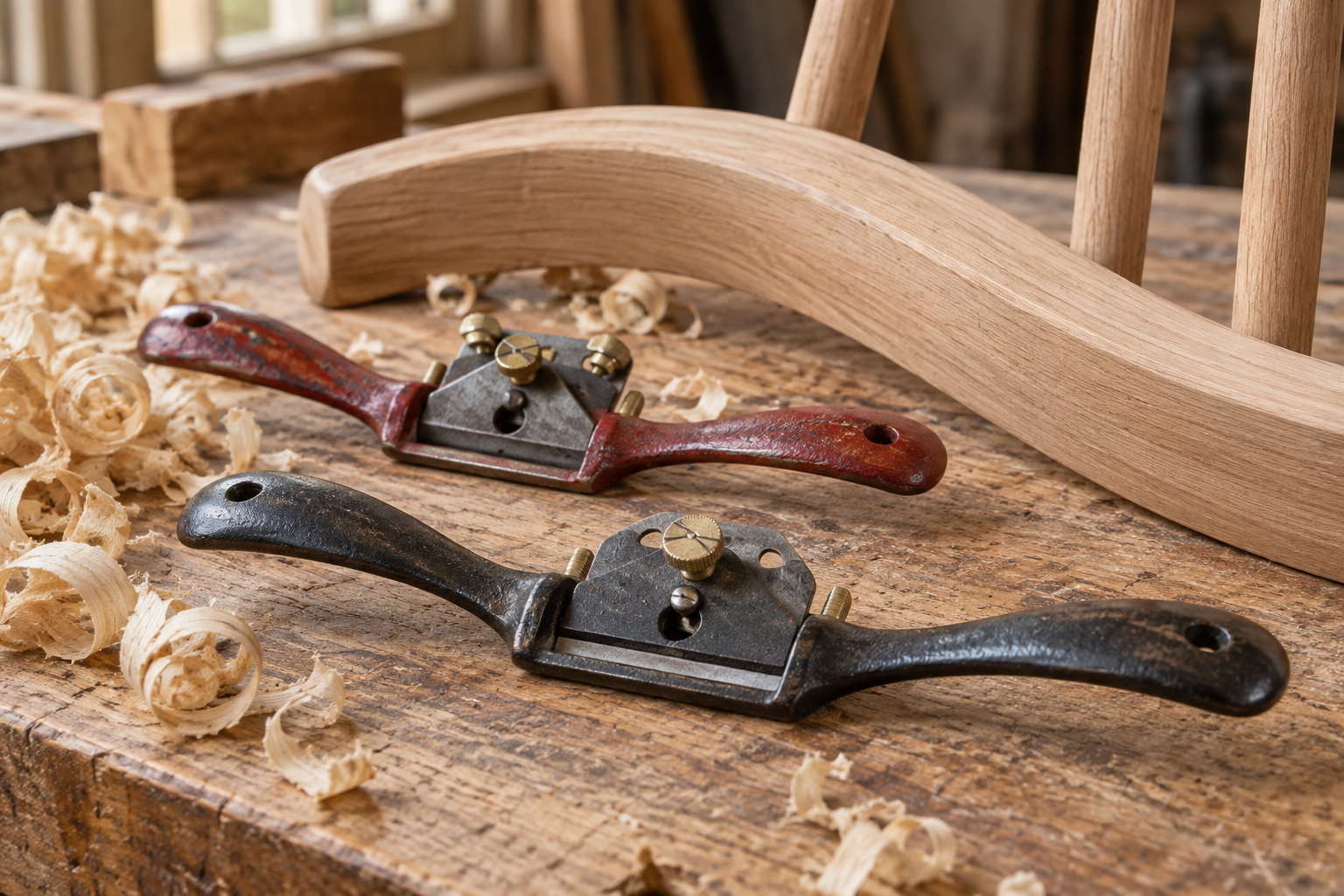
Shaping a solid-wood chair seat is one of the jobs where a spokeshave can remove stock quickly without leaving the torn, stepped surface a power tool often creates. The choice between a flat-bottom and round-bottom spokeshave matters because the seat is not flat: it usually has a broad central hollow, rising edges, and transitions that change direction across the blank.
Neither shave is universally better. A flat-bottom model is the more useful first purchase for most chair work, while a round-bottom model becomes valuable when you are deliberately cutting the inside of a deep scoop. Your timber, seat design, and preferred cutting direction matter as much as the tool’s sole shape.
What the bottom shape changes
A flat-bottom spokeshave has a relatively straight sole ahead of and behind the blade. It registers well on broad, gently curved surfaces and resists tipping when you take a shaving across a seat blank. It is particularly effective for flattening high areas, forming the initial hollow, and refining the transition between the hollow and the raised rim.
A round-bottom spokeshave has a convex sole, usually curved across the width of the tool. That smaller contact area allows the blade to follow a concave surface without the front or rear of the sole riding on the edges and lifting the cutting edge away from the wood. It can enter a tighter hollow than a flat shave.
There is a limit, however. A round-bottom shave does not automatically produce a smooth bowl. Its narrow contact patch makes it easier to rock the tool, dig in, and leave washboard marks. It is a shaping tool, not a substitute for careful layout and controlled cuts.
Flat-bottom vs. round-bottom
| Factor | Flat-bottom spokeshave | Round-bottom spokeshave |
|---|---|---|
| Best surface | Broad, shallow curves and raised areas | Concave hollows and tighter scoops |
| Learning curve | Lower; easier to keep stable | Higher; rocking changes the cut quickly |
| Stock removal | Fast on open areas | Good inside a hollow, slower to control |
| Surface quality | More predictable on transitions | Can leave ridges if the stroke overlaps poorly |
| Versatility | Useful for general shaping and edge work | Specialized for concave work |
| Best first purchase | Usually yes | Usually no, unless seats are the main project |
When a flat-bottom spokeshave wins
Choose a flat-bottom shave if you are making a first chair, working mostly on shallow saddles, or want one tool that also handles chair legs, curved aprons, and edge work. It gives you a stable reference while you establish the seat’s perimeter and remove the high spots outside the deepest area.
It also works well on a seat with a wide, gentle hollow. Many traditional seats do not need a deep bowl. A depression around 12 to 25 mm deep, blended over a generous area, can be comfortable without requiring a highly specialized tool. On that type of design, a flat shave can remove most of the waste and leave a surface that needs only scraping or light sanding.
The main failure mode is trying to force it into a tight hollow. The sole bridges the curve, the blade stops cutting in the middle, and you end up pushing harder. That often causes chatter, bruised fibers, or a sudden deep bite when only one corner of the blade catches.
When a round-bottom spokeshave wins
A round-bottom shave earns its place when the seat has a pronounced central scoop or when you need to work into a concave transition that a flat sole cannot reach. It is useful for steepening the hollow after a coarse tool has removed the bulk of the waste, especially near the lower center of a saddle seat.
It is not the ideal tool for leveling the whole blank. On a nearly flat surface, the curved sole contacts on a small area and tends to rock. That makes depth control less consistent and increases the chance of creating isolated divots. Use short, overlapping strokes rather than trying to span the full seat in one pass.
A round-bottom shave is also less forgiving of a dull blade. The tool is already unstable compared with a flat model; a dull edge requires extra force and makes the sole skid. If you buy one, budget time for honing and learn to set the blade for a shaving roughly 0.1 to 0.3 mm thick during general shaping. Take lighter cuts near the rim.
The better tool for deep seats
For a deeply dished chair seat, consider a chair-seat travisher before buying a round-bottom spokeshave. A travisher has a more deliberately curved sole and is designed to remove material inside a hollow. It is usually faster and more natural for the center of the seat.
The trade-off is versatility. A travisher is specialized and may sit unused between chair projects. A round-bottom spokeshave can handle other concave work, but it still does not remove large amounts of waste as efficiently as a well-tuned travisher or a coarse rasp.
For heavy removal, a coarse woodworking rasp is often the cheaper and safer starting point. Establish the hollow with a rasp, then use the spokeshave to refine the surface. This reduces the temptation to force a fine-bladed shave through too much wood.
How to use either shave on a seat
Mark the finished perimeter and draw depth lines or a series of contour lines across the blank. A compass, flexible curve, or simple cardboard template helps prevent an attractive-looking but uneven scoop. Clamp the seat securely, but support it so the clamps do not obstruct strokes.
Start across the grain or at a slight diagonal only where the fibers allow it. As you approach the final shape, follow the grain direction in each section. Reversing direction across figured or interlocked grain can produce tear-out even with a sharp blade. If a shaving lifts a splinter ahead of the cut, stop and change direction rather than increasing pressure.
Keep the sole fully supported and use both hands. On a flat shave, a longer stroke is often efficient on the broad areas. On a round shave, use strokes about 50 to 100 mm long while learning, overlapping each pass by roughly half the tool width. Check with a straightedge, template, or your hand every few minutes.
What to buy
For one general-purpose tool, buy a flat-bottom spokeshave with a rigid body, a blade that can be sharpened squarely, and an adjustment system that does not shift when tightened. A cheap shave is fine if the casting or sole is sound and you are willing to flatten, tune, and sharpen it. A more expensive model saves time mainly through better fit and easier adjustment, not magic cutting ability.
Add a round-bottom model when your designs regularly include deep hollows, or when you already have a flat shave and want a complementary tool. If chair seats are occasional projects, the flat-bottom shave plus a rasp and scraper is the better-value setup. If you make several seats each year, a travisher and flat shave cover more ground than owning two spokeshaves alone.