What's inside
As an Amazon Associate I earn from qualifying purchases. This post may contain affiliate links at no extra cost to you.
For trimming a sticking door, a cordless planer is faster than repeated sanding and more controlled than attacking the edge with a circular saw. The DeWalt DCP580 and Makita XPK02 are both brushless 18V/20V-class planers with a 3-1/4-inch cutting width, but they feel and work differently. The better choice depends less on headline cutting depth than on your battery platform, how much material you expect to remove, and how cleanly you need to finish the edge.
As an Amazon Associate we earn from qualifying purchases at no extra cost to you.



Our Top Picks
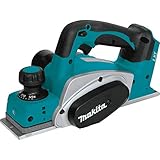
 Makita XPK01Z 18V LXT Lithium-Ion Cordless 3-1/4-Inch PlanerOne Size14 x 9 x 8 inches7.2 poundsCheck on Amazon
 Makita XPK02Z 18V LXT® Lithium-Ion Brushless Cordless 3-1/4"8.07 x 15.32 x 8.07 inches0 poundsCheck on Amazon


DeWalt DCP580 vs Makita XPK02 at a glance
| Feature | DeWalt DCP580 | Makita XPK02 |
|---|---|---|
| Battery platform | DeWalt 20V MAX | Makita 18V LXT |
| Planing width | 3-1/4 inches | 3-1/4 inches |
| Maximum depth per pass | 5/64 inch | 1/8 inch |
| No-load speed | 15,000 RPM | 12,000 RPM |
| Rabbeting depth | Up to 5/8 inch | Up to 5/8 inch |
| Approximate bare-tool weight | About 6.8 lb | About 7.4 lb |
| Key advantage | Compact feel and fast blade speed | Greater maximum cut and solid stock removal |
Which planer is better for fitting a door?
For ordinary door fitting, both tools have more than enough capacity. Most interior doors need only 1/16 inch or less removed from one edge. A typical job involves marking the hinge side or latch side, taking two or three controlled passes, and checking the fit. Neither planer needs to be run at its maximum depth for this work.
The DCP580 has the livelier cutting action. Its 15,000 RPM cutterhead leaves a good surface when the blades are sharp, and the tool is relatively easy to steer at the start and end of a pass. That matters when trimming a finished door, where a heavy push or a long run-out can create a visible low spot.
The Makita XPK02 can remove more material in one pass, with a stated maximum depth of 1/8 inch. That is useful when a swollen exterior door needs substantial correction, or when you are flattening a rough edge before making a final light pass. The extra capacity does not mean you should routinely take 1/8-inch cuts on a door. Large cuts increase the chance of tear-out, motor slowdown, and an edge that is no longer square.
Handling, balance, and adjustment
Both planers use a front depth-adjustment knob and a shoe that must be kept flat against the work. The DCP580 generally feels slightly more compact and easier to control one-handed during short trimming passes. Its kickstand also lets you set the tool down without resting the blade on the bench or floor.
The XPK02 is a little heavier bare, although the difference depends on the battery fitted. Its weight is not a problem when planing a door edge horizontally, and it can help keep the sole planted. It becomes more noticeable when working overhead, trimming the top of an installed door, or making many passes on a large exterior door.
Neither tool is a substitute for careful setup. A door edge should be marked with a sharp pencil or knife, and the planer should be checked for a square sole before starting. If the door is already hung, remove it whenever practical. Planing in place makes it harder to support the door, increases the chance of striking hinges or flooring, and encourages an awkward sideways cut.
Finish quality and common failure modes
Both machines use reversible carbide blades. A dull blade is the fastest route to chatter, burn marks, and torn grain. Keep spare replacement planer blades available, particularly for old paint-covered doors. Do not try to plane through screws, nails, or hinge hardware; even carbide inserts can chip, and metal fragments can become a serious hazard.
Start with the depth set close to zero, then increase it gradually. On a solid-wood door, plane with the grain when possible. Reversing direction can lift fibers at the exit end, especially on rails and stiles. Make the first and last few inches of each pass with even pressure on the front and rear handles. Pressing down hard on the front at the start can make the leading edge lower than the middle.
For a painted or veneered hollow-core door, make shallow passes and stop before the planer reaches the thin edge band. Removing too much can expose the hollow core or weaken the stile. A belt sander or cordless random-orbit sander is usually safer for the final few thousandths of an inch.
Battery life and dust collection
Door fitting is normally a small job, so either tool should complete several doors on a decent 4Ah or 5Ah battery. Planing deep cuts in hardwood, however, draws considerably more power. A compact battery keeps the tool lighter but may run down quickly during repeated heavy passes. Use the battery system you already own rather than buying into a second platform for a single planer.
Both planers can eject chips aggressively. A cordless shop vacuum and the correct dust bag or hose adapter make interior work cleaner, but chips can still scatter. Wear eye protection and hearing protection, and never rely on the planer’s chip outlet to contain dust from old paint.
Which cordless planer should you buy?
Choose the DeWalt DCP580 if you already use DeWalt 20V MAX batteries, value a lighter-feeling tool, or mostly fit interior doors with shallow cuts. Its faster cutterhead and manageable size suit controlled trimming, and the 5/64-inch maximum cut is ample for normal installation work.
Choose the Makita XPK02 if you own Makita 18V LXT batteries or regularly work on thicker, rougher, or exterior doors. The 1/8-inch maximum depth gives it more stock-removal headroom, while the additional weight can help on long, flat passes. It is not automatically the better finishing tool; you still need a light final cut and sharp blades.
If neither battery platform is already in your workshop, compare the cost of the tool, charger, and at least one 4Ah battery rather than comparing bare-tool prices. For occasional door fitting, the cheaper complete kit is perfectly adequate. Spend more only when the battery ecosystem, heavier workload, or preferred handling justifies it.