What's inside
As an Amazon Associate I earn from qualifying purchases. This post may contain affiliate links at no extra cost to you.
If you want to install trim without owning a compressor, a cordless brad nailer is the obvious answer — but not always the better value. Pneumatic brad nailers are still lighter, more consistent, and about half the price. The trade-off is the air hose, the compressor, and the setup time. Here’s how they actually compare on trim jobs like baseboard, window casing, crown, and shoe molding.
As an Amazon Associate we earn from qualifying purchases at no extra cost to you.


Our Top Picks


How Each System Actually Works
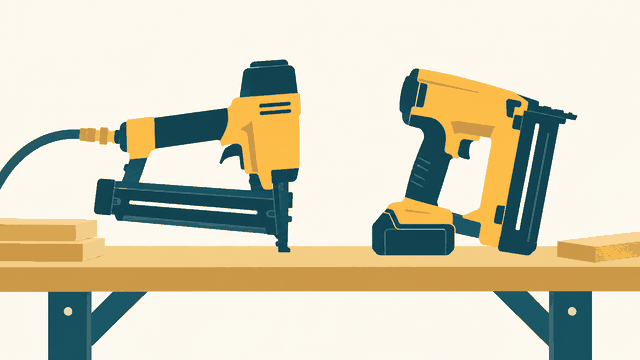
A pneumatic 18-gauge brad nailer is a simple air tool. The compressor stores air at 90-120 PSI, sends it through a hose, and the nailer uses that burst of pressure to drive a brad in one stroke. There’s very little inside to go wrong — a trigger valve, a piston, and a driver blade. Weight is typically 2.2 to 3.0 pounds without the hose.
A cordless brad nailer has to make its own power. Most use a sealed nitrogen gas cylinder and a small motor/battery to compress it, then release it to drive the nail. Others use a flywheel or solenoid. Either way, you get a self-contained tool that weighs 4.8 to 6.2 pounds with battery. No hose, no compressor, no waiting for a tank to fill. You load 18-gauge brads from 5/8-inch to 2-1/8-inch, same as pneumatic, and pull the trigger.
The practical difference is feel. Pneumatic is light in the hand and you can work overhead or in tight corners longer without fatigue. Cordless is nose-heavy and bulkier, which matters on crown or when you’re holding casing level with one hand and nailing with the other.
Driving Power and Finish Quality on Trim
For softwoods like pine, poplar, and MDF — which is 90% of interior trim — both types drive flush when set correctly. The gap shows up on hardwoods and layered material.
Pneumatic gives you instant depth adjustment via regulator pressure. Set to 70-85 PSI for 3/4-inch MDF baseboard, bump to 90-100 PSI when you hit a stud or oak jamb. Recoil is minimal and recovery is instant, so you can fire 3-4 brads per second without the driver losing energy. Sinking depth stays within 0.010-0.015 inch if your air is dry.
Cordless has two limits: charge time and temperature. Most 18V cordless brad nailers need 0.5 to 1.5 seconds between shots to recharge the firing mechanism. Fire too fast and you get a shallow drive or a blank fire. In cold garages (below 40F) or with a low battery, drive depth can drop noticeably on the last 20% of charge. On hard maple or white oak trim, even a fully charged cordless will occasionally leave a brad 1/32-inch proud, requiring a nail set. It also leaves a slightly larger driver mark because the driver hits harder to compensate for no continuous air supply.
Failure modes are different. Pneumatic misfires are usually air-related: moisture in the line causing inconsistent pressure, a leaky hose fitting dropping 10-15 PSI, or the compressor cycling at the wrong moment. Cordless misfires are battery and mechanism related: jammed brads from tipping the nose, overheating after 400-500 rapid shots, or the tool locking out when the battery is low to prevent a weak drive.
If you shoot a lot of 2-inch brads into hardwood window stools or stair trim, pneumatic is more consistent. If you are tacking up painted MDF or pine casing and filling holes anyway, you won’t notice a difference.
Noise, Runtime, and Job Site Setup
This is where cordless wins if you truly want to avoid a compressor. A pneumatic setup needs a compressor (even a small 1- to 6-gallon hot-dog), a 25-foot hose, ear protection for the compressor, and oil for an oil-lube pump. Total setup is 5-10 minutes, plus draining the tank after. Noise is 75-90 dB at the compressor, even if the nailer itself is relatively quiet at around 82-85 dB.
A cordless 18-gauge brad nailer is ready in seconds and fires at about 85-88 dB with no continuous noise. Runtime is good enough for trim: a compact 2.0Ah battery delivers roughly 800-1,200 brads, a 4.0Ah battery 1,500-2,000, depending on length and wood hardness. For a typical 12×16 room — about 60 linear feet of baseboard plus 2 window casings — you’ll shoot 250-400 brads. One battery covers it easily.
The hassle with cordless is weight and maintenance. You carry the battery, and you have to keep spares charged. You also need to periodically check the gas cylinder and driver service interval — most manufacturers recommend a service after 30,000-50,000 shots to re-charge the nitrogen or replace driver seals. Pneumatic tools run for years with just a drop of air tool oil daily and occasional O-ring replacement.
Cost and What You Already Own
Upfront price often decides it. A decent pneumatic 18-gauge brad nailer is $60-$120. If you don’t own a compressor, add $120-$200 for a quiet 1-gallon or 2-gallon trim compressor and $25-$40 for a hose and fittings. You can run other tools off that same compressor later — pin nailer, micro pinner, blow gun.
Cordless costs more to get in. A bare tool is $220-$320, and a kit with battery and charger is $280-$380. If you already own that brand’s 18V batteries, the bare tool is the comparison point. If you don’t, the kit price is real. Batteries are $60-$100 to replace every 3-5 years.
Long-term operating cost is lower for pneumatic if you already own a compressor — just oil and brads. Cordless saves time if you only do short trim jobs a few times a year and don’t want to store a compressor. For a landlord or DIYer doing one room at a time, that time savings often outweighs the $150 premium.
| Cordless 18-Ga Brad Nailer | Pneumatic 18-Ga Brad Nailer | |
|---|---|---|
| Tool Weight | 4.8 – 6.2 lb with 2.0Ah battery | 2.2 – 3.0 lb (plus hose) |
| Power Source | 18V/20V battery + internal gas cylinder | External compressor at 70-120 PSI |
| Nail Range | 5/8 – 2-1/8 in, 18 gauge | 5/8 – 2-1/8 in, 18 gauge |
| Shots Between Delays | ~1 shot per second max, lockout when hot/low battery | 3-4 per second continuous |
| Typical Runtime | 800-2,000 shots per charge | Unlimited while compressor runs |
| Noise | 85-88 dB per shot only | 75-90 dB continuous from compressor |
| Kit Cost (New Buyer) | $280 – $380 with battery/charger | $180 – $360 with compressor/hose/fittings |
| Best Failure to Watch For | Shallow drive from low battery/cold, jams if nose not flat | Moisture in line, pressure drop from leaks/long hose |
Which Should You Buy for Trim Without a Compressor?
Buy cordless if you have no compressor and don’t want one. For installing baseboard, door casing, crown, and shoe molding in a finished house, a 18V cordless trim nailer kit is faster, quieter in the house, and you can carry it room to room without dragging a hose around furniture and stairs. If you already live on one battery platform, stay on it — the bare tool is much better value than buying into a new system. Look for tool-free depth adjustment and a dry-fire lockout, both matter on trim where you can’t afford blow-throughs.
Buy pneumatic if you do a lot of trim or plan to do more air-tool work. A pneumatic brad nailer paired with even a small quiet compressor will be lighter, cheaper, and more consistent on hardwoods and long crown runs. It’s also the better choice if you shoot trim for hours — the weight difference alone saves your wrist. The compressor pays for itself if you’ll also use a pin nailer for small returns or an air duster for cleanup.
If you are on the fence, consider how often you’ll use it. Once or twice a year for touch-up trim and small built-ins: cordless. A whole-house trim job, or you’re outfitting a shop: pneumatic, even if you have to buy the compressor. You can always add a cordless later for punch-list work — many trim carpenters own both and grab the cordless for one or two brads and the pneumatic for production.