What's inside
As an Amazon Associate I earn from qualifying purchases. This post may contain affiliate links at no extra cost to you.
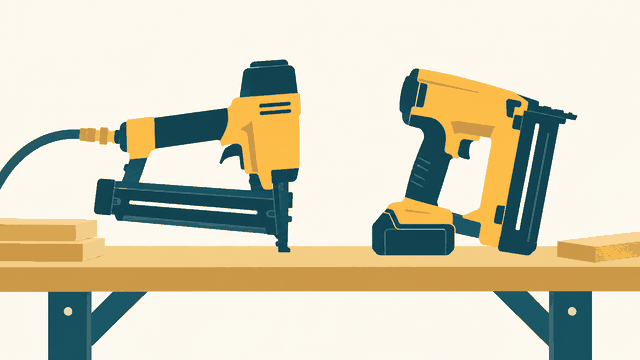
Thin cabinet face frames are easy to split, dent, or push out of alignment with a brad nailer that is too forceful or poorly controlled. For this job, the best 18-gauge nailer is usually a compact pneumatic model with a narrow nose, adjustable depth, and a comfortable trigger—not necessarily the most powerful or feature-packed one. A cordless model can make more sense when you have only a few frames to install or do not want to manage a compressor hose.
As an Amazon Associate we earn from qualifying purchases at no extra cost to you.


Our Top Picks


What matters on thin face frames
Face-frame stock is commonly around 3/4 inch thick, but narrow rails and stiles leave little room for a misplaced fastener. An 18-gauge brad, typically around 1.0 to 2.5 inches long depending on the nailer, holds trim and frame joints well without leaving the larger hole of a finish nail. For attaching a frame to a cabinet box, choose a brad long enough to pass through the frame and get useful bite in the case material, while avoiding a length that risks poking through the cabinet interior.
For a 3/4-inch frame attached to a 3/4-inch cabinet side, a 1-1/2-inch brad is a sensible starting point. Test the actual assembly first: plywood thickness, gaps, and the nailer’s depth setting all affect the result. A long brad driven at an angle can emerge where you do not want it, and a brad placed close to the edge of a narrow stile can split the wood.
Look for tool-free depth adjustment, a nose that gives a clear view of the firing point, and a trigger that is easy to control in single-fire mode. A dry-fire lockout helps prevent the tool from marking the work after the magazine is empty. A belt hook is convenient on a ladder or during overhead cabinet work, but it matters less than balance and visibility.
Nailer types compared
| Type | Best for | Trade-off on face frames |
|---|---|---|
| Pneumatic 18-gauge brad nailer | Repeated cabinet work and long sessions | Needs a compressor and hose; light tool is easier to hold steady |
| Cordless 18-gauge brad nailer | Small jobs, punch-list work, or sites without a compressor | Heavier in the hand; battery and firing system add cost |
| Budget pneumatic nailer | Occasional trim and frame installation | May have rougher depth control or less comfortable nose access |
Best all-around choice: a compact pneumatic nailer
If you already own a compressor, a compact pneumatic 18-gauge nailer is the strongest fit for installing multiple face frames. It is generally lighter than a cordless tool, so it is easier to keep square against the stile while firing. It also avoids the cost and weight of a battery platform. Shop for a tool with a narrow contact nose and depth adjustment that can be changed without a hex key.
Air demand is modest for a brad nailer, so a small compressor can handle cabinet installation. The nuisance is the hose: it can drag across finished surfaces or pull the tool off line. Keep the hose behind the work, use a short whip hose if available, and support the frame before firing. Compare pneumatic 18-gauge brad nailers by nose visibility, depth control, and serviceable parts rather than by maximum nail length alone.
When cordless is worth buying
A cordless 18-gauge nailer is a better buy when the job is small, the work area is finished, or hauling a compressor would take longer than the nailing. It is also useful for installations in occupied homes where the compressor’s noise and hose are unwelcome. The cost is higher, and the tool’s added weight can make precise placement tiring when working above shoulder height.
For a few dozen brads, that weight may be a fair trade for setup time. For a full kitchen or repeated cabinet work, a pneumatic tool is usually more comfortable if you already have air. If you need cordless convenience, compare cordless 18-gauge brad nailers within the battery system you own; buying a separate battery platform for one nailer can erase the convenience advantage.
Is a cheaper nailer good enough?
Yes, for occasional installation. A basic pneumatic nailer can drive brads accurately enough if it feeds reliably, holds a consistent depth setting, and lets you see the nose against the work. Spend more when the tool will see frequent use or when better balance, easier jam clearing, and finer depth adjustment save time on every frame.
Do not pay extra for a long magazine capacity or a high advertised firing rate for cabinet work. You will be positioning and checking the frame far more often than you will be firing rapidly. A few useful options to compare are budget pneumatic brad nailers and brad nailers with tool-free depth adjustment.
Avoid the common failures
Test-fire into scrap matching the frame and cabinet materials before touching the finished work. Set depth so the brad head sits just below the surface; too shallow leaves a head that catches a putty knife, while too deep creates a crater that may show through paint. If the tool buries brads inconsistently, check air pressure against the manufacturer’s range, confirm the nose is flush, and inspect for damaged or mismatched fasteners before increasing pressure.
Brace the face frame tightly against the cabinet box and place brads where they will not interfere with hinges, shelf pins, or drawer hardware. On narrow stock, stay well away from the edge and avoid driving into an existing joint line. If a brad bends or follows the grain, stop and remove it rather than firing another into the same spot. A clamp or temporary pin nail can hold a frame in position while you check reveals; the brad nailer should secure an aligned frame, not pull a crooked one into place.