What's inside
As an Amazon Associate I earn from qualifying purchases. This post may contain affiliate links at no extra cost to you.
Plywood is made from alternating veneer layers, so a router bit can cut cleanly through one layer and tear the next. The right bit depends less on the plywood’s nominal thickness than on which face needs to look best, whether the cut goes all the way through, and whether you are using a handheld router or CNC machine.
As an Amazon Associate we earn from qualifying purchases at no extra cost to you.


Our Top Picks
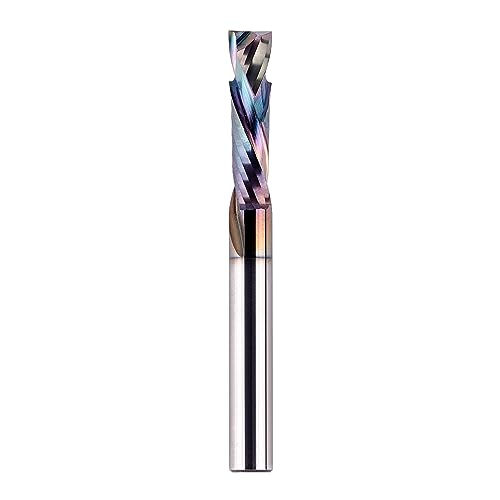 SpeTool Compression Router Bits 1/4 Inch Shank 11/4" Dia - 1" CL -1/4" Shank3.43 x 0.47 x 6.06 inches0.1 poundsCheck on Amazon

How the bits cut
A spiral upcut bit pulls chips upward as it cuts. That upward shear action clears waste efficiently and usually leaves the bottom face of a plywood panel clean. The trade-off is that it can lift the top veneer, producing splinters or small chips along the visible upper edge.
A compression bit combines both cutting directions. The lower portion of the bit is upcut, while the upper portion is downcut. When the bit is cutting at the correct depth, the two forces meet inside the material and compress the veneer layers instead of lifting them. That makes it the better choice when both the top and bottom faces of a sheet need clean edges.
For a typical 3/4-inch plywood panel, a compression bit may need roughly 1/8 to 1/4 inch of its upcut section buried in the material before the downcut section begins doing its work. The exact geometry varies, so check the manufacturer’s cutting-length specification. If the bit is only cutting 1/8 inch deep into the panel, it may behave like a downcut bit rather than a compression bit.
Edge quality compared
| Feature | Compression bit | Spiral upcut bit |
|---|---|---|
| Top face | Usually very clean once fully engaged | Most likely to show lifting or splintering |
| Bottom face | Usually very clean | Typically cleanest of the two |
| Through-cuts | Best for clean edges on both faces | Good when the bottom is the important face |
| Blind pockets | Can leave a rough transition if depth is wrong | Excellent chip evacuation and pocket clearing |
| Handheld use | Works, but needs careful depth and feed control | Generally easier to use |
| Cost | Usually higher | Often cheaper and more versatile |
In a clean through-cut, compression wins on overall appearance. It is particularly useful for cabinet parts, drawer components, signs, and CNC-cut panels where both faces may be visible. A good compression bit can leave an edge that needs only light sanding.
An upcut bit is not automatically a poor plywood bit. It is often the better tool when the cut is a pocket, dado, or mortise and the bottom of the cut matters more than the top. Its open flute design also removes chips well, reducing heat and recutting when the router is moving quickly.
Choosing for a handheld router
For handheld work, start with a spiral upcut router bit if you are trimming plywood edges, cutting grooves, or making occasional joinery cuts. It is simpler to control because its cutting action is consistent across the bit’s length. A 1/4-inch or 1/2-inch diameter bit covers many cabinet and furniture tasks.
Use a compression bit when the top face must stay clean and the cut goes through the panel. Set the depth so the bit’s compression zone is actually inside the plywood. On a 3/4-inch sheet, a pass that cuts only 1/4 inch deep will not produce the same result as a full-depth cut. For a through-cut, leave a small amount of material for a final pass, or cut into a spoilboard and make the final pass at full depth.
Compression bits also demand more attention to feed direction and stability. A climb cut may reduce splintering in a localized area, but it can pull a handheld router forward unexpectedly. Use conventional routing for most of the cut, clamp the work securely, and make shallow test cuts before committing to a visible panel.
CNC use and feed settings
Compression bits are especially useful on CNC routers because the machine can hold a consistent depth and feed rate. They are a sensible upgrade if you routinely cut plywood sheets, cabinet parts, or nested components. A carbide compression bit for plywood CNC work costs more than a basic upcut, but fewer chipped edges can save considerable sanding and rework.
Do not assume a slower feed always gives a cleaner edge. If the router spins at 20,000 RPM and the bit has two flutes, a feed rate of 100 inches per minute produces a chip load of 0.0025 inch:
Chip load = feed rate ÷ (RPM × number of flutes)
That is only a starting point. Follow the bit maker’s recommended range, then adjust for plywood grade, machine rigidity, and cut depth. A feed that is too slow can burn the veneer and dull the carbide; too fast can chip the edge or overload the router. Vacuum dust promptly, since recut chips can leave a rough, heat-darkened edge.
When the cheaper upcut is the better buy
Choose the upcut bit if only one face needs to look good, if you are mainly cutting pockets, or if you need strong chip evacuation in deep cuts. It is also the practical choice for occasional DIY work. You can reduce top-edge tearout by applying painter’s tape, scoring the cut line with a sharp knife, using a sacrificial surface, or making a shallow first pass followed by the final cut.
For frequent sheet-goods work, buy a 1/2-inch compression router bit matched to your plywood thickness. For mixed work, keep a 1/4-inch spiral upcut bit as the general-purpose option and reserve the compression bit for visible through-cuts.
The practical choice
Buy a compression bit when both plywood faces and the finished edge matter, especially for repeated through-cuts on a CNC. Buy an upcut bit when you want lower cost, cleaner chip removal, or better performance in pockets and blind cuts. Neither bit eliminates poor plywood, a dull cutter, or an unsuitable feed rate. The cleanest result comes from matching the bit’s cutting geometry to the face you need to protect and cutting at a depth where that geometry can work.