What's inside
As an Amazon Associate I earn from qualifying purchases. This post may contain affiliate links at no extra cost to you.
For cutting dados in plywood with a router, a spiral upcut bit is usually the better all-around choice. It clears chips efficiently, cuts cleanly, and works well with a router table or handheld router. A downcut bit can produce a cleaner top edge, but it packs chips into the dado and can leave a rougher bottom unless you control feed rate and depth carefully.
The right choice depends on which surface matters most, how deep the dado is, and whether you are using a handheld router or CNC machine. Plywood’s layered construction also changes the trade-off: the face veneer can chip even when the core cuts cleanly.
As an Amazon Associate we earn from qualifying purchases at no extra cost to you.



Our Top Picks
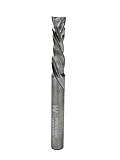
 SpeTool 1/4 Inch Shank Downcut Spiral Router Bit1/4" Dia - 1" CL -1/4" Shank3.46 x 0.55 x 6.14 inches0.07 poundsCheck on Amazon

Quick comparison
| Characteristic | Spiral upcut | Spiral downcut |
|---|---|---|
| Chip removal | Excellent; chips are pulled upward | Limited; chips are pushed into the cut |
| Top face edge | More likely to chip, especially in fragile veneer | Usually cleaner and less prone to breakout |
| Dado bottom | Generally cleaner | Can collect chips and burn if fed too slowly |
| Handheld router use | Best general-purpose option | Useful for shallow cuts and clean top edges |
| Router-table use | Very effective | Works, but chip packing requires attention |
| Best use | Deep dados, repeated cuts, hardwood-faced plywood | Visible top surfaces and shallow dados |
How the cutting action differs
An upcut spiral bit pulls chips toward the router. That lifting action keeps the flutes open, so the bit can remove material efficiently during a deep cut. It also tends to pull fibers upward at the top edge. In plywood, that can lift or chip the face veneer, particularly on inexpensive construction plywood or brittle oak and birch veneers.
A downcut spiral pushes chips toward the workpiece. The downward shearing action presses the surface fibers in place and normally leaves a cleaner upper edge. The disadvantage is chip evacuation. In a dado 1/4 inch deep, this may not matter much. At 3/8 inch or 1/2 inch deep, especially in a narrow slot, chips can remain under the bit. That increases heat, makes the router work harder, and can leave a scorched or uneven bottom.
Neither bit eliminates tear-out. A downcut only controls the upper edge; the exit side, loose veneer, and poorly supported plywood can still break out. A sacrificial backer or a climb-cutting cleanup pass can help, but climb cutting is aggressive and should be limited to a very light finishing pass with firm control.
Which bit should you buy?
Choose an upcut bit when you need one bit for most plywood dados, especially if the dado is deeper than 1/4 inch. A solid-carbide 1/4-inch spiral upcut router bit is a practical starting size for cabinet work. It clears waste well and is less likely to overheat than a downcut during a long or deep pass.
Choose a downcut bit when the top face is the visible side and the cut is relatively shallow. It is useful for dados in finished cabinet sides, drawer parts, and plywood panels where the upper lip must stay crisp. Look for a 1/4-inch spiral downcut router bit when minimizing top-surface fuzz is more important than rapid chip removal.
For frequent work, owning both styles is reasonable. The cheaper option is fine if you are making only a few shallow dados, painting the project, or using a straight bit with a sharp edge and a good guide. A premium spiral bit earns its cost through cleaner repeated cuts and longer edge life, not because it makes an inaccurate setup accurate.
Bit size and dado fit
Do not assume nominal plywood thickness matches the sheet. “3/4-inch” plywood is commonly closer to 23/32 inch, and imported or shop-made panels may vary further. Measure the actual panel with calipers. If the bit is narrower than the panel, make the dado in two controlled passes or use a router jig that references the actual workpiece.
For a 3/4-inch panel, test the fit in scrap before cutting the project. A useful starting target is a joint that slides together with firm hand pressure and no obvious side-to-side wobble. A dado that is only 0.005 inch too tight can split a plywood edge; one that is 0.010 inch too loose may need glue to prevent visible movement.
Use a 1/2-inch shank bit when your router accepts it and the bit is available in that size. The larger shank is stiffer and usually produces less vibration than a comparable 1/4-inch-shank bit. It does not, however, make an unsuitable router safe: observe the bit’s maximum speed and keep the cut within the router’s capacity.
A reliable cutting procedure
Mark the dado location, clamp a straightedge securely, and test the setup on scrap from the same plywood. Set the first pass to approximately 1/8 inch deep. For a final dado depth of 3/8 inch, use three passes rather than forcing the full depth at once. On a handheld router, this reduces deflection and gives the bit a better chance to clear waste.
Run the router at an appropriate speed for the bit diameter, and feed steadily rather than creeping along. A slow feed with a downcut bit is a common cause of burning. A fast feed with a dull upcut bit causes chatter, fuzzy walls, and excessive load. If the bit squeals, smokes, or leaves dark marks, stop and inspect the bit, speed, depth, and feed rate.
With an upcut bit, place masking tape over the cut line when the plywood face is prone to splintering. With a downcut bit, use dust extraction and periodically clear the dado between passes. Never reach near a spinning bit to remove packed chips. A shop vacuum connected to the router or jig helps, but it will not fully solve chip packing in a narrow slot.
Best choice by situation
For deep or repeated dados, buy the upcut. For a shallow dado in a visible veneered panel, buy the downcut. For a CNC router, a downcut is often attractive for holding the top surface clean, but an upcut or compression bit is usually better when full-depth chip evacuation matters. If both faces must stay clean, consider a compression spiral router bit for plywood, provided the cut depth matches the bit’s compression section.
For most cabinet and furniture work done with a handheld router, start with a sharp upcut spiral bit, make test cuts, and control the top edge with tape or a sacrificial surface. Move to a downcut when top-face tear-out is the recurring problem—not simply because the label sounds cleaner.