What's inside
As an Amazon Associate I earn from qualifying purchases. This post may contain affiliate links at no extra cost to you.
The best TIG welder for the money in 2026 is an AC/DC inverter machine in the $500–$900 range — it covers steel, stainless, and aluminum without forcing you to buy a second welder later. Below that price you lose AC (and with it, aluminum capability); above it you’re paying for duty cycle and pulse features most home and small-shop welders won’t fully use.
As an Amazon Associate we earn from qualifying purchases at no extra cost to you.



Our Top Picks



What Actually Determines Value in a TIG Welder
Price alone is a poor filter. A $350 DC-only machine is expensive if you ever want to weld aluminum, and a $1,400 industrial unit is wasteful if you weld twice a month. Rank any candidate on these five criteria:
- AC/DC capability. AC is required for aluminum and magnesium. DC covers steel, stainless, chromoly, copper, and titanium. A true “value” machine does both.
- Amperage range. A low end of 10–20A matters for sheet metal and thin tubing; a high end of 200A+ handles 1/4″ aluminum plate. Wide range = one machine for more jobs.
- AC balance and frequency control. Adjustable AC balance (cleaning vs. penetration) and frequency (arc focus) are what separate a capable aluminum welder from a frustrating one.
- Pulse and start controls. Pulse reduces heat input on thin material; 2T/4T, slope, and crater-fill controls matter on long welds. Nice to have at this price, standard above it.
- Included torch and consumables. Some budget machines ship with a rigid, unforgiving torch and no tungsten or collets. A flex-head torch plus a starter kit is worth roughly $80–$120 of the sticker price.
The Best TIG Welders for the Money, by Situation
Best overall value: Primeweld TIG225X (225A AC/DC)
The 225A AC/DC class around $700–$900 is where value peaks, and the Primeweld TIG225X is the reference point. It offers full AC balance and frequency adjustment, pulse, a CK Worldwide flex-head torch in the box, and 225A output — enough for 1/4″ aluminum in a single pass with helium-free gas. It’s the best TIG machine for the money for anyone who welds both steel and aluminum regularly.
Best budget AC/DC: YesWelder TIG-250P AC/DC (250A)
Typically $450–$650, it delivers AC/DC, pulse, and high-frequency start at a price that undercuts the mid-range significantly. Trade-offs: a less refined torch, shorter warranty support, and a noisier fan. For aluminum work a few times a month, it’s the best TIG welder for money under $650.
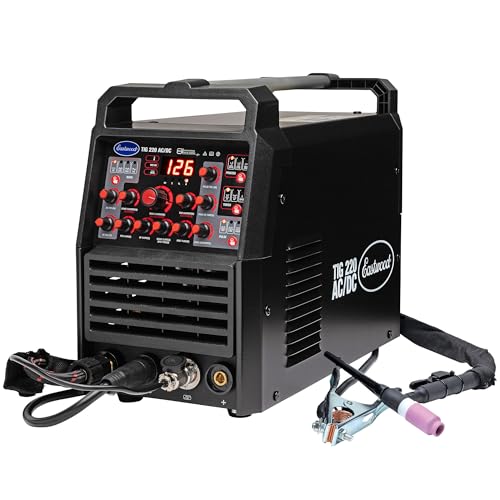
Best for beginners: Eastwood TIG 200 AC/DC
Around $800–$900 with simplified controls and decent documentation. You give up some fine-tuning granularity versus the Primeweld, but the gentler learning curve and US-based support suit a first machine.
Best DC-only budget pick: AHP AlphaTIG 200X / similar 200A DC inverters
If you will never touch aluminum, a DC-only inverter at $300–$450 buys cleaner steel and stainless arcs per dollar than any AC/DC unit at that price. Just be honest about the “never” part — upgrading later costs more than buying AC/DC now.
Best pro-grade step up: Miller Dynasty 210 or Lincoln Aspect 230
At $3,000+, these aren’t “value” in the budget sense — but for daily commercial use, the duty cycle, arc quality, and service network justify it. Skip them if you weld weekends only.
Head-to-Head: The Three Value Tiers
| Spec | YesWelder TIG-250P | Primeweld TIG225X | Miller Dynasty 210 |
|---|---|---|---|
| AC/DC | Both | Both | Both |
| Max output | 250A | 225A | 210A |
| Min output | 10A | 10A | 1A |
| Duty cycle @ max (120V/240V) | ~60% @ 240V | 40% @ 240V | 60% @ 240V |
| AC frequency range | 20–250 Hz | 40–200 Hz | 20–400 Hz |
| Pulse | Yes | Yes | Yes (advanced) |
| Weight | ~42 lbs | ~69 lbs | ~47 lbs |
| Input power | 120/240V | 120/240V | 120–480V (auto-line) |
| Typical street price | $450–$650 | $750–$900 | $3,200–$3,800 |
Reading the table: the YesWelder wins on paper max amps, but the Primeweld’s CK torch and more mature AC arc control make it the better aluminum machine. The Dynasty justifies its price only through duty cycle, micro-amp starts (1A for ultra-thin work), and multi-voltage flexibility.
Decision Matrix: Match Your Situation to a Machine
| Your situation | Right choice | Why |
|---|---|---|
| Steel/stainless only, tight budget | 200A DC inverter ($300–$450) | Paying for AC you won’t use is wasted money |
| Occasional aluminum, under $650 | YesWelder 250P class | Cheapest credible AC/DC + pulse combo |
| Mixed steel/aluminum, regular use | Primeweld TIG225X class ($750–$900) | Best arc quality and torch per dollar |
| First welder ever | Eastwood TIG 200 or TIG225X | Simpler controls; support matters when learning |
| Professional fab shop, daily use | Miller/Lincoln premium tier | Duty cycle and service network pay back fast |
| 120V outlet only, no 240V circuit | Any dual-voltage unit, expect ~140A max | Fine for 1/8″ aluminum and thinner steel |
Ownership Costs the Spec Sheet Hides
Budget around $150–$250 beyond the machine itself before your first weld:
- Argon cylinder: An 80 cu ft bottle runs roughly $250–$350 filled (you lease or buy the bottle, then pay ~$50–$70 per refill). At a typical 20 CFH flow rate, an 80 cu ft bottle gives about 4 hours of arc time — figure $12–$17 per arc-hour in gas.
- Tungsten and consumables: A 10-pack of 2% lanthanated tungsten (~$20–$30) lasts months. Collets, cups, and back caps are a few dollars each but add up; buy a stubby gas lens kit early.
- Pedal quality: Foot pedals on budget machines are a common early failure point. A pedal failure mid-weld means a crater crack; some welders upgrade to a SSC-style pedal (~$150) within a year.
- Torch flex: If your machine ships with a rigid torch body, a flex-head conversion or aftermarket CK/Furick torch dramatically improves tight-joint access for about $80–$150.
- Electrical: 225A machines want a 50A 240V circuit. Electrician install typically runs $200–$500 — include it in your budget math.
Common Money-Wasting Mistakes
- Buying AC/DC “just in case” while only welding steel. A DC inverter does steel better at the same price; put the savings toward a bigger argon bottle.
- Buying cheap then upgrading. Selling a $400 machine at $250 loss, then buying the $800 machine you wanted, costs more than buying right first.
- Ignoring duty cycle. 40% at 225A means 4 minutes welding per 10 at max output — irrelevant for sheet metal, limiting for 1/4″ aluminum production work.
- Skimping on the torch. A stiff, heavy torch causes hand fatigue and sloppy starts. It’s the part you actually touch; it’s worth real money.
FAQ
Is a cheap AC/DC TIG welder worth it over a quality DC-only unit?
Only if aluminum is on your project list. For steel and stainless alone, a $350 DC inverter outperforms a $500 AC/DC machine’s DC arc most of the time, since more of the build budget goes into the DC side.
How much amperage do I actually need?
Rough rule: 1 amp per 0.001″ of thickness for steel, ~1.3× that for aluminum. So 1/8″ aluminum wants ~165A — a 200A+ machine with headroom. Thin 20-gauge sheet needs a stable low end (under 15A), which matters more than max output.
What’s the best TIG welder for the money if I can only run 120V?
A dual-voltage AC/DC inverter like the YesWelder 250P. You’ll get roughly 140A usable on 120V — enough for 1/8″ aluminum and 3/16″ steel — and the machine grows with you when you add a 240V circuit.
Bottom Line
For most buyers, the best TIG welders for the money cluster at $700–$900: full AC/DC, pulse, real AC frequency and balance control, and a torch you won’t immediately replace. Drop to $450–$650 if aluminum is occasional and budget is firm; go DC-only at $300–$450 if aluminum never enters the picture. Spend what’s left on argon, tungsten, and a decent pedal — that’s where welds are actually won.