What's inside
As an Amazon Associate I earn from qualifying purchases. This post may contain affiliate links at no extra cost to you.
The best drum thrones for long practice sessions are usually round or motorcycle-style seats with firm, layered padding, a threaded height adjustment, a double-braced base, and a weight rating comfortably above the player’s body weight.
There is no single best throne for every drummer. A wide round seat suits players who move around the kit and want freedom at the hips; a motorcycle-style seat gives more leg support and can feel steadier during long rock, metal, or double-kick sessions. The right choice also depends on whether the throne stays in a rehearsal room, travels to gigs, or must fit into a small home practice space.
As an Amazon Associate we earn from qualifying purchases at no extra cost to you.


Our Top Picks



Best drum thrones by playing situation
| Situation | Best choice | What to prioritize | Typical market range |
|---|---|---|---|
| Regular home practice on a budget | Round throne with 2.5–3-inch foam | Threaded height adjustment, 14-inch seat, double-braced legs | $60–$110 |
| Long sessions and frequent rehearsals | Motorcycle-style throne with 3–4-inch foam | Contoured support, stable base, replaceable seat hardware | $120–$220 |
| Fast double-bass or heavy playing | Heavy-duty motorcycle-style throne | Wider rear support, 18–20-inch height range, high load rating | $160–$300 |
| Frequent gigging and public transport | Compact round throne | Lower packed size, moderate weight, folding legs | $50–$130 |
| Players wanting maximum adjustment | Hydraulic or premium threaded throne | Reliable height lock, smooth adjustment, reinforced base | $220–$450 |
Top picks for different drummers
Best overall: Roc-N-Soc Nitro
The Roc-N-Soc Nitro is a strong choice for drummers who spend many hours behind the kit and want easy height changes. Its hydraulic adjustment allows quick positioning without repeatedly turning a threaded rod. The contoured seat is available in motorcycle-style and round configurations, so players can choose between additional thigh support and greater freedom of movement.
Its main advantage is adjustability rather than portability. Hydraulic hardware adds cost and weight, and the throne is less appealing if it will be carried on public transport every week. For a fixed kit, teaching studio, or frequently adjusted shared setup, however, the Nitro’s smooth height changes are useful.
Best heavy-duty threaded throne: Gibraltar 9608HM
The Gibraltar 9608HM is suited to players who want a substantial, traditional throne with a large motorcycle-style seat and a double-braced base. Its broad seat distributes pressure over a larger area than a small round cushion, while the threaded height system provides a secure mechanical adjustment.
This type of throne works especially well for rock and metal players, larger drummers, and anyone who wants the base to remain planted during forceful playing. The trade-off is bulk: a heavy-duty double-braced throne takes more room in a hardware bag and is slower to adjust than a hydraulic model.
Best balanced professional option: DW 9120M
The DW 9120M combines a motorcycle-style seat with a sturdy double-braced base and a threaded height adjustment. It is a sensible middle ground for drummers who want more support than a basic round throne but do not need hydraulic adjustment.
The contoured seat can reduce the feeling of sliding forward, which is useful when the throne is positioned correctly for the bass drum and hi-hat. It is still important to check the seat shape before buying: some players prefer the unobstructed leg movement of a round cushion, particularly for jazz, orchestral, or low-volume playing.
Best portable budget option: Tama HT230
The Tama HT230 is a practical choice for beginners, casual players, and giggers who need a dependable throne without premium pricing. Its round seat and folding legs make it easier to pack than large motorcycle-style models. It is also less visually and physically imposing in a small bedroom or apartment practice space.
A compact round throne may be less comfortable over several hours than a wider, thicker model. If you practice only 30 to 60 minutes at a time, that compromise can make sense; if you routinely play three-hour rehearsals, spend more on padding and seat support before paying for cosmetic features.
Seat shape: round versus motorcycle-style
Round seats
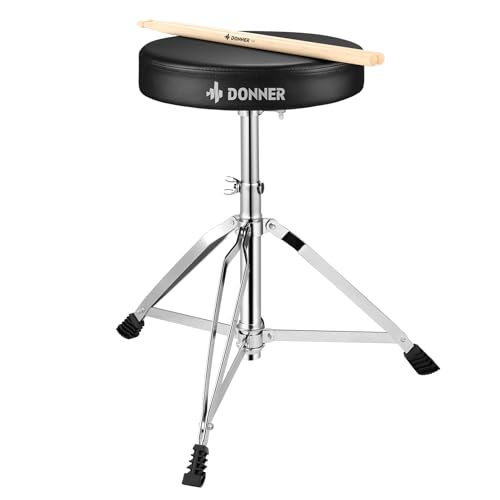
Round seats, commonly measuring about 12 to 14 inches across, let the legs move freely in every direction. They are a good fit for drummers who shift between multiple toms, play jazz or orchestral setups, or prefer minimal contact with the thighs.
Their weakness is support. A narrow or thin round cushion can create pressure at the sit bones during long sessions, and a soft seat may compress unevenly. A 14-inch seat with firm, layered foam is generally more suitable for extended practice than a small 12-inch cushion.
Motorcycle-style seats
Motorcycle-style seats usually have a wider rear section and a tapered front. The shape supports the thighs while leaving clearance around the legs, which can help during demanding bass-drum patterns. It is often the better choice for rock, metal, gospel, and other styles involving sustained, forceful playing.
Contouring is not automatically better. If the front edge presses into the thighs or the seat forces you into one position, it can restrict movement. Sit at the kit, if possible, and confirm that your knees remain slightly below hip level without the front edge contacting the legs.
Specifications that matter more than appearance
| Feature | Useful target | Why it matters |
|---|---|---|
| Seat diameter or width | 12–14 inches round; 15–18 inches wide for motorcycle styles | Balances support with freedom of movement |
| Foam thickness | At least 2.5 inches; 3–4 inches for long sessions | Reduces bottoming out as the foam compresses |
| Height range | Approximately 18–24 inches | Covers most standard drum-kit setups |
| Base | Three double-braced legs | Improves resistance to rocking and twisting |
| Weight rating | At least 1.25 times the player’s body weight | Leaves a useful margin for dynamic movement |
| Packed weight | About 8–15 pounds for portable models | Determines whether regular transport is practical |
Weight ratings are not the same as comfort ratings. A throne rated for 300 pounds may remain structurally safe, but thin foam can still become uncomfortable after an hour. For a 200-pound drummer, a practical target is a throne rated for at least 250 pounds, preferably more if the player moves aggressively or the throne will be shared.
Height adjustment and setup
Start with the throne slightly higher than the knees, then position the bass-drum pedal so the shin slopes gently downward toward the foot. Your thighs should not be forced upward, and your feet should reach the pedals without stretching forward. A throne that is too low often makes the hips and knees feel cramped; one that is too high can reduce control and encourage reaching.
Threaded adjustments are usually the best value. They are slower but mechanically simple and tend to hold position well when the locking nut is tightened. Hydraulic adjustments are quicker and convenient for shared kits, but they cost more and introduce a gas cylinder that may eventually need replacement.
Stability, portability, and ownership costs
Double-braced legs add stability, but they also add weight. For a throne that stays beside one kit, the extra metal is usually worthwhile. For weekly gigs, a lighter single-braced model may be easier to justify, provided it does not rock when you shift your weight.
Consider a simple cost-per-use calculation. A $90 throne used twice a week for three years provides about 312 sessions, or roughly $0.29 per session before replacement. A $220 throne used five times a week for the same period provides about 780 sessions, or roughly $0.28 per session. The more frequently you practice, the easier it is to justify better foam, stronger stitching, and serviceable hardware.
The seat cover and foam usually wear before the steel base. Look for loose stitching, flattened foam, a seat that tilts, or a height rod that develops side-to-side play. Wipe vinyl with a damp cloth and mild soap; avoid soaking foam or using solvents that can dry the cover. Periodically check the wing nut, mounting bolts, and leg fasteners. A common mistake is leaving the height-lock nut loose, which allows gradual height changes and can make a stable throne feel defective.
Final buying recommendation
Choose the Tama HT230 or a similar round, double-braced model for affordable portability. Choose the Gibraltar 9608HM or DW 9120M when long sessions and firm support matter more than packed size. Choose the Roc-N-Soc Nitro when multiple players need fast height changes or when premium adjustability is worth the added cost.
Whichever model you select, prioritize the correct height, firm rather than collapsing foam, and a base that remains planted when you shift between pedals. Those characteristics contribute more to sustained comfort and control than branding, decorative upholstery, or an extra inch of padding.