What's inside
As an Amazon Associate I earn from qualifying purchases. This post may contain affiliate links at no extra cost to you.
What keeps a hole square?
A drill can be perfectly good and still make a hole that wanders off perpendicular. The problem is often how the drill is held, especially when drilling into the edge of a furniture rail or through a narrow part. A guide helps control the angle; the right choice depends on how many holes you need, the stock’s shape, and how much setup time you can tolerate.
For occasional repairs and a few holes in flat stock, a portable drill guide is usually enough. For repeated, closely spaced holes, a drill press is more consistent. A simple shop-made block can work for a one-off job, but it is less forgiving and wears out. None of these options fixes a part that shifts during drilling, so clamping matters as much as the guide.
Drill guides compared
| Option | Best for | Typical trade-off |
|---|---|---|
| Portable drill guide | Occasional holes in panels, rails, or assembled furniture | Portable and versatile, but needs careful positioning and clamping |
| Drill press | Repeated holes in parts that fit on its table | Best control, but bulky and awkward for long or assembled pieces |
| Drill block | A few holes at a fixed location or angle | Cheap and quick, but limited by its hole sizes and wear |
| Freehand drilling | Noncritical holes where appearance or fit is not important | No setup, but the angle depends entirely on the operator |
Portable guides: the practical all-rounder
A portable drill guide holds a handheld drill in a sliding carriage, usually with guide rods that keep the bit aligned to the base. Many models offer stops or angle adjustments; some include a V-shaped base for holding round stock. Check the guide’s supported chuck size and bit range before buying. A drill that cannot be secured firmly in the carriage can tilt even when the guide itself is square.
Look for a broad, flat base, low play in the carriage, and a depth stop that locks securely. A guide with a positive 90-degree setting is easier to trust than one that relies on a printed scale. For general furniture work, a portable drill guide for a hand drill is a sensible buy if you need more than a couple of holes or work on parts too large for a drill press.
The limitation is the base. If it sits partly over an edge, bridges a joint, or rocks on a curved or uneven surface, the bit may still enter at an angle. Clamp a flat sacrificial board beside narrow stock to give the base full support. On an assembled chair or cabinet, the guide may also be blocked by adjacent parts; a smaller guide can reach tight areas, but often has a shorter travel and less stable footing.
When a drill press is the better choice
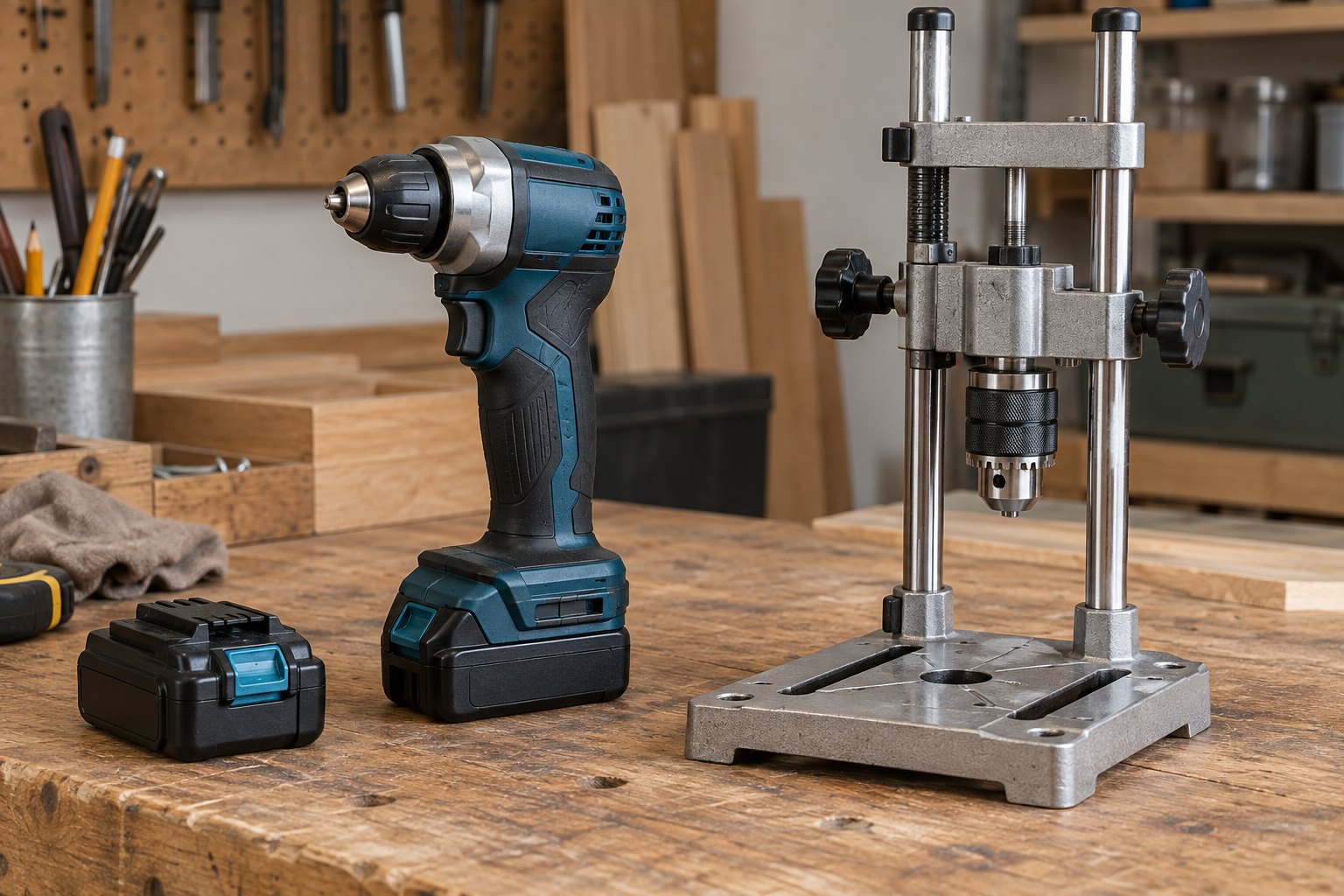
A drill press controls the spindle’s angle mechanically, making it the dependable option for batches of matching holes in small parts. Its table and fence can also help repeat location. The catch is part size: a long rail may not fit under the head, and a wide panel may be difficult to support without shifting. A drill press is not automatically more accurate if the workpiece is perched on a small table or held by hand.
For furniture parts, clamp the piece to the table, use a fence or stop for repeat positioning, and check that the table is square to the spindle. A drill press is worth considering when you expect regular work with dowels, hardware, or repeated joinery. If you only need a few holes a year, the cost and bench space may be hard to justify.
Drill blocks and simple jigs
A hardened drill block has accurately bored guide holes and is compact enough to use on a workbench or at an installation site. It is useful for a handful of holes when its available hole diameter matches your bit. Some blocks offer several common sizes, but a bit must fit the bushing closely: too much clearance lets it lean, while a tight fit can bind as sawdust collects.
A shop-made block can be cut from hardwood or a stable plastic offcut. Drill a straight reference hole using a drill press, then clamp the block to the work. It costs little and can be tailored to a specific task, but the hole can wear or become misaligned, particularly if you use it repeatedly with a large bit. For dowel holes or other work where alignment affects the fit, a purpose-made drill guide block with bushings is more reliable than an unbushed wood block.
How to avoid angled or misplaced holes
Mark the center clearly with a sharp pencil or marking knife, then make a small starter dimple with an awl. The dimple helps prevent the bit from skating, especially on hardwood or a finished surface. Clamp the part to a stable bench and support its underside with scrap if drilling through. Without backing, the bit can tear out the exit face as it breaks through.
Set the guide’s depth stop, or mark the required depth on the bit with tape. A depth stop is safer when several holes need to match, but check it against the actual bit tip: the cutting tip extends beyond the flutes and can make the hole deeper than the visible tape mark suggests. Start at low speed and feed steadily. For deep holes, withdraw the bit periodically to clear chips; forcing a packed bit can overheat it, wander, or burn the wood.
Before drilling the furniture part, test the setup on scrap of the same thickness. Check the angle with a small square against the bit or the finished hole. A guide can be out of adjustment, and a drill chuck can have runout. If the test hole is off, correct the setup before making a row of matching mistakes. For repeat hole spacing, use a fence or a marked stop rather than measuring each location by eye.
Which option should you buy?
Choose a portable guide for mixed, occasional work on parts that are too large for a press. Choose a drill press for repeatable work on pieces that fit safely on its table. Buy a bushing-style block for a small number of common-size holes, or make a temporary jig when precision is not critical and the setup is specific to one job. Freehand drilling remains reasonable for noncritical holes, but it is a poor bet for tight-fitting dowels or visible hardware that must sit square.
If your main need is holding an ordinary drill steady rather than drilling a fixed pattern, compare the guide’s base size and travel before focusing on extra angles or accessories. A portable drill guide with a depth stop is often the useful middle ground. Spend more only if you need repeatability, better fit, or access that a basic guide cannot provide.