What's inside
As an Amazon Associate I earn from qualifying purchases. This post may contain affiliate links at no extra cost to you.
Thick white oak is a demanding ripping job. It is dense, hard on carbide, and prone to pinching the blade as internal tension is released. The best table saw blade for it is usually a sharp 24-tooth ripping blade with a flat-top grind, not the 40- or 60-tooth combination blade already installed on many saws.
For a 10-inch saw, my first choice is a full-kerf 24-tooth blade when the saw has enough power and the stock is regularly thicker than 1-1/2 inches. A thin-kerf 24-tooth blade is easier on a portable saw, but it gives up some stiffness and can deflect more in a long, heavy cut. The right choice depends on the saw, the riving knife, and how much oak you expect to process.
As an Amazon Associate we earn from qualifying purchases at no extra cost to you.


Our Top Picks



The best blade type for thick white oak
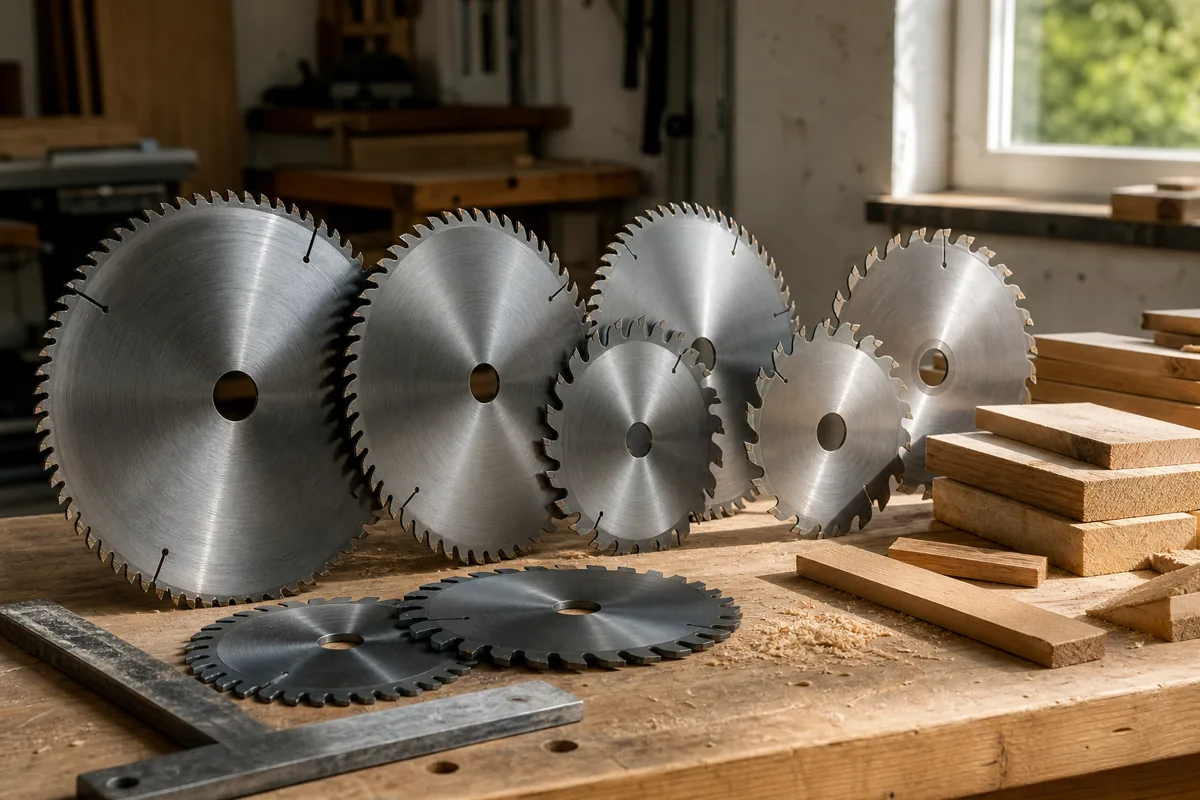
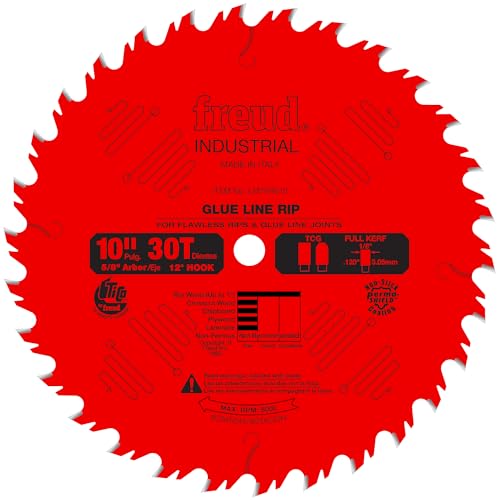
Look for a blade described as a ripping blade, with 20 to 30 teeth, a flat-top grind (FTG), and a low or neutral hook angle. Twenty-four teeth is the useful middle ground: fast enough for ripping, but with enough carbide to leave a reasonably clean edge for furniture parts.
A dedicated 24-tooth flat-top ripping blade removes waste efficiently. Its large gullets carry chips out of the kerf instead of packing with oak dust. A 40- or 50-tooth combination blade can make a cleaner-looking cut in dry, straight-grained stock, but it cuts more slowly and creates more heat. On thick oak, that extra heat can dull the edge quickly.
| Blade type | Best use | Advantages | Limitations |
|---|---|---|---|
| 24T FTG ripping | Thick stock and repeated rip cuts | Fast feed rate, good chip clearance, resharpenable geometry | More visible tooth marks than a fine-tooth blade |
| Thin-kerf 24T ripping | Portable or lower-powered saws | Uses less motor power and removes less material | More prone to deflection; must match the riving knife |
| 40T combination | Occasional mixed ripping and crosscutting | Acceptable finish and fewer blade changes | Slower in thick oak and more heat during long rips |
| 60T crosscut or general-purpose | Clean crosscuts and trim work | Fine finish across the grain | Poor choice for long rips in thick hardwood |
Full-kerf versus thin-kerf
A typical 10-inch full-kerf blade cuts a slot around 1/8 inch wide. Thin-kerf blades are commonly around 3/32 inch, though the actual measurement varies. Removing less wood matters when a 15-amp portable saw is struggling, especially in 2-inch or thicker oak. The motor stays closer to its usable speed, and the saw is less likely to trip its overload protection.
The trade-off is rigidity. A thin blade can wander if you force the stock, if the fence is not parallel, or if the wood closes on the back of the blade. That wandering leaves a scalloped edge and can create burning. A thin-kerf blade also needs a riving knife or splitter that fits its kerf. If the knife is thicker than the cut, the stock will bind. If it is too thin, it may not prevent a narrow kerf from closing.
Before buying, measure the riving knife thickness and check the blade maker’s stated kerf. A full-kerf blade is often the safer choice on a cabinet saw with a 3-hp motor. A thin-kerf blade is sensible on a jobsite saw, provided the knife and arbor hardware are compatible.
Features that matter in white oak
Carbide quality matters more than a shiny finish or a high tooth count. Look for substantial carbide tips that can be sharpened several times. White oak’s silica and abrasive dust wear an inexpensive blade faster than ordinary pine. A blade with expansion slots or stabilizing features can reduce noise, but these features do not compensate for a dull edge or a poorly aligned saw.
A low hook angle, roughly 5 degrees or less, gives you better control than an aggressive 15-degree ripping blade. High-hook blades feed aggressively and can grab knots or push the workpiece forward. That is an unnecessary risk when handling long, heavy boards. Flat-top teeth also leave a more predictable bottom surface than alternating bevel teeth, although the cut will show more tooth marks.
For a smoother edge without changing blades, leave the ripping blade slightly proud of the final dimension. Then make a light cleanup pass with a hand plane, jointer, or router. Trying to make a 24-tooth blade produce a furniture-ready finish often leads to slow feeding and burning.
What to buy for different saws
For a cabinet saw or a powerful hybrid saw, choose a full-kerf hardwood ripping blade. This is the best long-term option for repeated 8/4 oak, resawing-sized work, and production ripping. It costs more than a basic construction blade, but the carbide and ability to resharpen usually make it cheaper over time.
For a 15-amp jobsite saw, a thin-kerf 24-tooth ripping blade is often the practical choice. The cheaper option is fine if you are ripping a few boards for a one-time project and can accept a cleanup pass. Do not expect a bargain blade to stay sharp through a large stack of kiln-dried oak; replace it when the cut starts requiring force rather than immediately assuming the saw lacks power.
How to rip thick oak without burning it
Joint or straighten one edge before using the table saw fence. A bowed board can press into the fence, twist, and pinch the blade. Set the blade so the gullets are just above the top surface—about 1/8 to 1/4 inch above the stock. Excessive blade height increases exposed tooth area and makes kickback more severe.
Check that the fence is parallel to the blade, or fractionally open at the rear if your saw’s design allows it. Use a riving knife, push handles, and outfeed support. Keep your feed rate steady. Hesitating halfway through a cut lets the teeth rub in one place, creating heat and burn marks. For 2-inch oak, a controlled feed of roughly 1 to 2 feet per second may be appropriate, but the correct rate is whatever keeps the motor from bogging without forcing the board.
If the blade burns despite a straight board and steady feed, stop. The blade may be dull, the fence may be closing on the cut, or the oak may have internal stress. A new blade will not fix a misaligned fence. Test with a short offcut first, and never reach over the blade to retrieve material while it is spinning.
When to sharpen or replace the blade
Sharpen the blade when the feed effort rises, the cut wanders, or burn marks appear on otherwise straight stock. Clean pitch and oak residue before diagnosing sharpness; buildup can make a good blade behave like a dull one. If several carbide tips are chipped, the plate is warped, or the blade has been overheated until it turns blue, replacement is safer than continued use. For most serious oak work, buying a blade that can be professionally resharpened is worth the added cost.