What's inside
As an Amazon Associate I earn from qualifying purchases. This post may contain affiliate links at no extra cost to you.
Our Top Picks
 DEWALT 15 Amp 8-1/4 in. Compact Portable JobsiteOne Size22.75 x 22.75 x 13 Inches54 poundsCheck on Amazon



The short answer
For finish carpentry, a benchtop table saw is usually the better choice when the saw will stay in a shop and you care about repeatable cuts, a larger table, and cleaner sheet-goods work. A jobsite table saw is the better choice when you carry tools to occupied houses, work from a truck, or need one saw to handle framing, trim, and occasional cabinetry.
The cheaper option is fine if your work is mostly ripping baseboard, casing, shelving, and narrow plywood strips. Spend more on a benchtop saw when you regularly break down full sheets, cut wide stiles and rails, or need the fence to return to the same setting without constant adjustment.
As an Amazon Associate we earn from qualifying purchases at no extra cost to you.



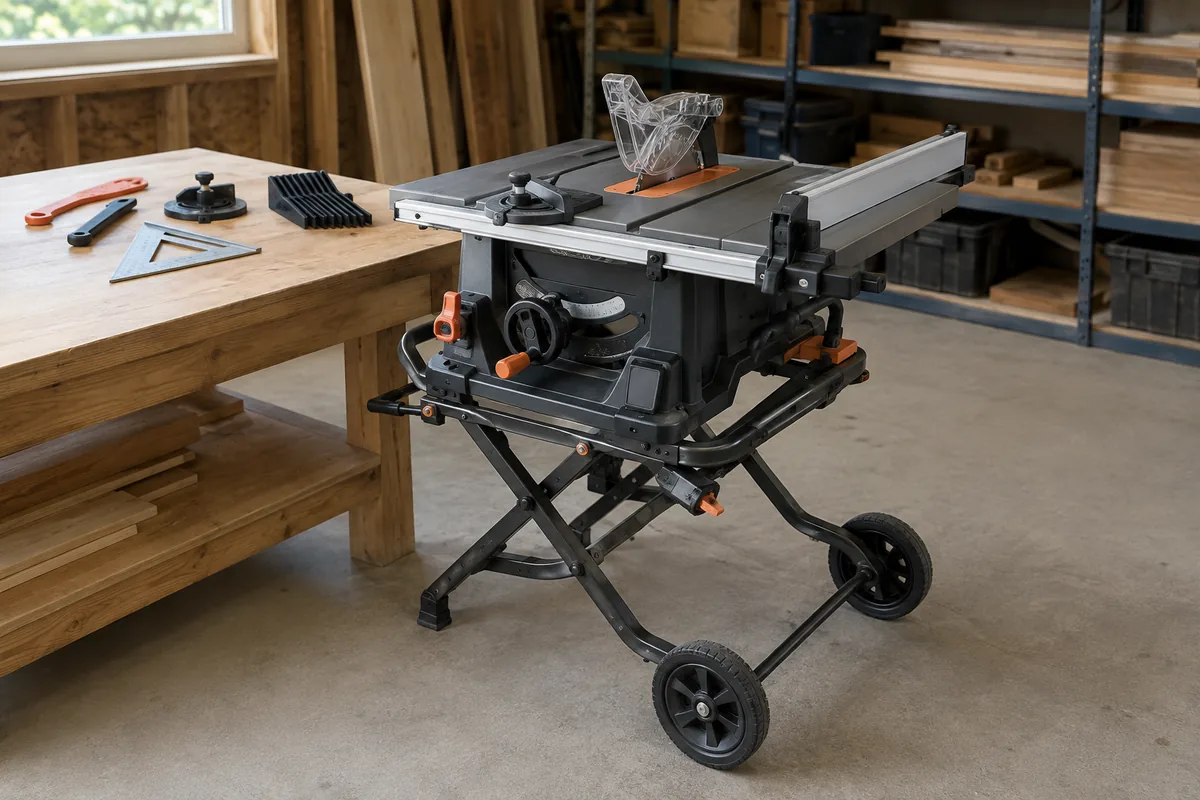
What finish carpentry demands from a table saw
Finish work exposes small inaccuracies. A 1/16-inch error in a rough framing cut may disappear behind drywall; the same error can leave a visible reveal on a cabinet panel or make two casing legs look mismatched. The saw should hold the fence parallel to the blade, leave a clean edge, and provide enough support that the workpiece does not tip as it exits.
Most finish-carpentry cuts use a sharp combination or fine-finish blade rather than the stock general-purpose blade. A 40-tooth combination blade is a sensible starting point for solid wood and plywood. For veneered plywood or melamine, a 60-tooth plywood blade reduces tear-out, but feed more slowly and support the panel properly.
| Factor | Benchtop table saw | Jobsite table saw |
|---|---|---|
| Best location | Dedicated bench or shop stand | House, garage, truck, or changing jobsite |
| Typical rip capacity | About 24 to 30 inches, depending on design | About 24 to 32 inches, often with a telescoping fence |
| Table support | Compact; often needs outfeed support | Usually better integrated support and stand options |
| Dust collection | Often basic or awkward | Usually a more enclosed blade housing |
| Portability | Light enough to carry, but not always convenient | Designed for repeated transport and setup |
| Typical advantage | Lower cost and smaller footprint | Better jobsite usability and accessories |
Accuracy and fence control
A benchtop saw can make excellent finish cuts, but its small table and lighter fence leave less room for error. If the fence flexes when you push a 20-inch panel against it, the cut may taper. Check the fence with a straightedge and measure its distance from the miter slot at the front and rear. A small difference is not automatically dangerous if the rear is slightly farther from the blade, but a fence that closes toward the blade can pinch the work and cause burning or kickback.
Many jobsite saws have more substantial rack-and-pinion or telescoping fence systems. That does not make every jobsite saw more accurate, but it often makes adjustments faster and more repeatable. This matters when switching between 3 1/4-inch casing, 4 1/4-inch baseboard, and narrow filler strips throughout the day.
If you buy a benchtop table saw for finish carpentry, budget time for setup. Verify the blade is square to the table, align the fence, and test the riving knife with your blade. A five-minute setup can prevent a cabinet side that is 1/16 inch narrower at one end.
Capacity and material handling
Both categories can commonly rip at least 24 inches, enough for many shelves and cabinet parts. The limitation is not always the advertised rip capacity; it is how safely you can support the material. A full 4-by-8-foot sheet weighs roughly 50 to 70 pounds depending on thickness and material. Handling one alone on a small benchtop saw is awkward and increases the chance of lifting the panel into the blade or letting it steer the cut.
For sheet goods, break the sheet down with a track saw, circular saw and guide, or a well-supported scoring setup before bringing manageable pieces to the table saw. A table saw is excellent for repeatable final-width cuts, not necessarily for wrestling full sheets by yourself.
Jobsite saw stands can improve this substantially. Outfeed and side support keep long trim from dropping and twisting as it leaves the blade. Without support, a 12-foot length of baseboard can pull the workpiece sideways, ruining the cut and potentially pushing it into the blade.
Dust, noise, and jobsite practicality
Jobsite saws generally have more enclosed blade housings and better provisions for a shop-vac hose. Neither category is clean with a bare dust port, and cutting MDF produces fine dust that spreads quickly. Use a vacuum rated for fine dust, keep the blade guard installed, and avoid relying on a dust mask as the primary control.
A benchtop saw may be the quieter and less annoying choice if it lives in a shop on a sturdy bench. A jobsite saw is easier to put away at the end of the day, but its folding stand adds cost, storage bulk, and another set of parts that can loosen or break. If you already own a solid workbench, the inexpensive saw can be the better value.
Safety and common failure modes
Use a riving knife, blade guard, and push stick whenever the cut allows. Remove the guard only when a specific operation requires it, and use a featherboard or other appropriate control instead. Never reach over the blade to retrieve a cutoff. A push stick should keep your hand at least 6 inches from the blade; more distance is better for wide cuts.
The most common finish-work failures are not dramatic blade failures. They are burning from a dull blade, chipped veneer from feeding too quickly, a tapered rip from a misaligned fence, and kickback caused by a trapped cutoff. A zero-clearance insert can improve support around the blade for narrow pieces, but it must match the blade height and must not interfere with the riving knife.
Which one should you buy?
Choose a benchtop saw if you make trim and cabinet parts in a garage or shop, already have a sturdy bench, and can provide outfeed support. Put the savings toward a quality finish blade, a reliable vacuum, and a stable outfeed table. A jobsite table saw with a folding stand is worth the extra cost when setup speed and transport matter more than the smallest footprint.
Choose a jobsite saw if you move between rooms, work alone, or routinely cut long stock outside a shop. Its stand, fence adjustment, onboard storage, and better material support can save more time than the price difference. For frequent built-ins or cabinet production, step up to a heavier contractor or cabinet-style saw instead; neither compact category is ideal for repeated full-sheet processing.
Before buying, measure your storage space, check the fence and miter-slot quality in person if possible, and confirm that replacement blades and inserts are readily available. A precisely set up inexpensive saw will outperform an expensive saw that is unstable, poorly supported, or used with a dull blade.