What's inside
As an Amazon Associate I earn from qualifying purchases. This post may contain affiliate links at no extra cost to you.
Our Top Picks
 DEWALT ATOMIC Compact Series™ 20V MAX* Brushless CordlessOne Size12.35 x 4.84 x 9.7 inches0 poundsCheck on Amazon


Short answer: battery is simpler to grab, air is lighter in your hand
For scattered punch-list work—one loose trim piece, a few cabinet returns, a door stop, then nothing for an hour—a battery nailer is usually easier overall. It needs no compressor, hose, outlet, or setup. Pick it up, check the battery, and drive the fasteners.
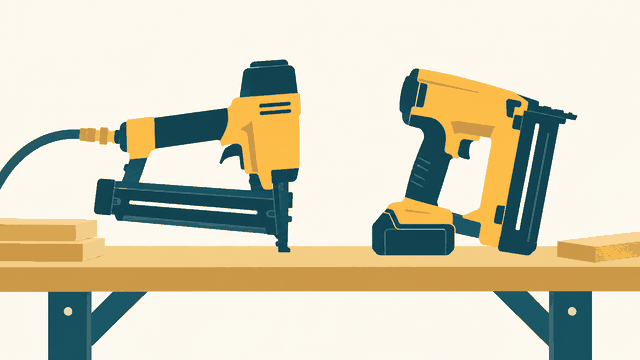
An air nailer is easier to hold and often quicker for repeated nailing. The trade-off is everything attached to it: compressor, hose, fittings, and a place to plug in. If you already own that equipment, air may be the cheaper and less tiring choice. If you are buying a whole setup for occasional repairs, the battery tool is usually the simpler purchase.
As an Amazon Associate we earn from qualifying purchases at no extra cost to you.


What counts as punch-list work?
Punch-list jobs are short, varied tasks rather than a full day installing trim. You might drive 10 nails in one room, carry the tool upstairs, and return later to install a few more. That stop-start pattern makes setup time, carrying gear, and snagging a hose matter more than maximum production rate.
This comparison assumes a finish nailer or brad nailer, not a framing nailer. Match the nail type and length to the material: brads suit delicate trim and small moldings; finish nails offer more holding power for heavier casing and baseboard. Neither power source makes an unsuitable fastener safe or effective.
Air vs. battery for small repair jobs
| Factor | Air nailer | Battery nailer |
|---|---|---|
| Setup | Connect compressor, hose, and tool; check pressure | Fit a charged battery and load nails |
| Handling | Usually lighter at the tool, but the hose can tug or catch | Heavier in the hand; no hose to drag |
| Short, scattered tasks | Convenient if the compressor is already running or close by | Usually faster to start and move between rooms |
| Long runs of nailing | Good for repeated work; no tool battery to recharge | Good too, but battery runtime and weight matter |
| Noise | Compressor cycles can be loud, even between shots | Tool makes a brief, sharp noise per shot |
| Typical extra costs | Compressor, hose, couplers, and possibly oil | Battery and charger if you do not already own them |
| Common interruption | Compressor runs out of pressure, leaks, or trips power | Battery runs low or the tool needs a brief reset |
Exact weight, noise, and runtime vary by tool and battery size, so check the listed tool weight and whether it includes the battery. A battery that adds substantial weight can make overhead trim tiring. An air tool may feel lighter, but a long hose can pull on the nose or bump freshly painted walls.
Setup and moving around the house
With air, the compressor is the main variable. A small trim nailer does not need a large framing compressor, but the compressor must supply enough pressure and air volume for the tool. Set pressure within the nailer’s stated range; too little can leave nails proud, while too much can bury heads, damage trim, or increase the chance of a fastener penetrating too far.
On a punch list, the hose is not just clutter. It can catch on a stair edge, pull the tool off line, or rub against a finished surface. You can reduce that hassle with a short, flexible hose and a nearby compressor, but those do not make setup disappear. For work across several rooms or floors, a battery finish nailer is often the more convenient option.
Battery tools avoid the compressor but still need planning. Charge before starting, bring a spare battery if you have one, and remember that a battery platform may cost more if you do not already own compatible packs. For a job of 20 or 30 nails, an existing charged battery is rarely a concern; a dead one discovered halfway through the job is.
Nail placement, jams, and other failure modes
Neither system guarantees a clean shot. Nails can jam, bend, split a narrow trim edge, or sit proud because the depth setting is wrong. Test on scrap of the same material, adjust depth a little at a time, and keep the tool square to the surface. A nail driven at an angle can emerge where you do not expect it.
Air tools can stop firing when the compressor pressure falls below the tool’s minimum, or when a leaking connection wastes air. Check the couplers and hose if the tool starts leaving nails proud. Battery tools can slow, stop, or indicate a low pack; some also need a moment to reset after a jam. Follow the maker’s instructions before clearing a jam, disconnect the air supply or remove the battery, and keep your fingers away from the nose.
For delicate work, the biggest practical risk may be overdriving rather than a jam. A deep nail hole takes more filling and touch-up, especially on painted trim. Make a few test shots and use the least depth that leaves the head just below the surface.
Which one costs less?
If you already have a compressor, hose, and a compatible nailer, air is often the budget-friendly answer. A basic pneumatic trim nailer can cost less than a battery version, and the existing compressor may serve other shop tasks. If you need to buy the compressor and accessories just for occasional trim repairs, compare the total setup rather than the nailer’s price alone.
Battery makes more financial sense when you already own tools and batteries from the same platform. Otherwise, account for the pack and charger as well as the nailer. If the job is truly occasional and involves only a handful of fasteners, a hammer and finish nails—or a small tube of suitable construction adhesive where the application allows—may be cheaper still. Do not use adhesive as a substitute where the trim needs mechanical fastening or may need to be removed later.
Which should you choose?
Choose battery if you move between rooms, work in occupied spaces, dislike hose management, or want the tool ready without compressor setup. For most homeowners buying one nailer specifically for a varied punch list, a battery brad nailer or finish nailer is the easier tool to live with. Choose the fastener type based on the trim and the holding strength the job needs.
Choose air if you already have a compressor, value a lighter tool in your hand, or expect to drive hundreds of nails in one session. A pneumatic finish nailer is a sensible low-cost addition to an existing setup, especially for repeated trim work. For a short list of small repairs, though, the battery tool’s biggest advantage is practical: fewer things to unpack, route, and put away.