What's inside
As an Amazon Associate I earn from qualifying purchases. This post may contain affiliate links at no extra cost to you.
Installing Tapcon screws in a garage wall is easy when the drill bit matches the fastener and the wall material. It becomes frustrating when the bit dulls after a few holes, the hole is too shallow, or dust packs the flutes and prevents the screw from reaching full depth. For most homeowners, the best setup is a small carbide-tipped masonry bit set with accurate 5/32-inch and 3/16-inch bits, plus a drill that can run in hammer mode.
As an Amazon Associate we earn from qualifying purchases at no extra cost to you.


Our Top Picks
 DEWALT DW5205 Percussion Set With Tough Case 5-PiecesSmall10.3 x 9.9 x 1.7 inches1.15 PoundsCheck on Amazon
 DYRECELVE 12-Piece Masonry Drill Bit Set and Concrete5.51 x 2.95 x 0.64 inches0.45 PoundsCheck on Amazon


What bit size you need for Tapcon screws
Tapcon screw diameter determines the bit size, not the screw length. The common pair is:
| Tapcon screw | Recommended masonry bit | Typical use |
|---|---|---|
| 3/16-inch screw | 5/32-inch bit | Light brackets, cable clips, small shelving |
| 1/4-inch screw | 3/16-inch bit | Heavier brackets, storage rails, utility hardware |
Use the manufacturer’s instructions if your fastener is not a standard Tapcon. A hole that is too large can leave the threads with insufficient material to grip. A hole that is too small makes the screw excessively hard to drive and can strip the recess or snap the screw.
The best bit set type for a garage wall
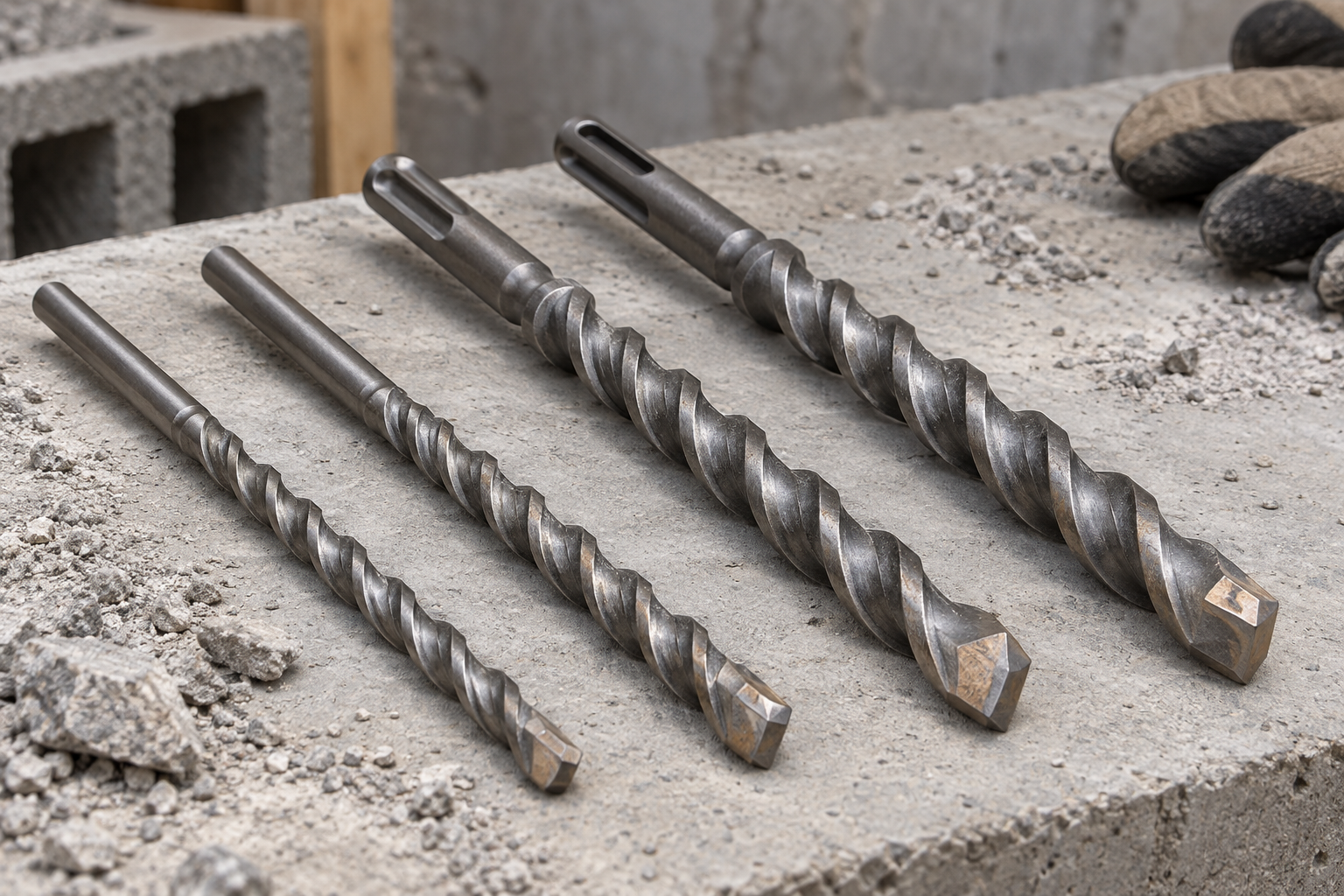
For occasional work in a concrete or concrete-block garage, buy a carbide-tipped masonry drill bit set with 5/32-inch and 3/16-inch bits. A set is more useful than a single bit because wall materials vary and bits wear quickly when they encounter aggregate.
Look for bits with a carbide cutting tip and flutes that clear dust efficiently. A basic two-cutter tip is sufficient for a cordless drill and normal garage projects. Four-cutter SDS bits cost more but cut more smoothly in hard concrete and are less likely to catch when drilling through aggregate.
A set containing several lengths is useful. A 4-inch overall bit is usually enough for Tapcon holes, while a 6-inch bit gives better access behind thick brackets or through block faces. Avoid buying a large general-purpose set if it omits the two sizes you actually need.
Rotary drill versus SDS
A standard cordless drill with hammer mode works for a few holes in ordinary concrete block or poured concrete. It is slower than an SDS rotary hammer, but it is cheaper and more versatile for other household jobs. Use a firm two-handed grip and moderate pressure; excessive force can overheat the bit without making it cut faster.
For more than about 10 to 15 holes, hard poured concrete, or repeated installation work, an SDS-plus rotary hammer is the better tool. Its hammer mechanism delivers more impact with less effort, and SDS bits stay engaged without a chuck slipping. An SDS-plus masonry bit set is worthwhile if you regularly install shelving, conduit, anchors, or garage storage systems.
| Setup | Best for | Trade-off |
|---|---|---|
| Carbide bits in hammer drill | Small projects and occasional Tapcons | Slower in hard concrete; more user fatigue |
| SDS-plus bits in rotary hammer | Many holes and dense concrete | Higher tool and bit cost; less useful as a normal drill |
| Standard drill bits | Wood and metal only | Not suitable for masonry; they dull or overheat quickly |
How to drill the holes correctly
Mark the hole, then check for hidden electrical wiring or plumbing before drilling. Hold the bit perpendicular to the wall and start slowly to keep the tip from walking. Once the carbide tip has made a shallow divot, switch to hammer mode if needed and drill at a steady speed.
Drill at least 1/4 inch deeper than the screw’s intended embedment. For a screw going 1 inch into the wall, make the hole about 1-1/4 inches deep. The extra space lets dust collect below the threads instead of packing between the screw and the hole. Put a piece of tape on the bit as a depth marker.
Pull the bit out every few seconds to clear dust, especially in solid concrete. You can also use compressed air or a small vacuum, but wear eye protection because the hole can eject fine abrasive dust. Do not blow dust toward your face. In hollow concrete block, avoid placing the fastener too close to an edge, where the face can crack or the screw can break through into the cavity.
Common failures and fixes
The screw spins without tightening: The hole may be oversized, the concrete may have crumbled, or the screw may have been driven too far. Move the fastening point if possible. Do not rely on a stripped Tapcon for a load-bearing bracket.
The screw will not enter: The hole may be too shallow or packed with dust. Remove the screw, deepen and clean the hole, and try again. A worn bit can also cut a tapered or undersized hole.
The bit stops cutting: You may have hit unusually hard aggregate, steel reinforcement, or simply exhausted the carbide tip. Let the bit cool, inspect it, and use a fresh bit rather than forcing it. For reinforced concrete, move the hole if the bracket allows; drilling through rebar is slow and can damage inexpensive bits.
The screw head strips: Keep the driver square, use the correct Torx or hex drive, and stop when the head is flush. An impact driver can install Tapcons quickly, but its high torque makes overdriving easier. For light-duty work, the cheaper two-size Tapcon bit set is fine. Spend more on SDS bits only when the wall hardness, hole count, or repeated use justifies it.